
Analyst flags unusual 2026 dip in debt costs; treasurer defends bond strategy
Get AI-powered insights, summaries, and transcripts
Subscribe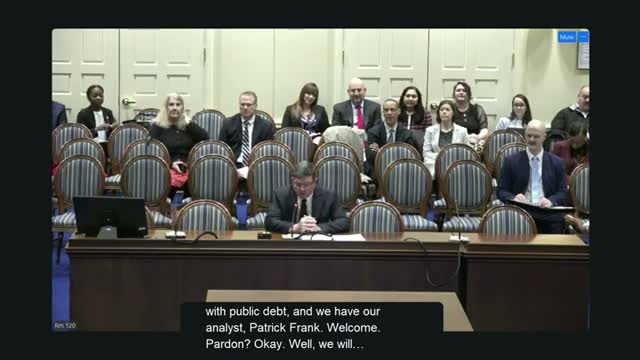
Summary
DLS analyst Patrick Frank told the Appropriations Committee that FY2026 shows an unusual decline in debt service because large issues matured and were not replaced, increasing reliance on general funds later in the forecast. Treasurer Davis defended the state's bond strategy and disputed that Moody's downgrade reflects a deterioration in payment capacity.
Patrick Frank, the Department of Legislative Services analyst, told the Appropriations Committee that Maryland’s public-debt forecast includes an unusual dip in debt service in fiscal 2026 because a large set of bonds matured and were not replaced. Frank said the forecast shows state property tax receipts around $1.1 billion in 2026 while projected debt service is roughly $1.4 billion, meaning the general fund must cover the difference and that general-fund contributions rise through the forecast period.
"I had to check my numbers three times when I looked at all that stuff to make sure all the numbers added up, but they do," Frank said, describing the 2026 decline as an analytical anomaly tied to maturities that occurred years earlier. He told members the annuity bond fund receives state property tax receipts and pays debt service and that the forecast assumes 3% growth in property-tax receipts while debt-service costs grow about 4% by the far end of the horizon. Frank also warned about the risk in relying on projected bond-premium deposits and urged caution when estimating premiums.
Treasurer Davis, appearing with his management team, said the state had preserved flexibility on sale timing to avoid locking in unfavorable market conditions and that investor demand remained healthy. "Maryland pays its bills," the treasurer said in defense of the state's market reception, noting multiple bidders on recent tranches and that other rating agencies continue to assign triple-A ratings to the state. Davis characterized Moody’s downgrade as a change in Moody’s approach rather than evidence the state has become unable to meet obligations.
Committee members pressed on how the downgrade could affect future borrowing costs. Frank and the treasurer described a complex interaction among market conditions, rating agency methodology, and investor behavior; both noted that short bond maturities (the Maryland constitution limits maturities to 15 years, with average maturities near 10 years) mean Maryland pays down principal faster and pays proportionally less interest than states with longer maturities.
The hearing produced no vote. The analysts recommended concurrence with the governor’s allowance for debt service as presented. The committee moved on to the next scheduled agency briefing.