Get Full Government Meeting Transcripts, Videos, & Alerts Forever!
Get email alerts on the Election Integrity topic
No spam. Unsubscribe anytime.
Secretary of State to absorb Election Integrity Commission; lawmakers press for funding details
Summary
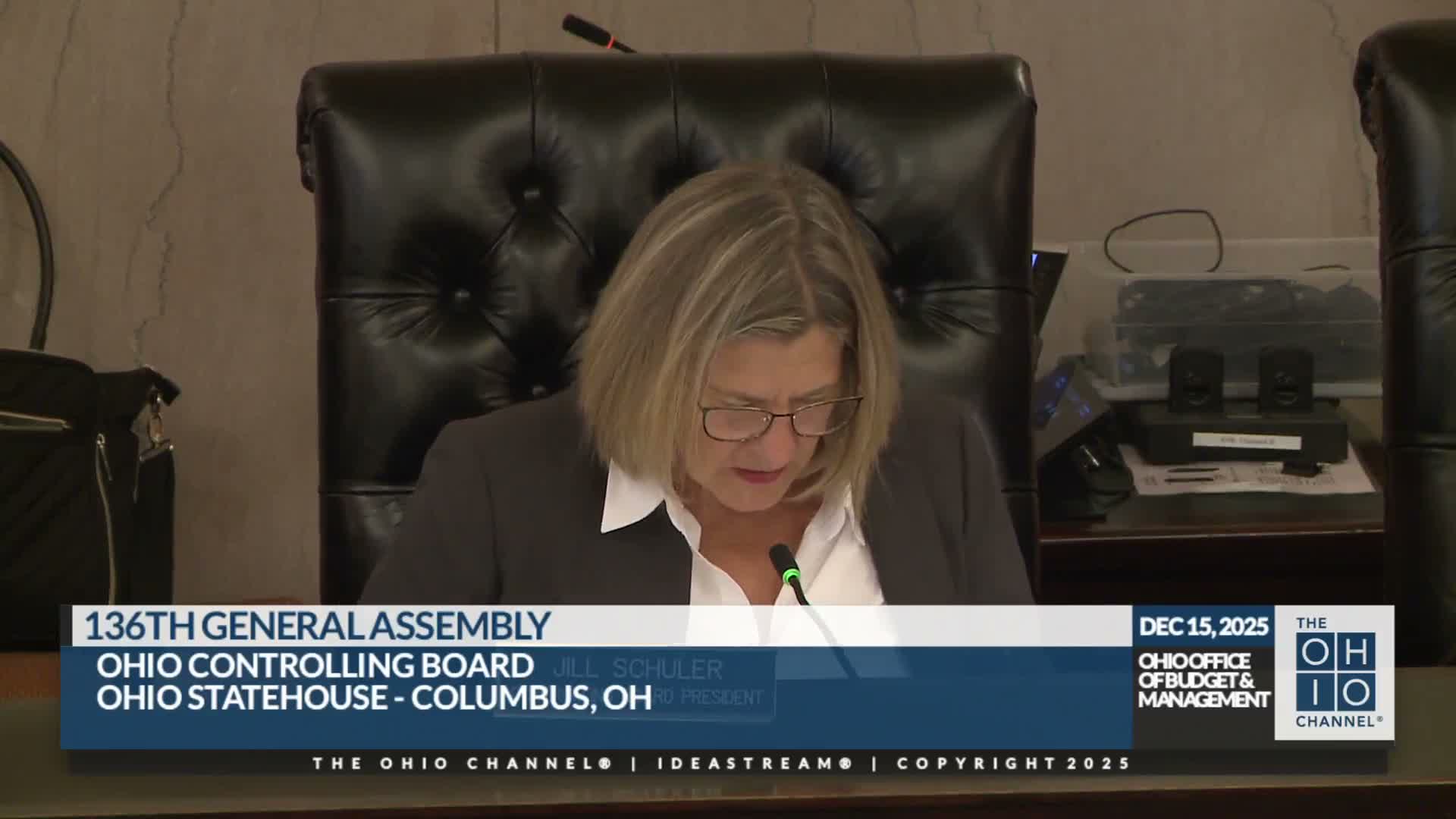
Leslie Piatt, CFO for the Ohio Secretary of State, told the State Controlling Board the Ohio Election Integrity Commission will transition into the Secretary of State's office on Jan. 1 and that staffing and funding will be phased in while officials determine the new fund's cash balance. Lawmakers pressed for details on permanent staffing, fees and safeguards against politicization.
The State Controlling Board approved an appropriation request to allow the Secretary of State's office to absorb functions of the Ohio Election Integrity Commission and set up initial staffing.
Leslie Piatt, chief financial officer for the Ohio Secretary of State, told the board the commission's duties will transition into the Secretary of State's office effective Jan. 1 and the unit will be called the Ohio Election Integrity Commission (OEIC). "This is now going to be part of the secretary of state's office going forward, January 1," Piatt said, adding that the office will request permanent funding once it understands what cash balance moves to the new fund created in House Bill 96.
Lawmakers pressed for specifics on how the new unit would be funded and staffed. Senator Ingram asked whether the appropriation was a short-term transition measure or the start of a permanent budget line; Piatt replied it is intended to stand the unit up and that a fund was created in House Bill 96 with some appropriation in FY26 and $0 budgeted in FY27. Representative Sweeney noted the request includes authority to hire new staff and asked whether the work would be funded by fees or a General Revenue Fund allocation. Piatt said the expectation is that fees formerly collected by the OEC would move to the OEIC and fund the operation, but that details are not yet certain.
Representative Sweeney also raised concern about politicization: she said that moving an entity that previously had bipartisan membership into an office controlled by a partisan official could be problematic and asked what measures would guard against weaponization. Piatt said she was not prepared to describe specific measures during that session but would bring the question to her team and keep the legislature informed.
Representative Stewart said the transition is aimed at improving performance after prior problems at the former commission, including an asserted backlog of uncollected fines and long case timelines. He noted a reported $96,000,000 in uncollected fines and said the new structure includes stricter timelines and staffing to collect fines and resolve cases more quickly. Piatt said investigators will begin work on past-due matters and cited operational improvements such as accepting electronic payments and providing virtual hearings.
The board approved the item without a recorded roll-call tally.
What happens next: The Secretary of State's office will continue implementing set-up steps, finalize staffing and report back to lawmakers on funding plans as the new fund's balance becomes clear.