
Architects and contractor report extensive concrete deterioration at ICB; committee recommends Miller Architects' plan to BOCC
Get AI-powered insights, summaries, and transcripts
Subscribe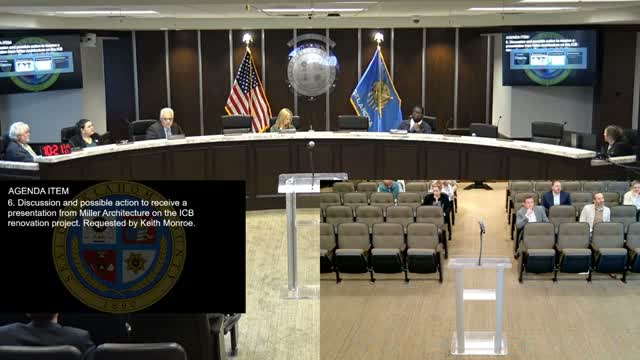
Summary
Miller Architects told the county the ICB building's brick facade and underlying concrete show widespread deterioration; the firm proposed a supplemental exterior structural system and redesign work with estimated fees and asked the committee to recommend the plan to the Board of County Commissioners, which the committee approved.
Miller Architects told Oklahoma County's Public Buildings Advisory Committee that extensive hidden deterioration in the ICB building requires a redesigned structural approach and additional construction administration.
Cody Pastolica of Miller Architects said testing and demolition revealed that much of the original brick facade could not be salvaged and that perimeter concrete had "honeycombing" and areas of unconsolidated material. He said concrete cores commonly returned strengths around 1,000–1,200 psi, well below the roughly 3,500 psi one expects in modern construction. "As we moved forward, the goal was to patch and repair," Pastolica said, "but we found areas that just kept going," and contractors stopped repairs on safety grounds.
Miller presented two parallel paths: continued repair methods (including an epoxy-injection option the firm described as uncertain) and a recommended supplemental exterior structural system that would "wrap" columns with reinforced concrete jackets and additional steel to provide a stable substrate for the new facade. Pastolica said the supplemental system would address both stability and anchorage for the curtain wall and new masonry.
To develop and implement that path, Miller proposed several fee items: $32,000 for an earlier redesign done last September; $18,287.50 for studies and options developed since last fall; $97,500 to produce full redesign and construction documents for the exterior structural system; and $29,310 for a six-month extension of construction administration services (with an optional additional 10-month CA period quoted at $19,250). Pastolica characterized the redesign and CA fees as the immediate next steps needed to produce final construction costs.
Lingo Construction's project manager, Aaron, provided a rough order of magnitude for construction under the concrete-and-steel concept: a little over $900,000 for concrete work, about $250,000 for steel, plus general conditions and contingencies. Lingo estimated general conditions at roughly $500,000, yielding a construction range "anywhere between $1.2 to $1.4 million" for the concept design provided.
County staff and the committee asked technical questions about how the proposed exterior "exoskeleton" would affect the building's appearance and interior connections. Pastolica said the facade would be designed to "respect the historic character," with some new steel elements visible only through double-height glazing; the exterior envelope itself, he said, would remain largely unchanged.
After presentation and questions, the committee moved and approved a recommendation that the Board of County Commissioners consider Miller Architects' proposed path and associated design and CA fees so the county can finalize construction estimates and proceed toward repair and stabilization.
The committee did not adopt a final construction contract at the meeting; staff said final construction pricing will follow after completion of the requested redesign and studies.