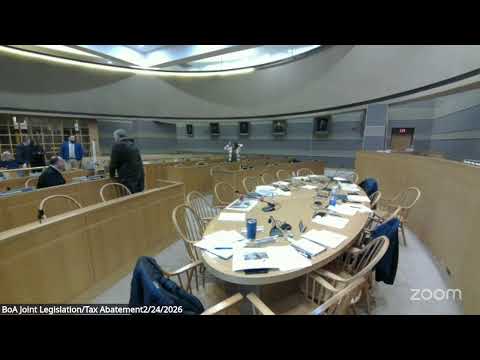
Committee hears Elm City Lofts presentation as developer seeks tax abatement and zoning change
Loading...
Summary
Developers presented a roughly $120 million plan to convert and add affordable units at the Elm City Lofts site, seeking an ordinance-classified tax abatement, state and historic tax-credit financing and federal support; committee members pressed for remediation details, unit counts and the city’s fiscal impact. No vote was recorded.
New Haven — Developers seeking a tax abatement for Elm City Lofts outlined plans and financing Tuesday to convert an existing building and construct adjacent apartment buildings aimed at low- and moderate-income households.
At a meeting of the Joint Legislation and Tax Abatement Committee, presenters said the roughly $120 million development would be targeted to households at about the 50–60% area median income tier and would rely on a mix of financing, including mortgage authority loans, sale of low-income housing tax credits, federal and state historic tax credits and an indicated federal support amount of $33,710,000, which presenters said they recently were told was likely to be available. The agenda lists ordinance LM2025-076 to classify the Elm City Lofts property as housing for low- or moderate-income households and to authorize the mayor to enter a tax-abatement agreement with Elm City Lofts LLC under Connecticut General Statutes §8-215 and the New Haven municipal code (city code section 28-4). The ordinance was presented for discussion; the transcript does not record a formal vote.
"I'm Josh Greenblatt. I'm with Vesta Corporation, the co-developer here," one presenter said in opening remarks. Architect Jason Long described the design: "The design concept is based on supporting the existing infrastructure," he said, noting adaptive reuse of the existing structure, new adjacent residential buildings, street-level retail and parking largely under or within the buildings.
Developers and their consultants told committee members they engaged a consultant, GeoQuest, to review prior environmental testing and to prepare a remediation plan. According to presenters, previous removal of radioactive materials and other work have been done and GeoQuest concluded remediation could be accomplished; presenters gave a rough remediation estimate described in the meeting as near $2.5 million and said certain federal or state funding is conditional on completing the remediation plan.
Committee members pressed for technical detail and documentation. One member said they would not want to encourage residential development if there remained a risk that people could get sick; presenters offered to make consultant testing and remediation reports available to the committee for review.
Members also focused on unit mix, tenant transition and neighborhood fit. Presenters said most apartments would be one-bedroom units and that the development would include studios and two-bedroom units. Rents discussed in the meeting were presented as illustrative: a studio at the 50% AMI level was cited around $1,077; a one-bedroom at 50% AMI around $1,154; a two-bedroom rents cited near $1,663 at 60% AMI. Unit-count figures appeared in discussion but were inconsistent in the transcript (members referenced 16, 84 and 96 units in different buildings; presenters later cited "30 studio units" and other totals); developers said they would provide clarified unit totals to staff.
A committee member reviewed recent local tax-abatement comparables and presented an illustrative 15-year abatement figure for a sample parcel. Presenters explained why a tax abatement affects operating viability and mortgage capacity: they said every increase in real estate tax raises operating expenses and can change mortgage sizing.
Presenters clarified that the funds they are seeking are not HUD program funds; they emphasized the financing mix is state funds, tax credits and the indicated federal support. The project team said they are selecting an architect and will subsequently issue requests for general contractors; they described an anticipated closing once financing sources are aligned, with presenters anticipating financial closing by the end of the year if funding is secured.
Evelyn Rodriguez asked whether the development would serve people exiting homelessness; presenters replied the project targets employed households at the 60% AMI range and is not designed as transitional housing for people exiting homelessness.
The committee requested more technical documentation on remediation, clearer unit counts and a fuller fiscal analysis of the city's contribution versus full tax liability. The transcript ends before a formal vote or final disposition on the ordinance is recorded; presenters said a vote would occur later in the meeting.
Reporting available materials and next steps: committee members said they expect the project team to provide the GeoQuest reports, a clarified unit breakdown, and detailed fiscal calculations ahead of any final action.