
Committee holds bill that would exempt small plug-in solar from interconnection agreements after safety testimony
Get AI-powered insights, summaries, and transcripts
Subscribe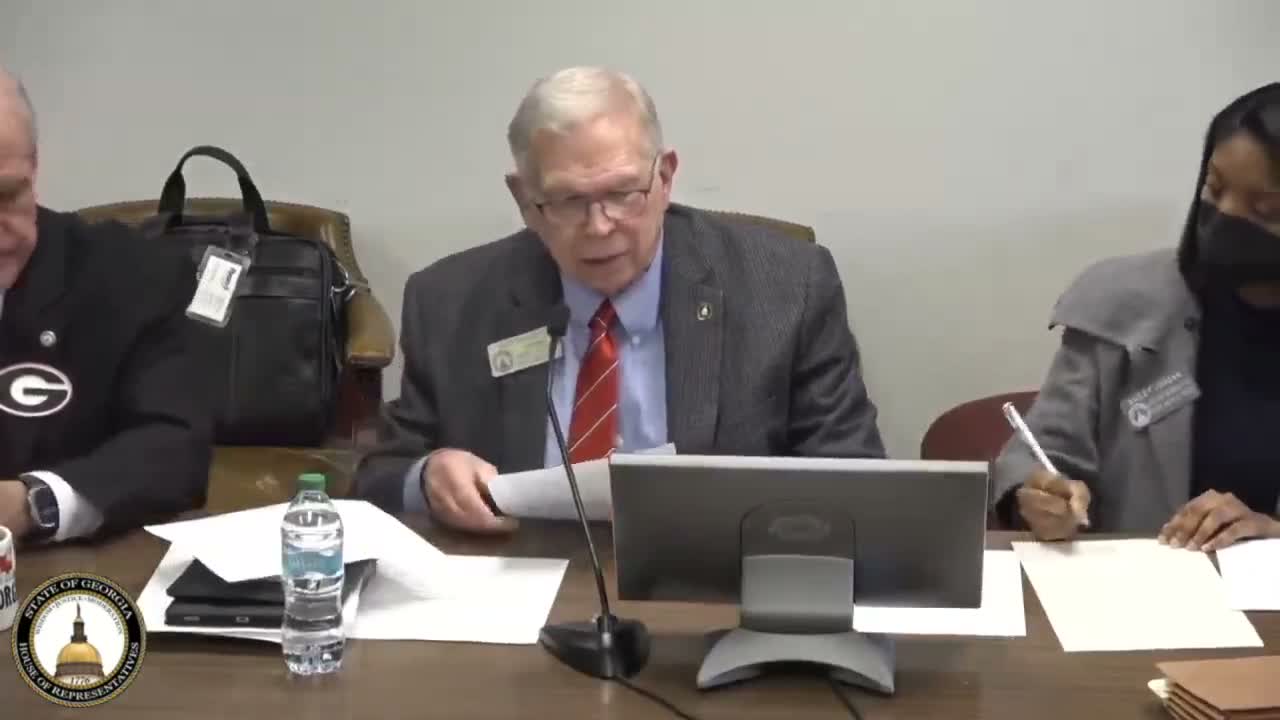
Summary
Lawmakers heard extensive testimony from Georgia Power, EMCs, municipal utilities, the Georgia Solar Energy Association and a Public Service Commissioner about safety, UL/NEC certification and Utah's experience before the House held HB1304 for further work; the committee suggested exploring a registry and certification requirements.
The House Energy, Utilities & Telecommunications Committee on May 20 heard extended testimony on a substitute to House Bill 1304 (LC560587S), a proposal from Representative Barnes that would exempt certain small plug-in or "balcony" solar systems (1,200 watts or less) from the state interconnection agreement requirement.
Representative Barnes said the substitute is intended to make it easier for consumers to adopt small solar devices sold at retail and that many systems include safety features that cut off generation when the grid goes down. "We're just trying to make it easier for consumers to be able to use them at home," Barnes said.
Georgia Power's Wilson Mallard, director of renewable development, told the committee the utility supports distributed solar generally but expressed concerns about a blanket exemption. "As of just earlier today, I asked [UL] and they confirmed there are currently no portable solar facilities that qualify for UL certification," Mallard said, adding that the company would favor a simplified interconnection process rather than a full exemption and would seek UL/NEC compliance and registry information before supporting an exemption.
Emily Patouk of Georgia EMC — whose member cooperatives serve roughly 73% of the state's land mass and more than 5 million Georgians, she said — opposed the bill as written and cited safety incidents in Utah after that state's 2025 law. "Following the passage of the bill in Utah, electric utilities have experienced back feed issues during both routine and emergency work," Patouk told the committee, and she said utilities are now working to repeal that law.
Industry testimony differed on a narrow point of standards. Don Moreland of the Georgia Solar Energy Association said individual components of rooftop and portable kits often have UL or IEEE endorsements, but that the UL kit-level certification is new and the bill should reference certification standards and registration. "Rooftop solar does not have a UL certification either," Moreland said; "the individual components are UL certified and this upcoming UL certification is designed to certify the kit."
Representatives of municipal utilities (Daryl Ingram, Electric Cities of Georgia) and the state's public service commission (Peter Hubbard) urged caution, citing National Electric Code and safety concerns about backfeed and overloading older home circuits. Hubbard said registry requirements and anti-backfeed devices — and limits tied to dedicated circuits — are possible technical mitigations.
After hearing witnesses and debate, the committee chair said there were unresolved safety questions and opted not to take a vote. The chair said the measure would be "held" so the author could consider amendments such as a registry and certification requirements before it returns to committee.
What happened next: the committee did not vote; Barnes said she would consider working further on the bill and indicated openness to adding a registry or other clarifying language.
Why it matters: portable plug-in solar is increasingly available through retail channels and raises technical and safety questions not fully addressed by existing code and interconnection practice. Lawmakers and utilities signaled willingness to consider streamlined processes but emphasized the need for recognized safety and location-tracking mechanisms before exempting systems from interconnection law.