Get Full Government Meeting Transcripts, Videos, & Alerts Forever!
Get email alerts on the Land Use topic
No spam. Unsubscribe anytime.
Black Lake specific‑plan amendment cleared for processing; supervisors debate affordable‑housing expectations and traffic impacts
Summary
The board authorized processing of a proposed amendment to the Black Lake Specific Plan that would permit up to 125 new units and visitor‑serving uses; supervisors sought explicit affordable‑housing analysis and traffic mitigation for Willow/Via Concha if the project proceeds.
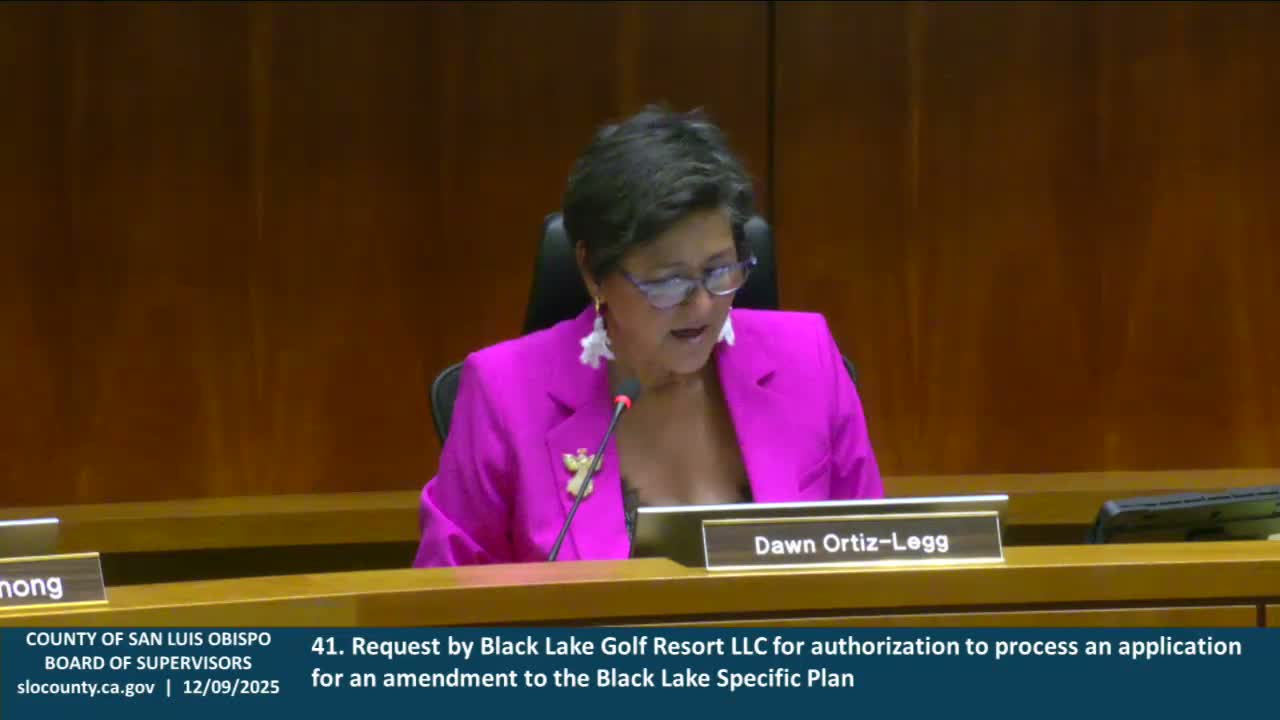
The Board of Supervisors on Dec. 9 authorized staff to accept and process an application to amend the Black Lake Specific Plan to allow expanded visitor‑serving uses and up to 125 additional units, while directing staff and the applicant to consider affordable‑housing options and traffic impacts as the project advances through planning review.
Staff said the proposed amendment would add 45 single‑family lots, 50 lodge/condo units that can be rented nightly, 24 cottages and a small number of tournament‑home parcels and would permit hotels and motels in the primary recreation area. The applicant and representatives described the proposal as an effort to revitalize the resort and restore an overnight lodging component previously available on site.
Neighbors objected at public comment to the proposed maximum lodging height (up to 50 feet), possible shadows and privacy impacts, increased activity adjacent to residential areas, and traffic and safety at the Willow Road / Via Concha intersection. A resident requested specific commitments the applicant had made in homeowner meetings — e.g., limiting height on the west end, no windows on the west facade, sound and privacy walls, and gated access — be included in future permits.
Board members debated whether to require on‑site affordable units or a contribution to the county’s regional housing fund. Planning staff said they can work with the applicant to test options, including ADUs and in‑lieu fees, and that the authorization stage is for process direction and objective setting; any precise inclusionary requirements or in‑lieu amounts would be evaluated later in the planning and conditional‑use process.
Supervisor Gibson urged that any change to the specific plan include an analysis of housing demand for affordable units tied to the project’s new permanent residential capacity. Supervisor Paulding favored authorizing processing while asking staff to pursue participation in the regional housing funding mechanism. Supervisor Pashong moved to authorize processing; the motion carried with a roll call showing three votes in favor and two opposed on the record to adding an explicit affordable-unit requirement at this stage.
What happens next
If processing is authorized, the application will return to planning review, be referred to public works (for traffic analysis and mitigation), and proceed to the Planning Commission and then the Board for final decisions; conditional‑use permits will control detailed design, hotel permit requirements and conditions and would include public outreach and environmental review.