Get Full Government Meeting Transcripts, Videos, & Alerts Forever!
Get email alerts on the Marthas Place topic
No spam. Unsubscribe anytime.
County and community partners pledge to sustain Martha’s Place after budget shortfall
Summary
County behavioral‑health officials presented a plan to reduce general‑fund reliance and work toward self‑sufficiency for Martha’s Place, the county’s children’s assessment center; community nonprofits pledged fundraising and fiscal sponsorship to close a roughly $215,000 shortfall and expand referrals and billing opportunities.
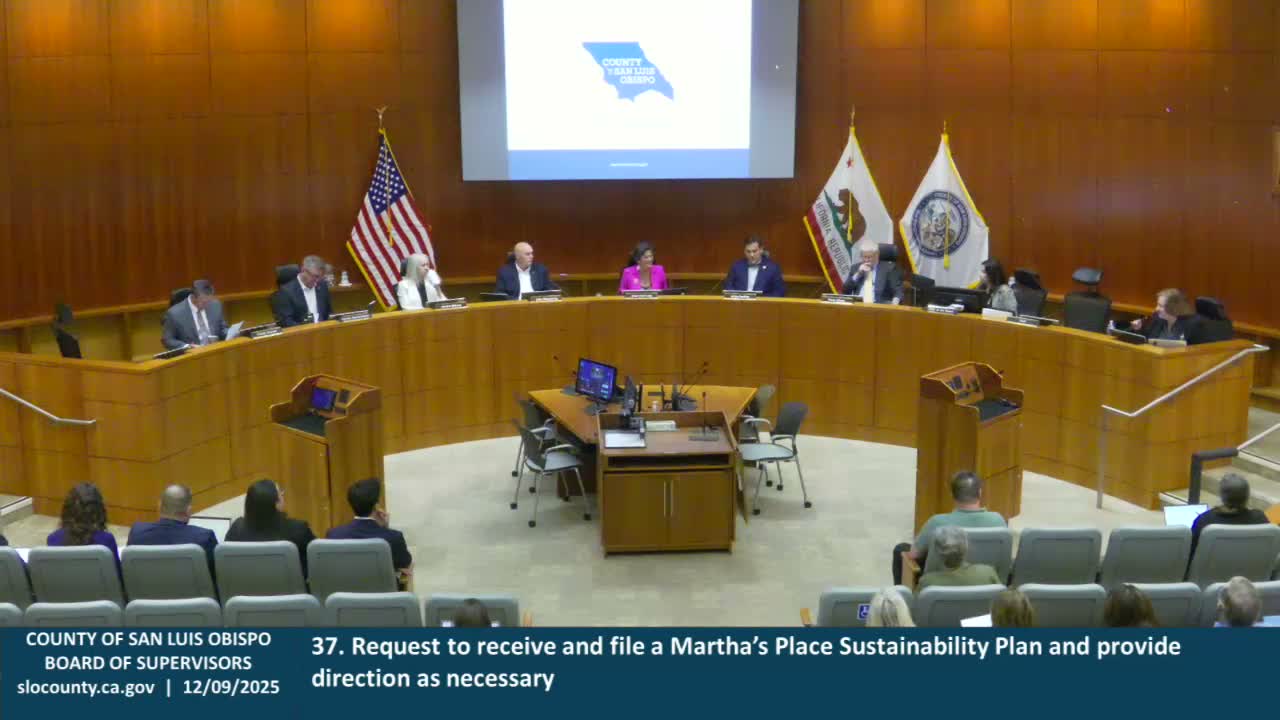
County behavioral-health leadership told the Board of Supervisors on Dec. 9 that Martha’s Place — a clinic in San Luis Obispo serving infants through age 5 with mental‑health, developmental and pediatric services — has been restored in the current budget but faces a funding gap that requires a sustainability plan.
Dr. Star Graeber, the county behavioral‑health director, described three parallel strategies: operational optimization (refining staffing and workflows and proposing a four‑day‑a‑week clinical schedule to reduce costs), maximizing Medi‑Cal and other allowable billing, and braiding public and private funding with a nonprofit fiscal sponsor and ‘Friends of Martha’s Place’ fundraising arm. Staff said the program needs roughly 200 billable assessments a year (about four per week over 50 weeks) to reach financial sustainability and estimated a present shortfall near $215,000.
County staff reported a grant application led by a community health partner to cover the gap; the county also plans to propose elimination of two FTEs in the coming budget cycle as part of operational changes. Community groups told the board they will step up: United Way of San Luis Obispo County, the Center for Family Strengthening and the Friends of Martha’s Place pledged to help with fundraising, fiscal sponsorship and outreach.
“Early diagnosis and treatment could have kept such a beautiful light from going out,” a family member wrote in a letter read at the board meeting, underscoring advocates’ argument that early intervention reduces long-term costs in the criminal‑justice and social‑service systems. Board members praised the plan and asked for outcome tracking and exploration of private‑pay or ADU models to increase revenue and improve long‑term sustainability.
What happens next
Staff said a detailed sustainability report will be provided in March 2026 and the county and nonprofit partners will continue to work to diversify funding — mixing Medi‑Cal billing, grants and private donations — while monitoring appointment volumes and billing performance weekly and monthly.