Get email alerts on the Environment topic
No spam. Unsubscribe anytime.
Board extends county's interim biosolids moratorium amid PFAS concerns
Summary
The board extended an interim moratorium on land application of biosolids to March 31, 2029 to allow state and federal PFAS testing and regulatory work to proceed. Agricultural and public health advocates urged a permanent ban; staff cited ongoing federal/state studies and a 1,500-cubic-yard annual cap for notification-triggering applications.
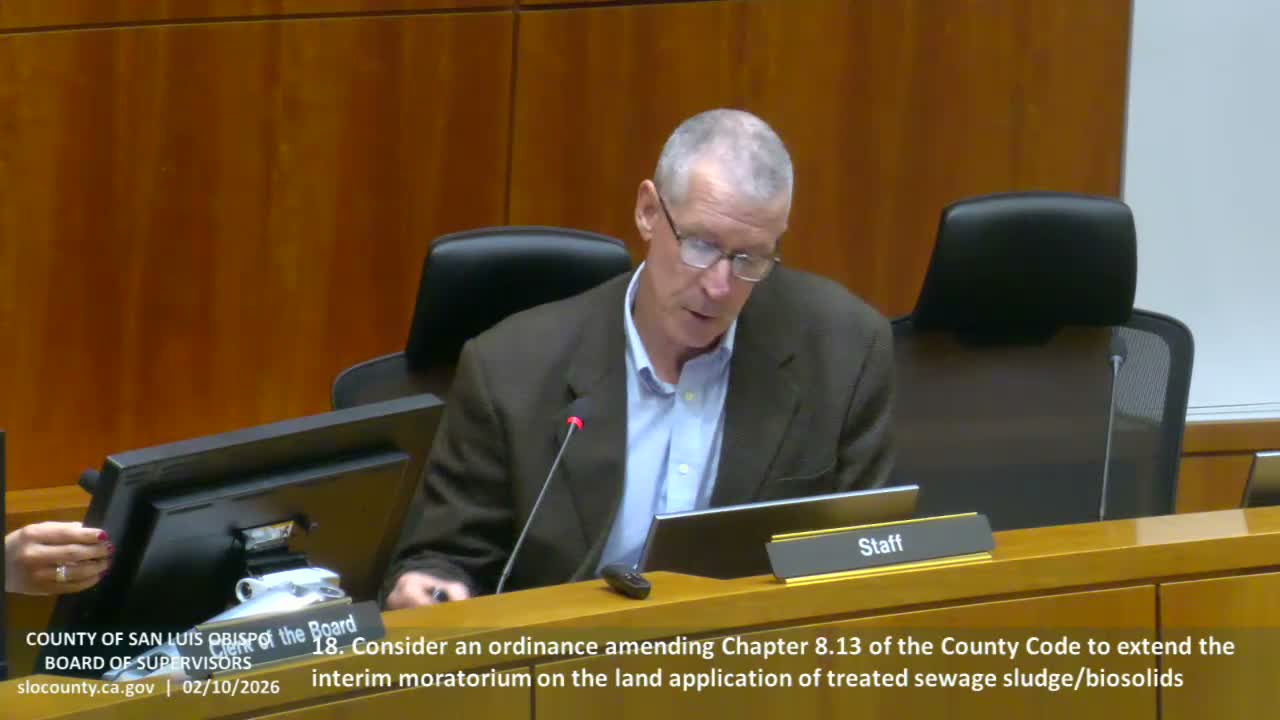
San Luis Obispo County extended its interim moratorium on land application of biosolids on Feb. 10, citing ongoing state and federal research into contaminants including PFAS and the need to allow regulatory work to catch up with local policy.
Peter Hague, director of Environmental Health Services, explained the interim code limits land application to historic levels, requires notification to Environmental Health for applications of 5 cubic yards or more, and caps Class A EQ biosolids at a cumulative total of 1,500 cubic yards in any 12-month period. "Biosolids are a nutrient rich organic material resulting from the treatment of sewage in a municipal wastewater treatment plant," Hague said while outlining the technical categories and state/federal activity.
The county noted the U.S. EPA's 2018 Office of Inspector General report raising questions about hundreds of unregulated pollutants in land-applied biosolids and referenced State Water Resources Control Board PFAS testing orders issued to wastewater treatment plants in 2020. Public commenters, including agricultural advisory voices, urged the board to adopt a permanent prohibition on land application; David Broadwater, a longtime local advocate, told the board "It's time to codify this status quo by adopting an ordinance permanently prohibiting this activity on county lands."
Board members agreed to extend the interim moratorium to allow time to consider federal and state regulatory work and potential local permanent restrictions. Staff said the extension will give the county time to review ongoing scientific work and Senate Bill 1383-related disposal considerations before potentially bringing a permanent ordinance forward.
What comes next: The county will monitor federal EPA risk assessments and state PFAS initiatives, coordinate with the Agricultural Liaison Advisory Board and stakeholders, and report back on options for a permanent ordinance or further extensions.
AI generated
The text on this page is AI generated. Summaries, highlights, analysis, and video transcripts are all produced from the original source material.
AI can make mistakes, so if you spot one, and we will fix it for everyone.
Note: the source content is unaltered by us. Any content source we link to, be it a video, an audio recording, or a document, is presented exactly as its publisher released it. That publisher is usually a government body, sometimes an individual official or another organisation.