Get Full Government Meeting Transcripts, Videos, & Alerts Forever!
Get email alerts on the Health And Human Services topic
No spam. Unsubscribe anytime.
County staff warn HR1 could strip coverage from thousands; board readies outreach and budget review
Summary
County staff told supervisors HR1's new work and eligibility rules could put an estimated 13,000 Medi-Cal recipients and about 3,200 CalFresh participants at risk, increase CalFresh administrative costs by roughly $1.6 million annually, and force the county to plan for higher indigent care demand. Supervisors and partners discussed outreach, navigation hubs and workforce ties.
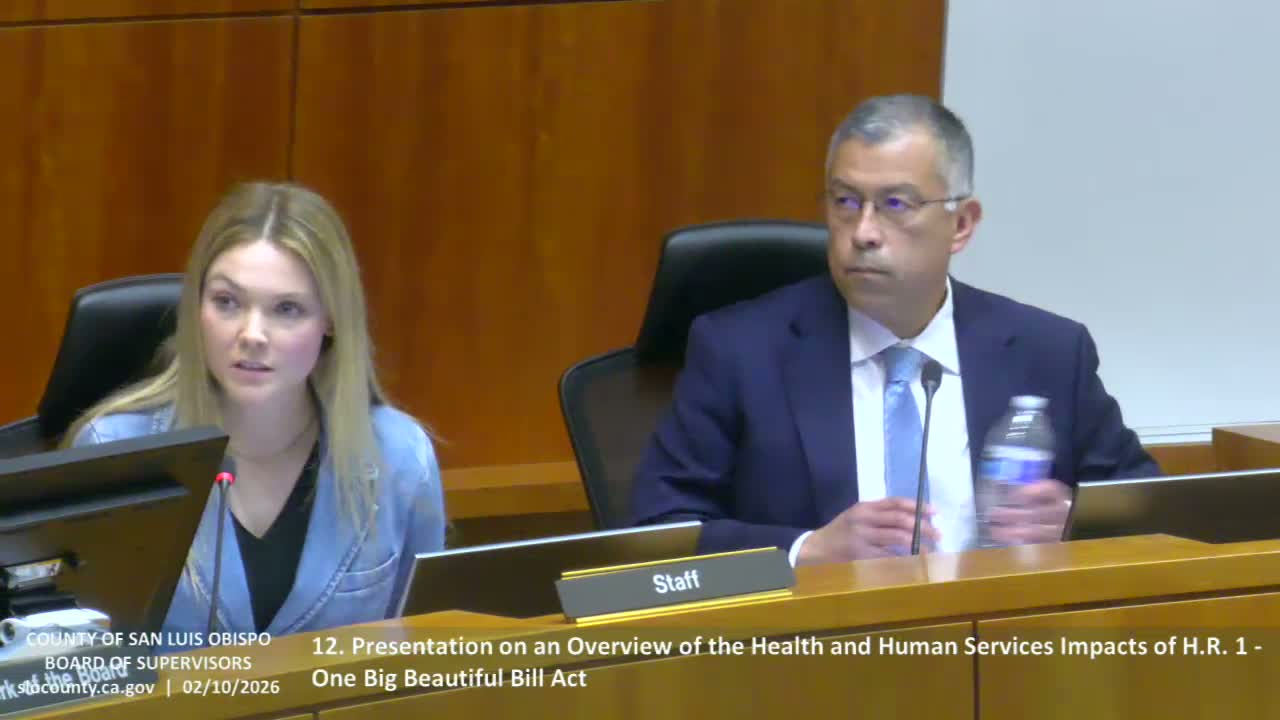
County staff presented a consolidated briefing on Feb. 10 outlining how the federal HR 1 changes could reshuffle health and nutrition coverage in San Luis Obispo County and raise local costs.
"HR 1 makes significant changes to Medicaid rules including tighter eligibility requirements, more frequent eligibility redeterminations, and expanded work requirements," Addison Gregory, administrative analyst in the executive office, told the board during a data-driven presentation that drew on state and county estimates.
The presentation estimated roughly 66,000 residents currently rely on Medi-Cal and about 29,000 participate in CalFresh. Staff projected that when HR 1 work requirements and more frequent redeterminations take effect, as many as 13,000 Medi-Cal adults could be subject to the new rules and might lose coverage if they do not meet work or reporting conditions; about 3,200 CalFresh recipients were flagged as potentially losing benefits under the new SNAP work rules that begin in June 2026.
The county also faces higher administrative costs: staff estimated California counties could face a greater share of CalFresh administrative costs (rising to a 22.5% county share from 15%), translating to an estimated $1.6 million additional county cost annually unless the state or federal government offsets those amounts.
Community partners urged ramped-up outreach and service coordination. Molly Kern of the SLO Food Bank described how reductions in benefits translate quickly into higher demand for charitable food assistance: when CalFresh payments paused during a past federal lapse, the food bank saw an additional 10,000 visitors within 14 days.
Marina Owens, CEO of SenCal Health (the county's managed care partner), said the managed care plan will expand navigation "hub" work, workforce supports and member outreach to prevent avoidable coverage loss. "We're invested in a regional member navigation hub with nonprofits and community partners," Owens said, noting SimCal will help coordinate re-enrollment and eligibility outreach.
Board members asked staff to coordinate modeling, share details with CSAC for statewide advocacy, and to prepare budget scenarios showing potential fiscal impacts to the county operating plan.
What comes next: County staff will continue refining financial estimates, coordinate with regional partners (SimCal/SenCal and nonprofits), and present budget impacts in upcoming budget planning sessions. Supervisors emphasized urgency in outreach, workforce-placement strategies and volunteer options to help people meet new work or participation requirements.
Sources: County presentation by Addison Gregory and written staff report provided at the Feb. 10 meeting.