Get Full Government Meeting Transcripts, Videos, & Alerts Forever!
Get email alerts on the Pedestrian Policy topic
No spam. Unsubscribe anytime.
Transportation Commission adopts draft pedestrian-signal policy emphasizing pedestrian priority
Summary
The Transportation Commission unanimously adopted draft policy guidance to expand leading pedestrian intervals, pedestrian recall and 'rest-and-walk' settings where feasible, following staff presentation and public comment urging stronger pedestrian priority.
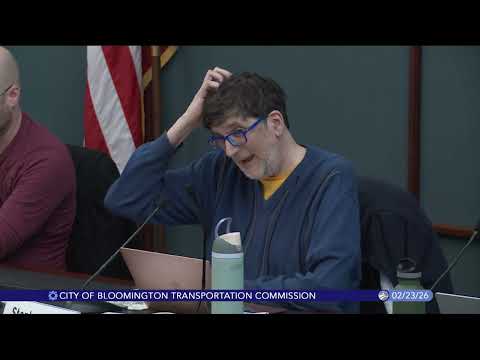
The City of Bloomington Transportation Commission on Feb. 23 adopted a draft policy that directs staff to prioritize pedestrian-focused signal settings at signalized intersections, voting 8–0 to approve staff findings.
Engineering staff presented the proposal, which responds to City Council resolution 23-17 and recommends wider use of leading pedestrian intervals (LPIs), pedestrian recall as the default where appropriate, and a 'rest-and-walk' approach tied to pedestrian-volume thresholds. Neil Copper, an engineering department presenter, told the commission the policy is still in draft form and staff brought it early for input: "we wanted to bring it to you well before it was final, to get additional input on this." He noted federal Highway Safety Improvement Program funds support the broader signal-retiming project that underpins the policy and that federal funding covers about 90% of the signal retiming costs.
During discussion commissioners pressed staff on implementation details, including how the settings would apply on state-owned roads and the limitations of older signal equipment. Copper said some intersections owned by the state would be outside the city's control and that a several-year equipment upgrade program has enabled broader LPI use. He cited two local examples where LPIs are currently in operation: "Third and Indiana and Third and Woodscrest" as early implementations.
A member of the public, Greg Alexander, urged stronger measures in favor of pedestrian recall across side-path crossings, arguing it is essential to meet the city's Safe Streets goals. Alexander said, "every intersection that's crossed by a side path or greenway needs pedestrian recall, full stop, non negotiable."
Commissioners also discussed whether the policy would live in an administrative policy document rather than codified city code; staff said the intent is an administrative policy that can be iterated and applied to signal decisions while leaving code changes for other, more structural items. After deliberation, Commissioner Stossberg moved to adopt the proposed findings and approve the policy; the motion passed 8–0.
Next steps: staff will finalize the policy text incorporating commission feedback, pursue the formal grant agreement tied to the signal-retiming work, and return with more detailed implementation plans and locations for commission review as projects move from policy to design.