
Public Service Commission urges staffing boost, warns ‘phantom load’ in PJM auctions inflates costs
Get AI-powered insights, summaries, and transcripts
Subscribe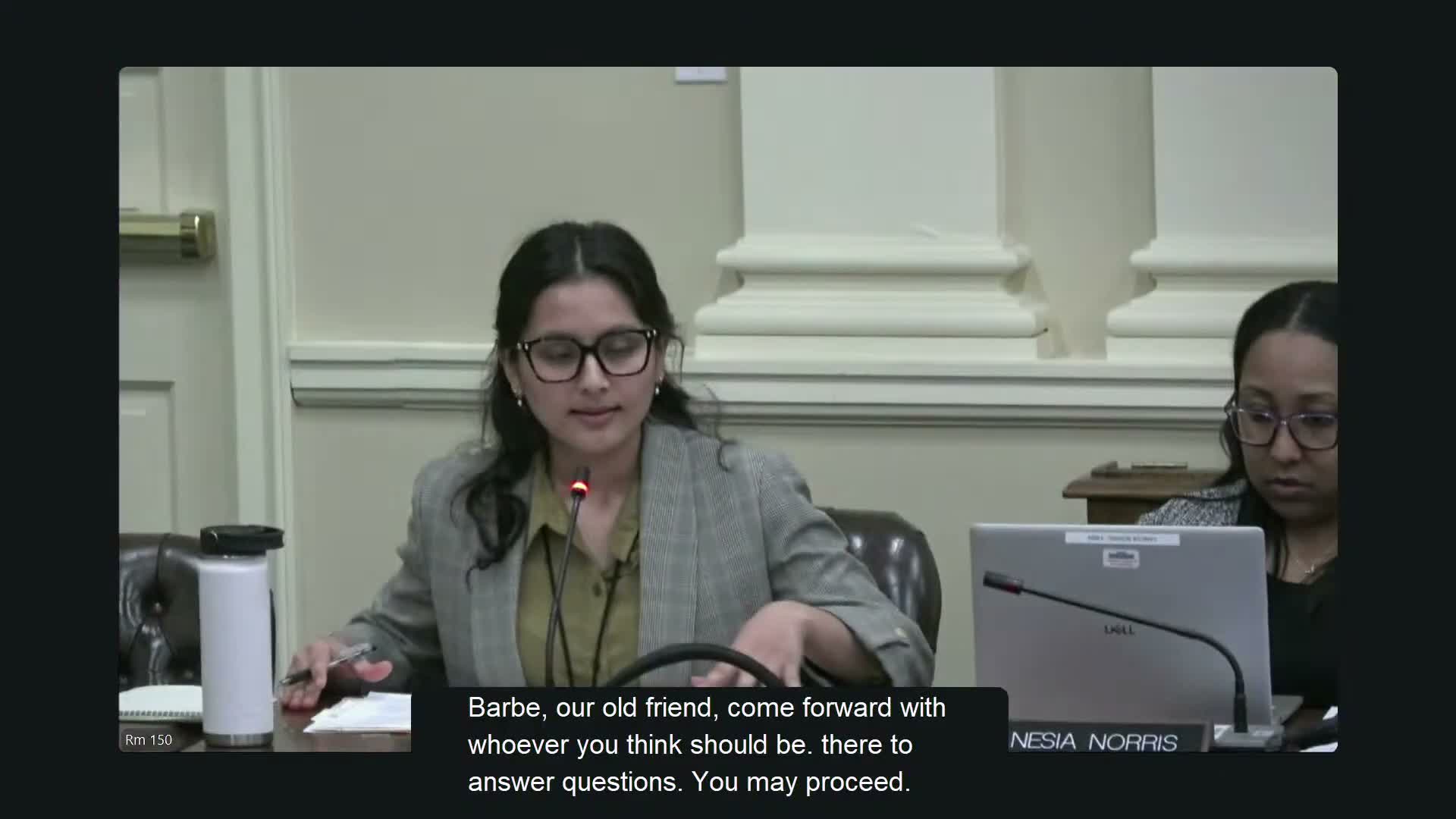
Summary
The Public Service Commission told the Appropriations subcommittee its top priorities are filling vacancies and addressing market-design issues that can inflate capacity costs, including so-called “phantom load” from unverified data-center applications; PSC also defended a moratorium tied to BGE call-center failures.
The Public Service Commission told the House Appropriations Committee’s Transportation and the Environment Subcommittee that filling longstanding vacancies and confronting distortions in the PJM capacity market are the agency’s top priorities as it implements the governor’s focus on affordability and reliability.
In written analysis presented by the Department of Legislative Services, DLS said the PSC’s fiscal 2027 operating allowance falls to $132.3 million, a $97.5 million (42.4%) decrease driven largely by one-time residential bill credits provided in fiscal 2026. DLS recommended committee narrative requiring the PSC to report how it will use $15 million allocated from the Strategic Energy Investment Fund’s dedicated purpose account.
PSC Chair Barbay, who said he has been in the job about a month, emphasized staffing gaps: he reported roughly 23 open positions and said hiring is the commission’s “top priority,” describing multiple hires in progress and additional candidates at various stages of the personnel process. He told the committee he hopes to staff up “as quickly as possible, hopefully, by sine die.”
Barbay also described what he called “phantom load” problems in PJM, the regional grid operator. Explaining capacity-auction mechanics, he warned that developers sometimes apply for authorization in multiple states and only build in one, which can make the expected load appear larger than reality and push capacity prices higher. He said the White House and a 14‑governor coalition have urged PJM to count as load only projects backed by signed contracts and ideally a down payment to prevent exaggeration. “The worst thing would be for ratepayers to be paying higher prices for data centers that are really not ever gonna be turned on,” Barbay said.
On consumer protections, delegates pressed the PSC about a moratorium on certain BGE collection and termination actions that the commission imposed after what Barbay described as “call‑center failures” and reported wait times that reached 150 minutes. The moratorium was put in place to prompt operational improvements and can be extended if necessary, Barbay said.
DLS highlighted notable customer affordability indicators: residential electricity prices rose (DLS cited an October 2025 average of 22.3¢ per kilowatt-hour), and total outstanding residential arrearages reached $377.6 million in March 2025. DLS asked the PSC to report whether the bill credits applied in August–September 2025 led to recent arrearage decreases.
The PSC also flagged limits on its authority: it regulates distribution charges but not the auction-based supply prices set through PJM and noted that certain federal and multistate processes (PJM and FERC) ultimately determine market design changes. Barbay urged additional regulatory economists and legal staff to match capacity at peer states’ commissions and said the commission will pursue policy and staffing changes to better protect ratepayers.
The subcommittee did not take action; members requested follow-up materials on the causes of Maryland’s rising residential prices and a PSC report describing planned uses of dedicated‑purpose funds and residential termination data.