
House Judiciary Committee Hears Hours of Testimony on "Biological sex" Bills; Amends and Advances Several Measures
Get AI-powered insights, summaries, and transcripts
Subscribe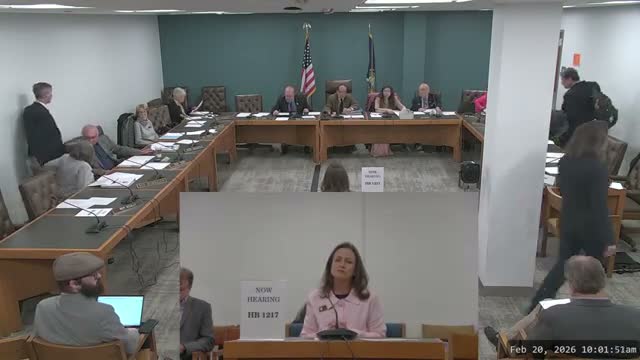
Summary
A daylong Judiciary hearing saw scores of witnesses and sharp partisan debate over bills that would let entities classify spaces by "biological sex," with one amendment adopted and several measures advanced while others were sent to interim study.
The New Hampshire House Judiciary Committee spent a full day hearing testimony and debating a cluster of bills that would allow or require sex‑segregated policies in restrooms, locker rooms, athletics and certain institutional settings.
Representative Katie Petterneil, the prime sponsor for one early item, told the committee the bill "permit[s] classification of individuals based on biological *** under certain limited circumstances," and said it is intended to protect women's privacy in intimate spaces. Opponents called the bills unnecessary, unenforceable and discriminatory.
Opponents included lawmakers, medical experts and dozens of residents. Representative Alice Wade (Dover Ward 2) responded directly to enforcement hypotheticals: "For the record, I am a trans woman," she said, arguing that "there is no enforcement mechanism in this bill" and warning it would invite wrongful accusations and police involvement for ordinary bathroom use. Legal advocates and civil‑rights groups repeatedly pointed to pending litigation and federal injunctions, with Chris Urschel of GLBTQ Legal Advocates and Defenders noting that a prior school sports ban was "promptly enjoined by a federal court and that injunction is still in place today as the litigation proceeds."
Medical witnesses and intersex advocates urged caution about genetic or single‑factor definitions of sex. Anatomist Anne Zumwalt warned that simple genetic tests or an SRY‑focused rule would exclude or misclassify people with conditions such as androgen insensitivity. Multiple witnesses described harms they said arise from these bills — including risks inside correctional facilities, potential for harassment in public places, and civil‑liability risk to schools and businesses.
Supporters said the measures give businesses and institutions flexibility. Representative Jim Cofalt, sponsor of HB 12‑99, said the bill is not "anti‑trans" but would allow "public and private entities to establish policies that draw that distinction," and described the proposal as an effort to provide "definition" where prior bills have been vague.
Amendment and votes
The committee considered an amendment to HB 12‑99 (referred to in committee as amendment 0854H) that narrows earlier language and adds a requirement that when a government facility applies sex‑based classifications for multi‑user bathrooms it must provide at least one single‑occupancy restroom in the same building available to all users. The amendment was moved and debated in committee and adopted on a roll‑call vote, 10–7 (clerk: "Motion passes 10 to 7"). The committee then voted to report HB 12‑99 "Ought to Pass as Amended" by roll call, 10–7.
Other committee actions
- HB 14‑47 (a related measure about classification of intimate spaces) was advanced by roll call as "Ought to Pass," 10–7. - HB 12‑17 and HB 14‑42 were referred to interim study by unanimous roll calls (17–0 in each case). - HB 15‑64, a proposal to remove "gender identity" from state anti‑discrimination statutes, was placed on the consent calendar as "Inexpedient to Legislate."
Why the committee split
Committee members and witnesses emphasized two central tensions: (1) whether the state should permit entities to set sex‑segregated policies to protect privacy and perceived safety, and (2) whether the bills would create uncertain, costly enforcement obligations and expose the state and private actors to litigation. Several members pressed sponsors on operational details — which documentary proof would be decisive (birth certificate at or near birth, current state ID, genetic tests) and who would have authority to ask for documentation in different settings.
What comes next
Items reported "Ought to Pass" will be carried forward for floor consideration. Bills placed in interim study will be revisited later, allowing the committee to solicit additional expert input before taking final positions. Many witnesses urged further study and clearer enforcement language; others urged the committee to act now to protect private spaces. The committee recorded its roll calls and assignments, and multiple members said they would propose additional amendments on the floor.
This hearing produced extensive written and oral records, with testimony from elected officials, medical and legal experts, and dozens of Granite Staters who urged opposite outcomes. The committee's adoption of an amendment and split votes underscore that lawmakers remain sharply divided on how — or whether — to change current law.