
TEDCO defends innovation funds as DLS recommends cuts; researchers and patients cite impact
Get AI-powered insights, summaries, and transcripts
Subscribe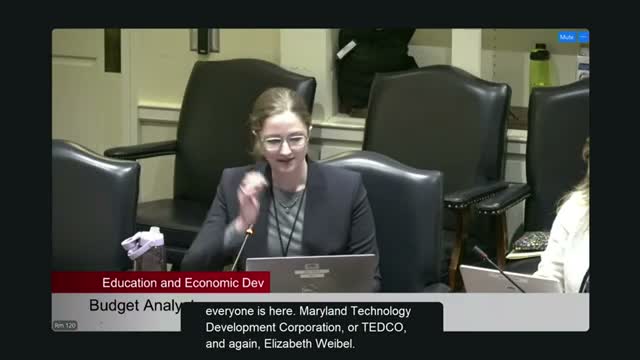
Summary
TEDCO pushed back on DLS recommendations to cut Equitec and other innovation grants, saying the funds support startups, workforce training and job creation; Maryland Innovation Initiative and the Maryland Stem Cell Research Fund testified with examples of follow‑on investment, company formation, and clinical benefits including sickle‑cell cures aided by MSCRF‑funded research.
Officials from the Maryland Technology Development Corporation (TEDCO) and affiliated programs urged the subcommittee to maintain funding for several innovation programs that DLS proposed to scale back in the FY27 allowance.
Elizabeth Bridal (DLS) presented the TEDCO analysis and recommended reducing certain mandated appropriations — including lowering Equitec Growth Fund support from $5 million to $3 million in 2027 — citing overlap with other state programs and tight fiscal conditions. DLS also noted the human relevant research fund’s revenue shortfall (about $185,000 collected to date versus a $915,000 projection) and recommended scaling administrative plans accordingly.
Troy Lamel Stovall, TEDCO’s CEO, strongly disputed those recommendations at the hearing. Stovall said Equitec and TEDCO’s social‑impact funds are unique early‑stage supports that cultivate companies, workforce training and statewide ecosystem connections; he cited internal figures for outputs including more than 2,500 trainees, support for over 750 STEM jobs, and hundreds of startup advances that could not proceed without the funding. Stovall also defended the Maryland Innovation Initiative (MII), arguing that a $250,000 appropriation authorized for the MII Partnership Extension Program would not be adequate to expand the initiative across the state.
Abhishek (executive director of MII) described MII’s program history and economic impact: over $65,000,000 in grants and investments historically awarded with roughly $830,000,000 in follow‑on funding and more than 200 startups supported. Rose Wong, CEO of health tech company 11o4 Health, described growth after licensing Johns Hopkins technology and said MII funding helped the firm expand oncologist engagement and patient access.
Ruchika Nijhara (executive director, Maryland Stem Cell Research Fund) described the fund’s role in advancing translation and manufacturing in state companies, noting economic metrics and the attraction of international firms. Dr. Robert Boratsky of Johns Hopkins and patient Tatiana Thompson described clinical advances in half‑match bone marrow transplant for sickle cell disease, noting MSCRF’s early role in funding trials that have increased access to curative treatments at lower cost than some gene therapies.
Why it matters: TEDCO’s programs fund early‑stage technology translation, workforce development and industry partnerships that state officials say produce significant private follow‑on capital and jobs. DLS’s recommendations to reduce some mandated funding raise questions about how the state prioritizes early‑stage investments versus budget tightening.
The subcommittee heard a mix of programmatic evidence and personal testimony and asked TEDCO to provide additional program metrics and clarify overlap with other state economic development initiatives.