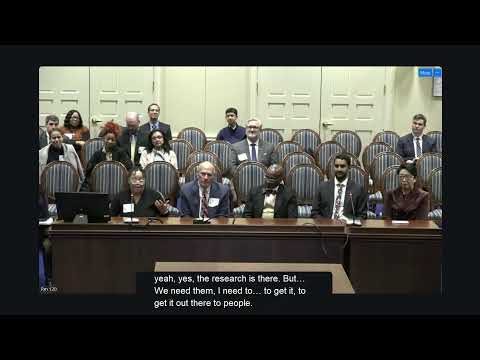
BCCC warns formula change would cut services as enrollment rebounds
Loading...
Summary
Baltimore City Community College officials told lawmakers FY27 support is vulnerable to a proposed contingent formula change that could cut funding and undermine scholarships and workforce programs; officials highlighted gains in headcount, the Mayor's Scholars Program funding gap, high vacancy rates, and new grants to support students.
Baltimore City Community College officials presented their FY27 budget outlook and asked the Education and Economic Development Subcommittee to oppose a proposed funding‑formula change that would reduce BCCC’s per‑FTES appropriation relative to four‑year institutions.
David Propert, the Department of Legislative Services analyst, opened the session with a detailed review of BCCC’s fiscal picture: the FY27 adjusted allowance is roughly $86.7 million (a decline of about $8.9 million or 9.3% year‑over‑year driven largely by one‑time PAYGO changes), and the college’s enrollment patterns showed sharp pandemic‑era declines followed by recovery — annual headcount rose from about 9,100 to roughly 10,500 (a 16.5% increase) in the most recent reporting year, though fall 2025 showed a small dip.
Propert and witnesses noted previous FTES counting errors that omitted eligible noncredit FTEs; DLS found earlier reporting used an incomplete FTES count for formula calculations. The briefing described a long period in which BCCC relied on a “hold harmless” funding portion that increased as FTES used in the formula fell, and DLS flagged a contingent change in the Budget Reconciliation and Financing Act that would lower the per‑FTES percentage from 68.5% to 67.5% beginning in FY27, reducing BCCC’s appropriation by an estimated $713,000 in that year.
Deborah McCurdy, BCCC president, urged the committee not to reduce the funding formula for Baltimore City because the college cannot rely on county offsets like other community colleges and because the change would risk workforce development programs, salary increments and promotions, and student supports. McCurdy described capital investments and realignment work, a final‑stage library planning and nursing and wellness center projects, and progress on an ERP system.
BCCC staff detailed recruitment and retention efforts: reorganized recruitment zones, full staffing for admissions, increased dual‑enrollment partnerships with Baltimore City Public Schools, and summer bridge program outreach. On grants and aid, BCCC reported using the Maryland Promise Scholarship to provide roughly $468,000 in free tuition to residents, receiving a $1,000,000 SNAP‑related workforce grant to train benefit recipients, and an ~$88,000 Department of Labor grant to expand adult basic education and English‑language services.
Public witnesses — including union and faculty representatives — urged full statutory funding and warned that frontline wages, a high share of contractual employees, and staffing instability harm students. Nina Kaniewski (ASME Local 1870), Angelique Cook Hayes (United Academics), and Todd Reynolds (AFT Maryland) all urged restoring or maintaining the 68.5% funding level per FTES and stressed that BCCC lacks local county revenue streams available to many other community colleges.
Why it matters: BCCC serves primarily Baltimore City residents; funding changes that reduce state per‑FTES support could materially affect operations, student scholarships, workforce training and program capacity. Committee members raised options for philanthropic and private‑sector partnerships to support targeted workforce placements.
The committee asked follow‑up questions about vacancy rates, the summer bridge yield, and efforts to secure new funding for the Mayor’s Scholars Program; BCCC representatives said they are pursuing philanthropic partnerships and renewed discussions with Baltimore City to restore or replace lost local support.