Morgan State presents FY27 budget, outlines medical‑school plan and retention efforts
Loading...
Summary
Morgan State officials told the Education and Economic Development Subcommittee that the university’s FY27 budget rises about 6.3% to roughly $559 million, enrollment is growing but first‑time and transfer counts dipped slightly, retention is above 70%, and an 18‑month planning effort for a public medical school is underway with possible entry in 2030–31.
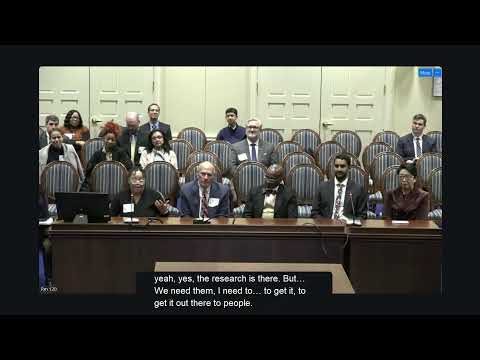
Morgan State University officials appeared before the Education and Economic Development Subcommittee to defend the university’s fiscal 2027 allowance, describe enrollment and retention trends, and outline plans to create a public medical school.
Micah Richards, budget analyst with the Department of Legislative Services, told the panel that the proposed FY27 budget increases about 6.3% to roughly $559,000,000 and highlighted both recent enrollment gains and small declines in select cohorts. Richards noted a 1.9% decline in first‑time, full‑time students and a 0.6% decline in transfer students from FY24 to FY25 and asked university leaders to explain those changes and detail retention and graduation efforts.
President Wilson said Morgan has grown rapidly — citing roughly 11,600 students this past fall and projecting the number to surpass 12,000 — and described the drops in first‑time and transfer counts as small in absolute terms. “This is not at all a concern,” Dr. Cara Turner, senior vice president for enrollment management and student success, told the committee, explaining the freshman decline was about 44 students and the transfer decline about two students. Turner also said institutional retention measures differ from the Maryland Higher Education Commission’s public figures because DLS’s external tracker uses Social Security numbers; institutional tracking relies on unique internal identifiers and shows retention above 70%, with fall 2025 at about 74.5%.
University leaders described concrete steps to support persistence and completion: redesigning academic advising, increasing advising staff and training, revamping summer orientation and first‑year courses, expanding peer mentoring, piloting chatbot supports through a Georgia State partnership, and pursuing grant funding for retention work.
On research funding, President Wilson reported a notable drop in awarded research dollars year‑to‑date: Morgan recorded $104,000,000 in research awards in FY2025 but was down to roughly $38,000,000 midway through the next year and expected to finish the year nearer $60–65,000,000 — a decline he described as about 40% from the prior year. Wilson thanked the governor for including a one‑time $8.5 million allocation in the proposed budget to help recover climate‑related research activity.
Wilson and the university’s CFO also described a conservative approach to budgeting that uses the prior year’s actuals to estimate revenues and expenditures and adjusts via amendments as enrollment data finalize. The university reported vacancies (about 196 positions noted in the DLS analysis) and said recruitment and hiring timelines — particularly for faculty and specialized trade positions — can extend nine to 12 months.
On a long‑term initiative, Wilson said Morgan has ended a proposed for‑profit partnership for a medical school and is pursuing a nonprofit public medical school model to keep tuition lower than private alternatives. The university received a $1.75 million Robert Wood Johnson Foundation grant to support an 18‑month planning process; a roughly 20‑member planning committee and two national advisors are in place, and Morgan is targeting the first entering medical class around 2030 or 2031 if the planning and approvals proceed.
Why it matters: Morgan is positioning itself for growth as a research institution while stressing that short‑term cohort fluctuations do not reflect systemic decline. The medical‑school plan — if realized — would be a significant expansion of public HBCU offerings in Maryland and would carry implications for workforce and health‑care access.
The committee concluded Morgan’s discussion after members urged the university to include city planning staff in East North Avenue redevelopment efforts and encouraged stronger community ties for the Lake Clifton site redevelopment. President Wilson said a consultant is working on the 59‑acre Lake Clifton planning and that the project will be integrated with broader East North Avenue plans.
The subcommittee did not take any votes on the university’s budget during the hearing; staff requested follow‑up information on retention metrics, vacancy fill plans, research award recovery strategies, and the medical‑school planning timeline.