Lauderhill outlines $65 million general obligation bond; officials say debt millage won’t rise
Loading...
Summary
Lauderhill officials presented a $65 million general obligation bond—$34M for parks, $21.5M for transportation and $9.5M for public safety—explaining financing tactics (phased drawdowns, interest income, level debt) they say will keep the debt-service millage steady. The measure goes to voters on March 10.
Lauderhill officials on the town-hall stage detailed a proposed $65,000,000 general obligation (GO) bond to fund parks, transportation and public safety projects and said they plan to hold the debt-service millage rate steady if the referendum passes on March 10.
Deputy City Manager and Finance Director Sean Henderson described the city’s approach to limit tax impacts: structure level debt, draw down the approved $65 million in phases (an initial $30–$35 million draw), and use interest earnings on borrowed funds to moderate debt-service payments. "We're making sure that we structure the debt in such a way where we're not going to raise the millage rate associated with the general obligation bond going forward," Henderson said during the presentation.
The package is split into three independent ballot questions: $9.5 million for public safety projects, $34 million for park improvements and $21.5 million for transportation and roadway projects. Staff and the meeting moderator emphasized voters can support any combination of the three questions on the March 10 ballot.
Officials offered concrete homeowner examples to illustrate projected impacts. Using an 8% property-value increase in a conservative scenario, Henderson presented sample annual debt-service payments rising from about $60.84 to $65.64 for one example property; staff repeatedly noted homestead assessment caps (3% annual increase for homesteaded properties) and said operating-millage reductions planned by the commission would offset much of the debt-side change for long-term residents.
City staff also described contingency planning if state legislation reduces or replaces property-tax revenue. The City Manager and finance staff said the city derives roughly 30% of its general-fund revenue from property taxes and therefore has diversified revenue streams, and they pointed to past experience with rollback-rate adjustments as evidence the city could adapt over time.
Officials stressed timing and implementation controls: they said the commission has approved a reimbursement resolution so some project spending and design can begin immediately if voters approve the bond, and stated that federal tax rules require 85% of bond-funded project expenditures to be completed within three to five years.
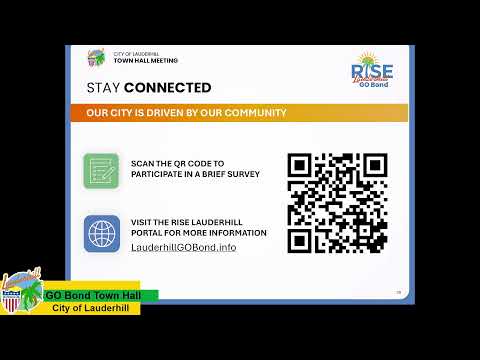
Next steps: the city will present final materials at upcoming meetings, continue community outreach, and the ballot questions will appear to registered Lauderhill voters on March 10. Staff urged residents to request mail ballots or vote in person and provided a QR code and website for polling-place and ballot-request information.
Ending: If the referendum fails, staff said projects would continue more slowly through pay-as-you-go or smaller revenue‑bond issues; if it passes, officials plan to begin construction and design work promptly and use staged drawdowns and interest earnings to try to limit immediate tax impacts.