Get Full Government Meeting Transcripts, Videos, & Alerts Forever!
Get email alerts on the Elections Reconciliation topic
No spam. Unsubscribe anytime.
Registrar defends reconciliation method; advocates present independent audit claiming larger discrepancy
Summary
The Registrar of Voters told supervisors the November special election showed a 103‑ballot variance using the county’s reconciled 'good ballot' method, while independent auditors presented paper‑based tallies alleging a much larger discrepancy; the board asked ROV and auditors to meet for detailed reconciliation.
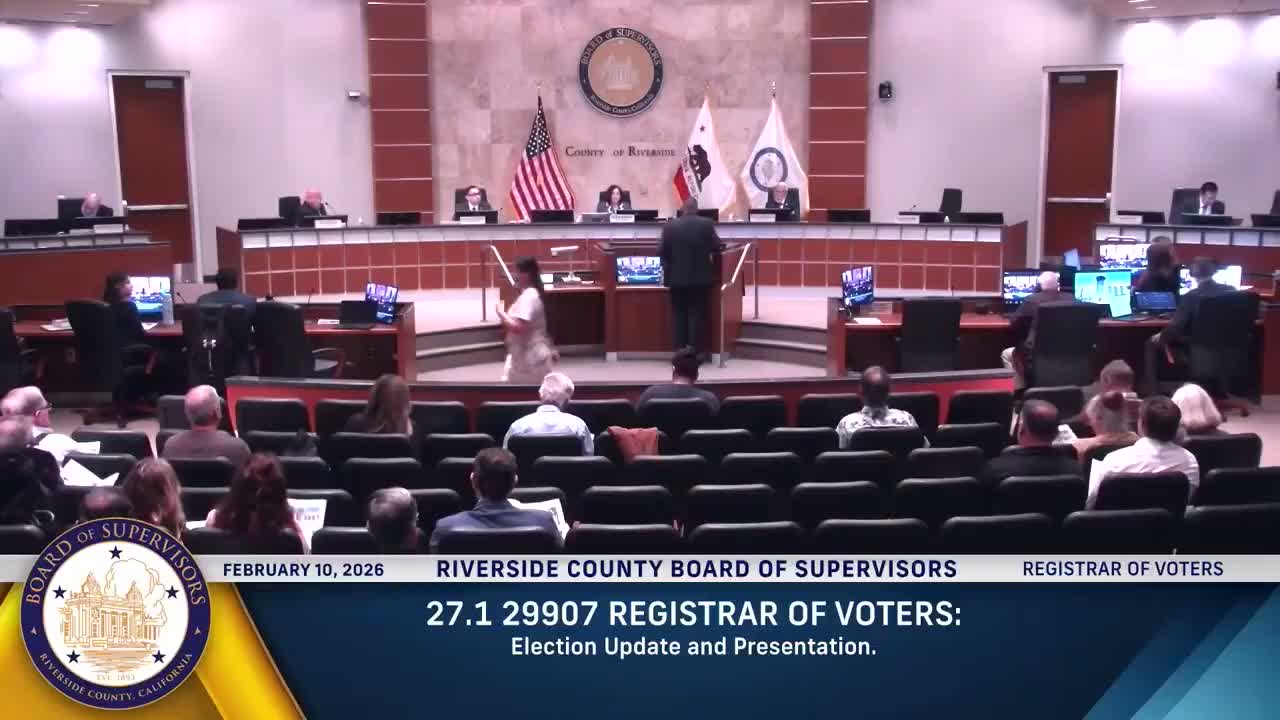
Riverside County’s Registrar of Voters briefed the Board of Supervisors on the office’s methodology for reconciling ballots and tabulation ahead of the June election, drawing a sharp public response from independent auditors and election‑integrity advocates.
Registrar staff described a two‑system reconciliation process: the Election Information Management System (EIMS) tracks envelopes and records ballots that have been signature‑verified as "good;" the Liberty Vote system (the county’s tabulation/scanning system) then scans and tabulates the physical ballots. Using that approach, the Registrar said, the November statewide special election had a variance of 103 ballots between ballots cast and ballots counted — well within normal reconciliation expectations — and far smaller than the much larger variance some auditors reported when they compared raw intake logs to tabulation totals.
Auditors and citizen groups described a separate, paper‑first process audit of vote‑center ballot statements, daily mail intake logs and drop‑box collection forms. Those advocates told the board their independent tally of field paperwork (after removing rejected/cured ballots) showed a substantially larger shortfall — tens of thousands in two recent elections — between physical envelopes received and final tabulated ballots, and asked the board to mandate a full manual count or expanded reconciliation procedures. "The proof is in the paper," one advocate said, urging supervisors to require a full manual recount of the paper trail.
Registrar staff and technical staff responded that the paper field forms are preliminary 'raw' counts created in fast‑moving conditions, and that many envelopes counted in field tallies are later found to be ineligible, cured, provisional or confidential; those processes (signature verification, curing, provisional handling, confidential ballots) are the reason audited raw counts differ from the ‘good ballots’ used for reconciliation. The ROV team described improvements including daily intake logs, scanning workflows, a 1% manual audit requirement, logic and accuracy testing, and an ASV (automatic signature verification) pilot with a confidence threshold for machine matches (staff said they will implement ASV more broadly for the next statewide election).
Supervisors and the registrar agreed to joint follow‑up: the board asked the registrar’s office to meet with advocates and independent auditors to reconcile differences between methodologies, to produce clearer documentation on cured/rejected ballot categories, and to return to the board with findings and recommendations. The board emphasized that resolving the disagreement is central to public confidence heading into the June election.
Next steps include scheduled working sessions between the ROV and auditing groups and a series of technical and procedural reviews the registrar committed to complete before the next election.