Get Full Government Meeting Transcripts, Videos, & Alerts Forever!
Get email alerts on the Short Term Rentals topic
No spam. Unsubscribe anytime.
Riverside County pauses vote on STR ordinance after heated public hearing and orders more enforcement work
Summary
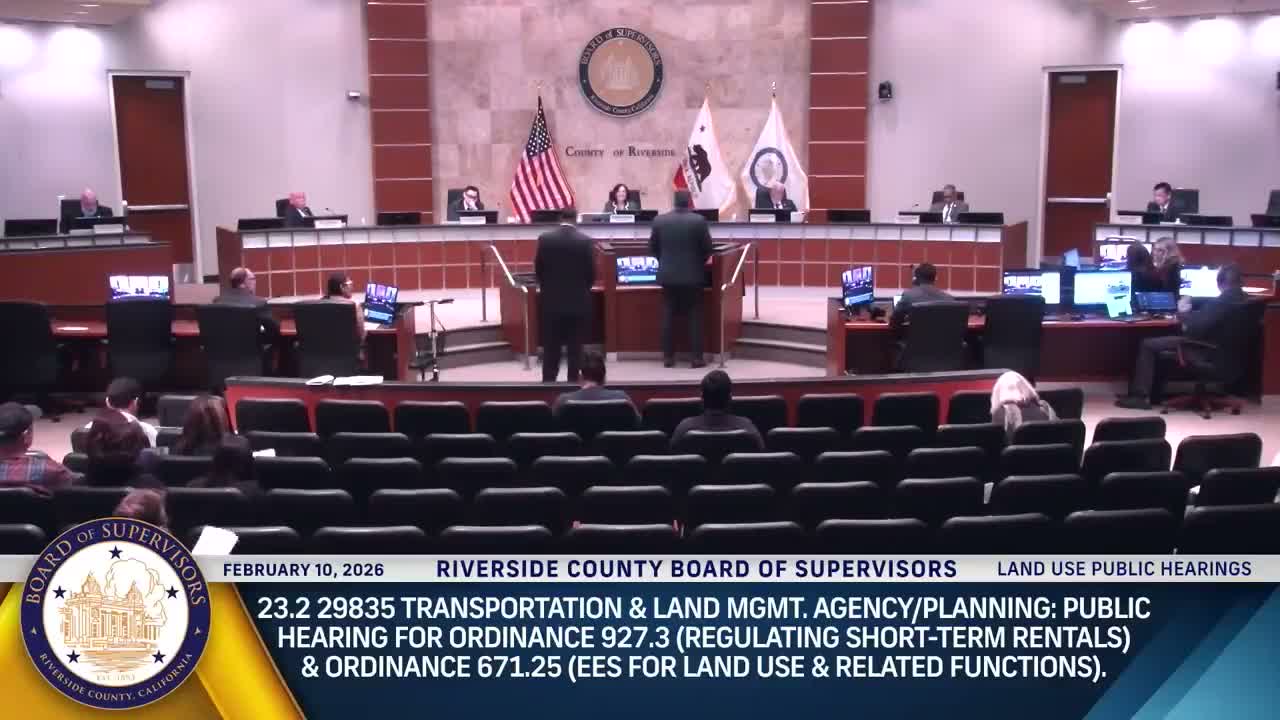
After hours of public testimony from residents and short‑term rental operators, Riverside County supervisors continued consideration of proposed short‑term rental rule changes and agreed to return the item for more detailed enforcement planning; staff will meet with district offices and examine overnight enforcement, response times and moratorium timing.
Riverside County supervisors declined to finalize changes to the county’s short‑term rental ordinance on Feb. 28, citing unresolved questions about enforcement capacity and the ordinance’s consequences for small owner‑operators.
The Transportation and Land Management Agency and Code Enforcement staff presented proposed amendments intended to strengthen enforcement where short‑term rentals (STRs) are harming neighborhoods. Staff described several major changes: replacing the current "verified notice" threshold with a broader "notice" category to speed enforcement, screening new applicants who have three notices in six months (or five total), shortening the owner/manager response time to 30 minutes for after‑hours complaints, and allowing immediate suspension or revocation in urgent circumstances such as threats to public safety.
The changes would also shorten renewal grace periods, require capped‑area STRs to host at least four rentals per year, and update application fees to reflect current deposit‑based fee rates.
During a multi‑hour public hearing, dozens of residents and STR owners in Wine Country, Thousand Palms, Idyllwild and other unincorporated areas told the board the proposal did not yet strike the right balance. Owner‑operators told supervisors that a 30‑minute response requirement and the removal of the word "verified" could unfairly expose small, hosted operators to strikes and permit suspensions for complaints that are not substantiated. "Three unverified complaints potentially from one hostile neighbor can revoke my permit," said a Wine Country owner who asked the board to preserve protections for small host‑operators and to allow more time or exemptions for extenuating circumstances.
Residents and neighborhood advocates said the ordinance remains toothless without reliable on‑the‑ground enforcement. Several speakers described repeated late‑night disturbances, property damage and slow code responses. "Enforcement must physically verify these complaints in order to issue citations," one Wine Country resident said, urging more after‑hours availability of code staff or coordinated sheriff response.
Supervisors asked staff to work directly with the districts most affected, to clarify distinctions for hosted versus unhosted STRs, and to examine whether a 30‑minute response requirement should be extended (some supervisors suggested an hour or an explicit clause for extenuating circumstances such as wildfires or snowstorms). The board also directed staff to explore options for expanding late‑night enforcement coverage and improving coordination with the sheriff’s department.
Rather than adopt the ordinance, the board voted to continue the item off calendar and to return with further work and recommendations. Staff also will bring back a separate moratorium extension item for the board to consider at a subsequent meeting to ensure no lapse in local controls while the amendments and enforcement plans are refined.
The board’s action leaves the existing temporary moratoria and enforcement arrangements in place while staff and the executive office pursue a deeper review and additional community outreach. The board emphasized the need for stronger enforcement protocols and clearer protections for small hosted operators as the next steps.