Get Full Government Meeting Transcripts, Videos, & Alerts Forever!
Get email alerts on the Land Use Mead Valley topic
No spam. Unsubscribe anytime.
Residents oppose rezoning of Mead Valley acres as supervisors initiate foundation general‑plan change
Summary
The Board considered a request to initiate a foundation general plan amendment to reclassify roughly 100 acres in Mead Valley from very low‑density residential to light industrial, drawing large public turnout and sustained opposition over air quality, truck traffic and loss of housing.
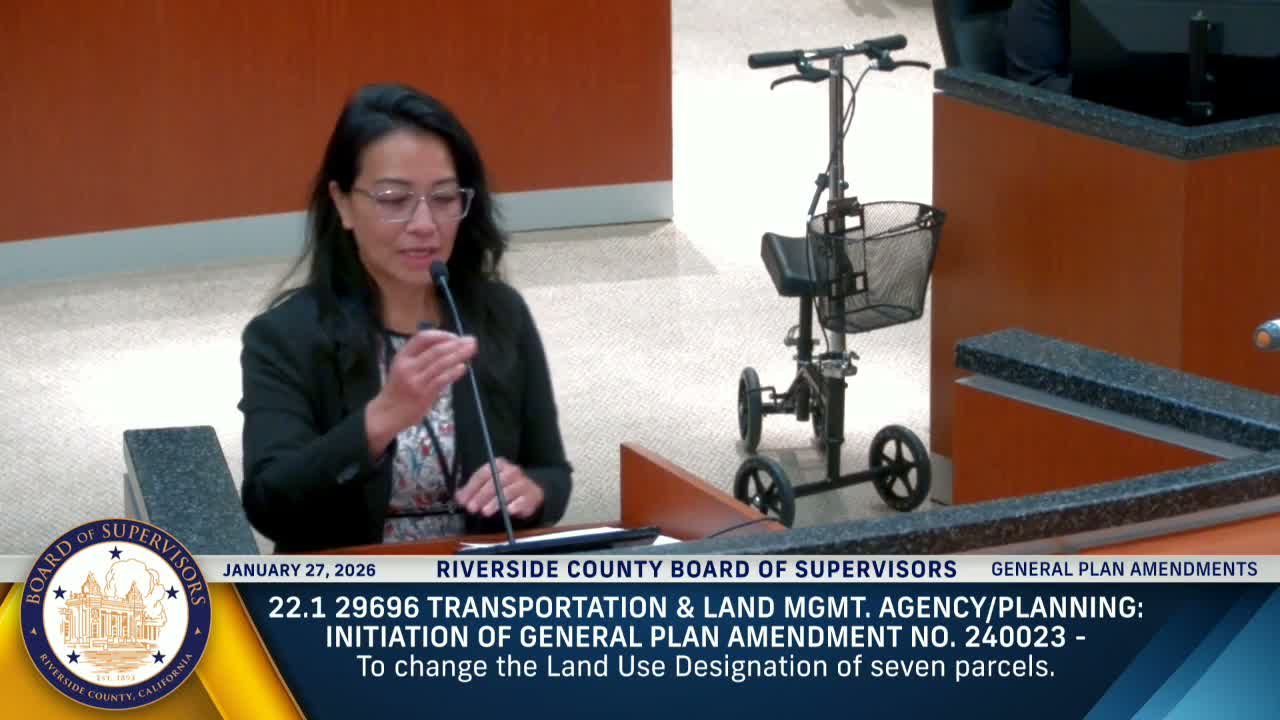
Riverside County supervisors on Jan. 21 voted to initiate a foundation general plan amendment that would allow consideration of changing roughly 100–103 acres in Mead Valley from "rural community, very low‑density residential" to "community development light industrial," prompting extensive public opposition.
Staff presented the proposal as a foundational change that would allow the applicant to submit a subsequent industrial project application; Selena Kelleher (EPD Solutions) representing Lansing Companies said outreach showed a portion of local respondents preferred redevelopment if it generated revenue for the community and cited fiscal‑impact analyses projecting higher recurring property tax revenue under industrial build‑out than under residential. Kelleher said potential benefits include road improvements, landscaping to replace informal dumping sites and job creation, estimating ~500 construction jobs and ~1,000 permanent jobs.
Public comment was heavily tilted toward opposition. Residents and community groups raised these points: the proposal would place industrial uses adjacent to homes and three schools (Mead Valley Elementary, Manuel Rio Elementary and Tomas Rivera Middle School); Mead Valley already has a high concentration of warehouse acreage per resident; rezoning residential land for industrial use could exacerbate housing shortages; and air‑pollution and truck traffic impacts would harm health and quality of life. Speakers repeatedly criticized the survey evidence (a cited 9% response rate and a 56% favorable fraction of that small sample) and noted over 100 written letters of opposition submitted to staff. "We do not need more warehouses. We need more housing," one public commenter said.
Board members acknowledged the project was a "foundation" change rather than a development approval; Supervisor Medina (chairing portions of the hearing) and staff explained community planning workshops are scheduled (kickoff noted for Feb. 25) and that further details on community benefits would be addressed when a project application is filed. The Board recorded a 4‑0‑1 vote to initiate the foundation change (the transcript records "That passes 4 0 1"). Staff and the applicant said additional community engagement and technical studies would follow if the initiative proceeds.
Supporters who spoke — including labor representatives and some local residents — argued the project would bring local jobs, traffic signal investments and funding for public services. Opponents urged the Board to pause foundation amendments until the Mead Valley community plan is completed and asked the county to consider warehouse moratoria and stronger truck‑route and air‑quality protections.
The transcript records initiation of the foundation‑component general plan amendment; further project details (specific development proposals, mitigations and any final planning commission or board votes on an implementing project) would come at later hearings.