Get Full Government Meeting Transcripts, Videos, & Alerts Forever!
Get email alerts on the Housing Needs topic
No spam. Unsubscribe anytime.
Regional housing study: Mono County’s unincorporated areas show 699 unmet housing needs; studios and one‑bedrooms in highest demand
Summary
A regional housing needs assessment presented to the Mono County Board of Supervisors estimated roughly 699 households in unincorporated Mono County have unmet housing needs (2025 estimate), with the largest affordability gaps for households at 0–80% AMI and strong demand for studios and one‑bedroom units.
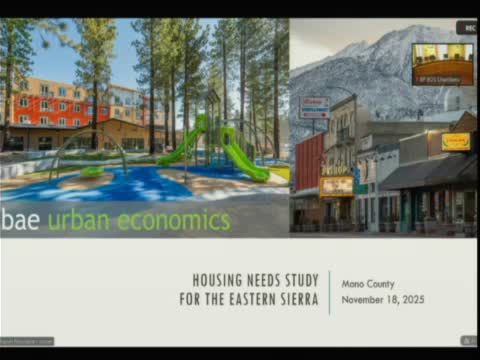
Consultants from BAE Urban Economics presented the first-phase results of a regional housing needs assessment to the Mono County Board of Supervisors on Nov. 20, 2025. The study — conducted for a coalition including Mono and Inyo Counties, the Town of Mammoth Lakes and other partners — produced a point‑in‑time estimate of unmet housing need and summarized household and labor-market characteristics across the Eastern Sierra.
Key findings presented by Aaron Hussain (BAE): - Regional trends: The two‑county region has lost population and households over the last decade, with Mono County showing an exacerbated recent decline relative to Inyo County. - Workforce dependence: The region is highly dependent on a resident workforce. Census commute data and local survey work indicate approximately 7,200 jobs located in Mono County, roughly 87% of which are filled by residents living in the county or nearby. - Vacancy and seasonal stock: Mono County’s overall housing vacancy rate is high and heavily driven by seasonal/second‑home inventory; Mammoth Lakes and June Lake show especially elevated seasonal vacancy rates (Mammoth ~60% seasonal vacancy in presentation graphics; unincorporated Mono ~50%). - Cost and affordability gap: Market-rate rentals and for‑sale prices are substantially higher than area incomes; BAE adjusted income thresholds to suggest market‑rate rents in unincorporated Mono typically require about 120% of AMI while median sale prices in Mammoth reach far higher multiples of AMI. - Estimated need: The regional housing‑needs model estimates roughly 3,200 households across both counties with unmet housing needs; within unincorporated Mono County the study estimated about 699 households with unmet needs as of 2025. About 400 of those are households at or below 80% of area median income, a band likely suitable for tax-credit affordable housing programs. - Unit type demand: The greatest shortfalls are in studio and one‑bedroom units, producing a mismatch with much of the existing housing stock (which skews toward two- and three-bedroom detached homes and condominium units used as second homes).
The consultant also reported resident and employer survey results: nearly 1,000 resident responses across the region, with about one‑third of respondents actively looking for new housing and a third indicating they work more than one job; employer responses (about 200) reported significant seasonal vacancies and indicated more workforce housing would enable growth.
Next steps: BAE will finalize the draft report and circulate it to the collective housing committee for review; the project will move into an action‑planning phase in early 2026 to prioritize and identify implementable solutions at jurisdictional and regional scales. County staff signaled that the action plan will be developed as a separate deliverable and expected in the spring of 2026.
Why it matters: The assessment provides a data-driven baseline (stock, vacancy, affordability and household-size mismatch) the county can use for grant applications (including CDBG discussed at the same meeting), project prioritization, and programs focused on workforce and affordable housing units that fit household size and income demand.