Get AI Briefings, Transcripts & Alerts on Local & National Government Meetings — Forever.
New Department of Social and Economic Mobility outlines priorities and explains CRF allocation formula
Loading...
Summary
Acting Secretary Walter Simmons told the subcommittee DOSM’s fiscal 2027 budget supports three consolidated offices and record minority-business payments; the department explained the Community Reinvestment and Repair Fund (CRF) formula used a 2010–2022 average of cannabis possession charges and targeted jurisdictions at 150% of the state average.
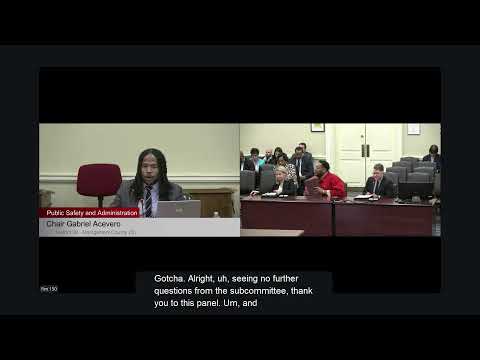
The newly formed Department of Social and Economic Mobility (DOSM) defended its fiscal 2027 request before the Public Safety and Administration Subcommittee on Jan. 30 and outlined how the department will allocate community reinvestment dollars targeted to jurisdictions disproportionately impacted by cannabis enforcement.
Natalie Andrade of the Department of Legislative Services told the committee the fiscal 2027 allowance is $20.8 million, driven largely by personnel and operational realignment after DOSM consolidated the Office of Small Minority and Women Business Affairs (OSBA), the Office of Social Equity (OSE) and the Office of Minority Business Enterprise (OMBE).
Acting Secretary Walter Simmons said the agency’s priorities are building organizational and operational infrastructure, establishing performance indicators and regional engagement. He highlighted DOSM’s claim that MBEs were paid $2.2 billion in FY25 — the agency’s highest level — and that the small business reserve attainment reached 15% in FY25, with an anticipated statutory increase to 20%.
On the Community Reinvestment and Repair Fund (CRF), Vice Chair Ivy asked for the allocation method. DOSM’s executive director of the Office of Social Equity said the department used a 2010–2022 average of cannabis possession charges, identified jurisdictions with levels at least 150% of the state average, and allocated funds accordingly; Baltimore City, Baltimore County and Prince George’s County were among the top recipients under that formula.
DLS also raised implementation questions: the social equity partnership program (SEP) had the statutory authorization for $5 million annually beginning in FY25 but recorded no expenditures in FY25, and DLS asked DOSM to explain anticipated launch timelines and whether it expects to expend the full $5 million. The department said it had finalized regulations, developed an application portal, and delayed formal program launch pending stakeholder feedback, and it will report back with a timeline.
What comes next: DLS asked for updates on position fills, SEP/CRF implementation timelines and county-level CRF expenditures; DOSM agreed to provide the requested details to the committee record.