Get Full Government Meeting Transcripts, Videos, & Alerts Forever!
Get email alerts on the Parole Budget topic
No spam. Unsubscribe anytime.
Parole board budget fails to advance after heated committee questions over parole rates and role
Summary
The Senate State and Local Government Committee declined to advance the Board of Parole budget after extended questioning about rising parole grant rates, the board’s role versus judicial sentencing and whether statutory presumptive parole changes explain the increase. The board reported 12,820 hearings and a 25.6% grant rate for the year.
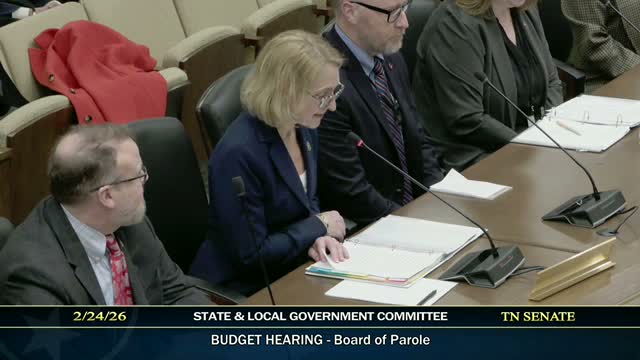
The Senate State and Local Government Committee left the Tennessee Board of Parole’s budget in committee on Feb. 24 after an extended session in which members pressed the board on rising parole grant rates and its decision-making standards.
Roberta Kustoff, identified to the committee as a parole board representative, told senators the board conducted 12,820 hearings in the past fiscal year and reported a 25.6% grant rate for that year. “We have conducted 12,820 hearings,” Kustoff said when summarizing the board’s workload and victim‑services efforts.
Several senators said the grant rate marked a sharp rise from the single‑digit rates they recalled in earlier years and asked whether statutory changes requiring presumptive parole for certain inmates explain the bump. Senator Roberts pressed the board on whether presumptive parole statutes are driving the increase and questioned the board’s practical role in light of those statutory mandates.
Kustoff (and board staff present) acknowledged the board’s grant rates have increased in recent years and said the agency would follow up with more detailed, segmented data. Kustoff told the committee the board could compile how much of the current grant rate stems from statutorily required presumptive parole versus discretionary grants.
The committee’s oral exchanges turned at times to the purpose of parole. Senator Roberts argued the parole board’s mindset should be to release people who have completed required programming unless a clear reason not to do so exists; he said he had been “appalled” by a hearing he observed in which an otherwise compliant person was denied parole. Other senators emphasized the board’s responsibility to protect public safety, not only the interests of incarcerated individuals.
Board staff described the factors that inform individual parole decisions, including programming completion, disciplinary records, time served, support in the community and victim and opposition statements. “We look at the programming they did. We look at the disciplinary record, the length of time served, and how they’ve conducted themselves,” a board representative said.
When the clerk called the roll at the conclusion of the presentation and questioning, the committee recorded four ayes and three passes, and the chair announced the budget did not pass and would remain in committee for further consideration.
Next steps: Board staff offered to supply the committee with more granular data separating statutorily required releases from discretionary grants and to follow up on specific hearing records referenced by members. The committee did not adopt the board’s budget at this meeting.