
Senate panel backs bill to create statewide authority for subterranean transit permitting
Get AI-powered insights, summaries, and transcripts
Subscribe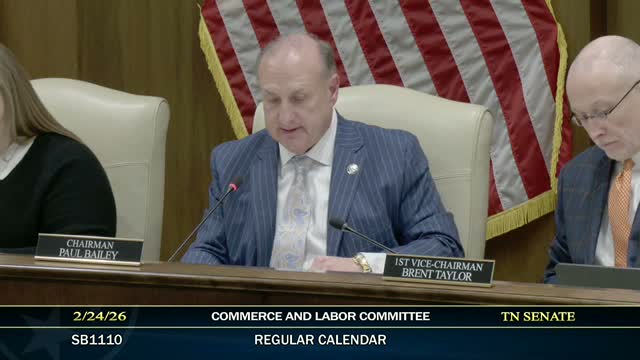
Summary
The Senate Commerce and Labor Committee approved an amendment creating a Subterranean Transportation Infrastructure Coordination Authority to centralize permitting and inspections for underground transit projects on state land, raising local‑input and appeal‑standing questions before the measure was sent to the Transportation Committee.
NASHVILLE — The Senate Commerce and Labor Committee on Wednesday approved an amendment to a bill that would create a statewide authority to coordinate permitting, inspections and judicial review for subterranean transportation infrastructure on state property.
Leader Johnson, who explained the amendment, said the measure would establish a Subterranean Transportation Infrastructure Coordination Authority governed by an 11‑member board appointed by the governor and legislative leaders and including key cabinet officials. "As amended, this bill would establish a clear uniform statewide compliance framework for subterranean transportation infrastructure," he said.
The authority would consolidate permitting and inspections for fully underground portions of qualifying projects on state‑owned property, standardize engineering and life‑safety standards and provide a three‑judge panel for consistent judicial review of civil actions, according to the sponsor's presentation. Leader Johnson emphasized that nothing in the bill authorizes construction beneath locally owned or privately owned property without the locality's or property owner's consent.
Several senators pressed the sponsor about local involvement and appeal standing. Leader Akbari asked whether the authority must include a local official; Leader Johnson said "there's no requirement that 1 be included," but noted the board composition gives the speaker and governor appointment discretion, meaning local representation could be included. On whether local governments could challenge authority permits, Leader Johnson said surface‑level construction would remain subject to local permitting while subterranean permitting beneath state property would be at the authority's discretion; appeals would be handled through the three‑judge panel and civil litigation pathways.
Leader Johnson framed the measure as a response to overlapping codes and permitting standards that can cause delay and uncertainty for multi‑jurisdictional underground projects. "This framework will not only provide certainty to private partners ... those rural communities that do not have their own codes or extensive permitting ... would not be left out of the benefits of this innovation," he said.
The committee adopted the amendment and moved the bill to the Transportation Committee. No final passage or regulatory text was presented in committee; the measure now goes to the next committee for further review.
What's next: SB2205 was sent to the Transportation Committee for additional consideration.