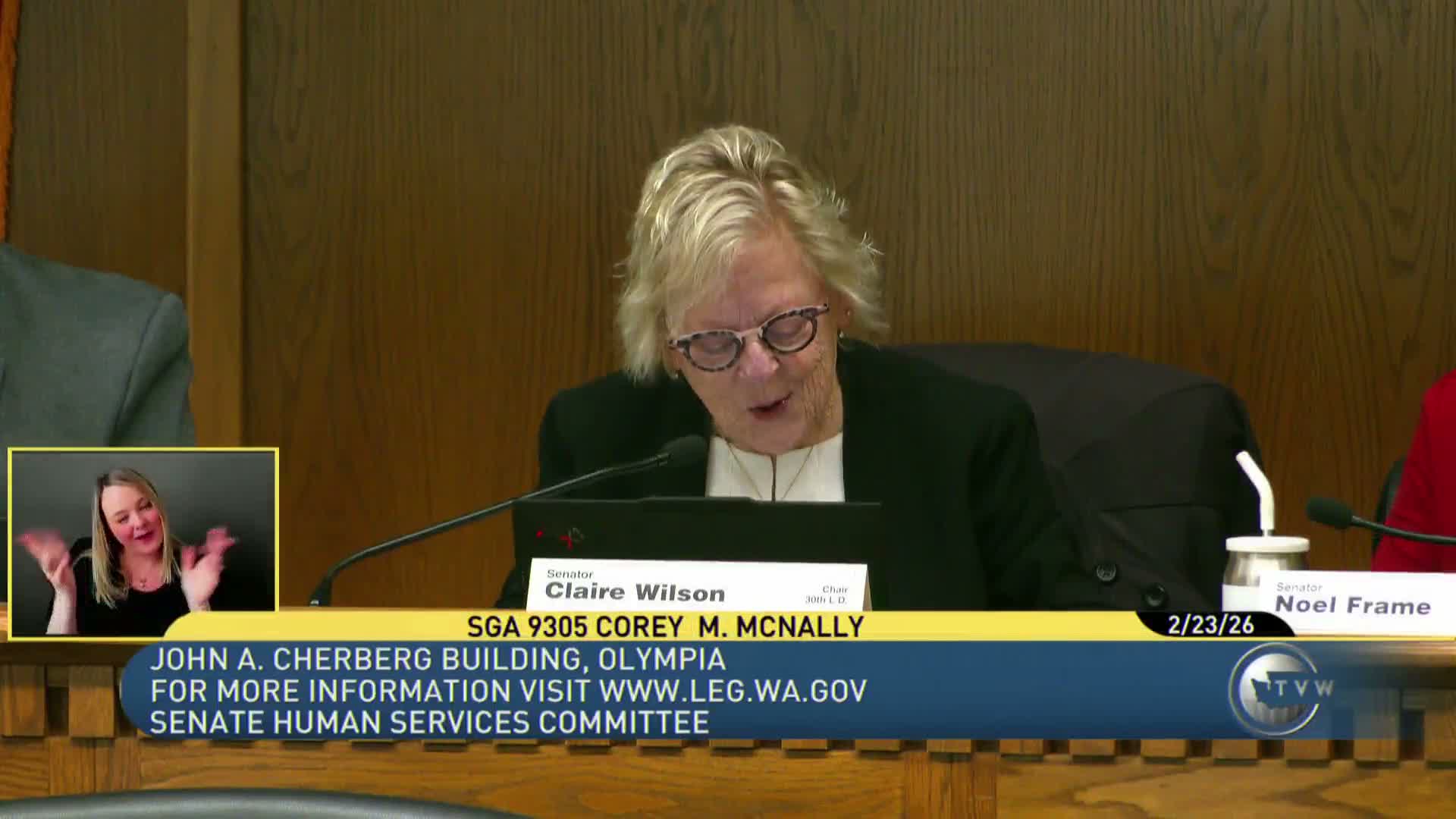
Senate committee hears confirmation for Corey McNally to the Indeterminate Sentence Review Board
Loading...
Summary
Corey McNally described the ISRB's role making release decisions, setting supervision conditions and approving release plans; senators questioned the board's standards, recidivism tracking and victims' participation process. McNally emphasized evidence‑based assessments and the board's neutrality on pending legislation.
The Senate Human Services Committee held a gubernatorial appointment hearing on Feb. 23 for Corey McNally to continue serving on the Indeterminate Sentence Review Board (ISRB).
Corey McNally (appointed originally by Gov. Inslee in August 2024 and reappointed by Gov. Ferguson for a five‑year term) described the ISRB's statutory functions: making release decisions for individuals under its jurisdiction, setting conditions of supervision, managing oversight of violations and approving release plans. McNally outlined a professional background in community mental health, the Special Commitment Center on McNeil Island and the Department of Corrections treatment and assessment programs.
Senators asked about the ISRB's relationship to civil commitment under RCW 7.109 and to sexually violent predator (SVP) proceedings. McNally said the ISRB operates under a different standard and statutory framework: release decisions under the ISRB use a "more likely than not" standard for the likelihood of committing the indexed offense if released, whereas civil commitment under RCW 7.109 uses a stricter criterion and is a separate court process. "So for civil commitment, it is a court process ... Individuals get sentenced under the ISRB just by their crime conviction," he said.
On performance and recidivism, McNally said the ISRB uses a structured decision‑making framework and that recent biannual reports found no racial discrepancy in release decisions; the board is pursuing a recidivism study to measure outcomes. He described victim participation procedures and said victim liaisons contact identified victims to offer written or in‑person testimony options.
Committee members thanked McNally for his expertise and commended the board’s reliance on actuarial risk assessments and evidence in decision‑making. The committee closed the confirmation hearing and subsequently returned to public testimony on the bills on the agenda; no confirmation vote was taken during the meeting.
Next steps: McNally's appointment will proceed through the normal confirmation process; the committee closed the appointment hearing with positive remarks about expertise and collegiality.