Committee hears DCYF licensing bill to align foster care, CRC staffing ratios and electronic attendance requirements
Loading...
Summary
Engrossed Substitute House Bill 2253 would update DCYF licensing statutes: revise crisis residential center staffing ratios (1:4 daytime; 1:6 sleeping), clarify foster‑care probationary license rules, exempt kinship caregivers from certain blood‑borne‑pathogen training, and codify electronic attendance verification for subsidy-funded childcare; committee members raised jurisdiction and duplication concerns.
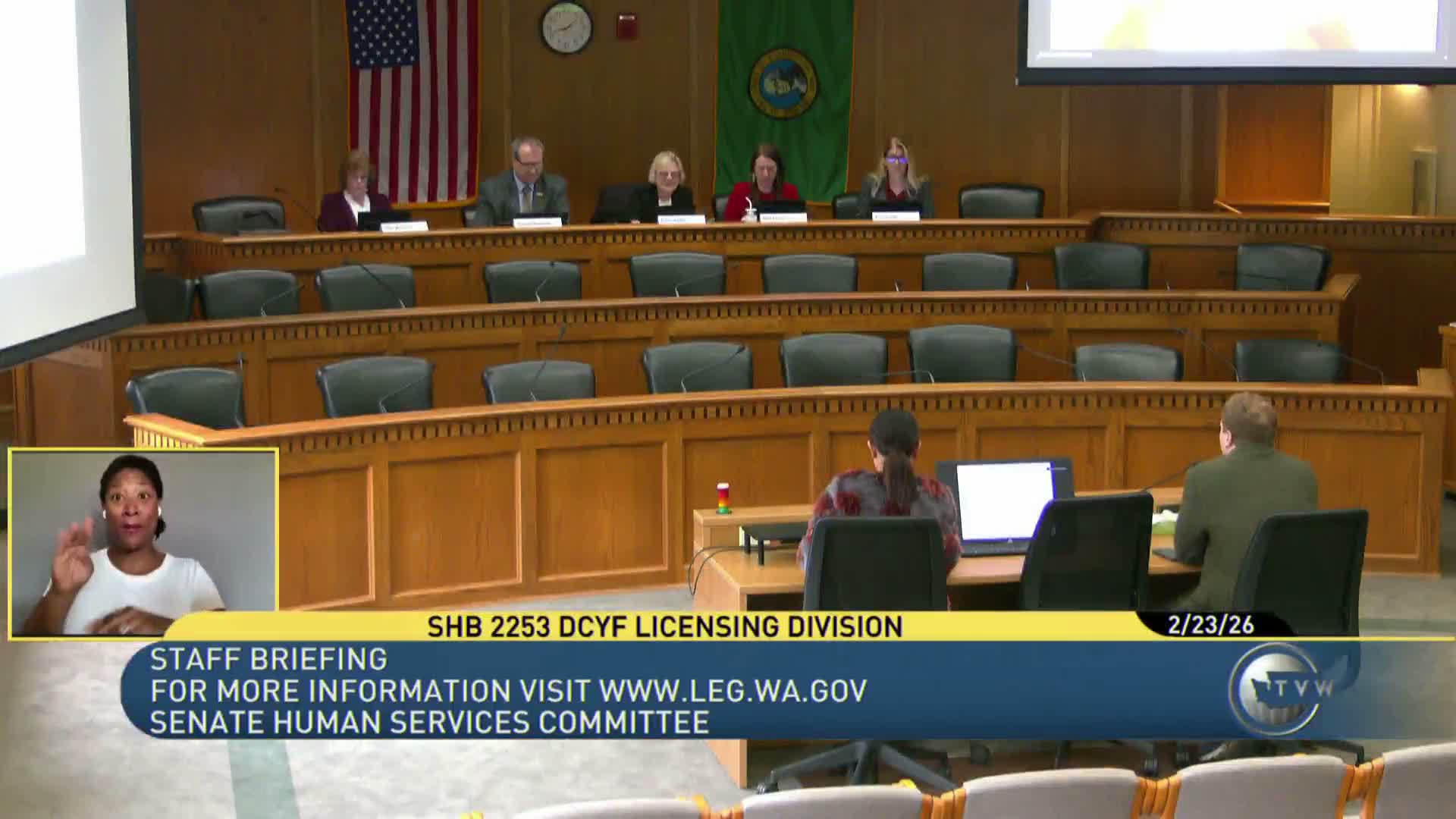
Engrossed Substitute House Bill 2253, presented to the Senate Human Services Committee on Feb. 23, is an agency‑request bill that makes multiple technical and statutory fixes to Department of Children, Youth and Families (DCYF) licensing rules for foster care, crisis residential centers (CRCs) and childcare.
A staff presenter described provisions including immediate termination of child‑specific probationary licenses when high‑potency synthetic opioids or illicit substances are found in a home, a requirement that kinship caregivers not be required to complete blood‑borne‑pathogen training, changes to how inactive foster home licenses are defined and appealed, and a switch from specifying the category of care on a license to more flexible language. The bill also revises CRC staffing ratios to 1 staff to 4 youth during working hours and 1 staff to 6 youth during sleeping hours, aligning statute with long‑standing program practice, and would require childcare subsidy systems to capture daily check‑in and check‑out times verified by a parent’s electronic signature or biometric identifier.
Representative Jared Birnbaum (24th Legislative District), sponsor and floor manager in the House, told the committee the measure began as agency technical corrections and evolved to include House floor amendments on electronic attendance and probationary license language. He said DCYF participated in negotiations to avoid unintended consequences for licensure or childcare services.
Committee members questioned whether childcare licensing language belongs in Human Services (it is often handled in Early Learning/K‑12 committees), whether the bill duplicates existing WACs, and how an "immediate" revocation for subsidy fraud would affect families and access to care; staff said investigations and intermediate steps would vary and that DCYF will provide additional written clarifications. Senator Freme asked if there is any "off ramp" for families when fraud is found; staff indicated that the immediate revocation follows an investigation and that more implementation detail could be provided in follow‑up.
Jarrell Sanders, DCYF licensing lead, said the updates will ease burdens for kinship caregivers and staff and urged support. Derek Harris, CEO of Community Youth Services, described two CRC programs that have operated at the 1:4 daytime and 1:6 overnight ratios for decades and said the change is budget neutral and prevents unnecessary reductions in services.
The committee did not take a vote on the bill at the hearing; members asked DCYF for follow‑up in writing and flagged statutory placement and duplication with existing licensing rules as issues to resolve before executive action.
Next steps: staff will provide requested clarifications in writing; the bill will be considered on the committee’s executive schedule.