Committee Hears Bill to Re‑classify Environmental Violations as Felonies; Sponsors and Labor Disagree on Worker Protections
Loading...
Summary
The House Committee on Environment and Energy heard ESSB 53 60, which would create three tiers of criminal violations for state environmental laws and impose penalties up to class B felony. Sponsors cited repeat polluters; labor and industry warned the bill could expose frontline workers to criminal charges for accidents.
The House Committee on Environment and Energy heard testimony on ESSB 53 60 on Tuesday, a bill that would create three tiers of criminal violations under the Water Pollution Control Act, the Clean Air Act and the Hazardous Waste Management Act with penalties ranging from gross misdemeanor to class B felony.
Sponsor Sen. Yasmin Trudeau (27th Legislative District) said the proposal responds to repeat, large-scale pollution events, citing what she called the “Tacoma Boat Fires” and a case of tire‑crumb dumping into the Puyallup River. “We had criminal polluters who wrote off really big issues as the cost of doing business,” Trudeau said, and argued the measure would give prosecutors tools to match penalties to harm.
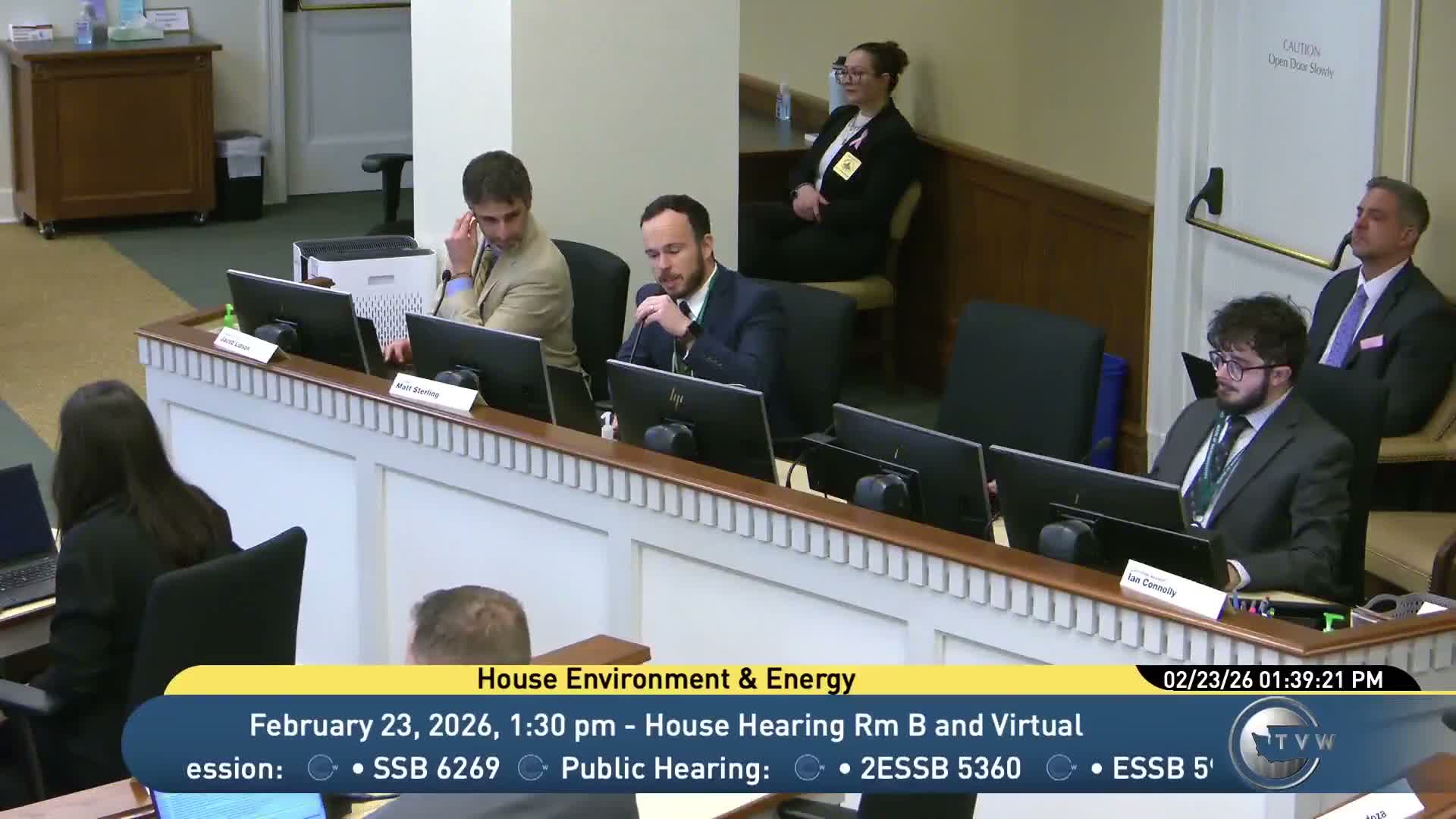
Committee staffer Matt Sterling summarized the bill’s structure: first‑degree violations would be class B felonies where knowing conduct places another person in imminent danger of death or serious bodily harm; second‑degree violations would be class C felonies for knowing conduct that does not create imminent danger; and criminal negligence could be charged at the gross‑misdemeanor level for lesser harms. The bill would also establish affirmative defenses and exemptions — for example, compliance with a permit would not constitute a criminal violation — and direct Ecology and other agencies to provide public guidance.
The Attorney General’s Office (AGO) voiced conditional support while stressing limits on its prosecutorial power. Adam Eitman, legislative director for the AGO, said the office provided a list of roughly 20 environmental prosecutions in the last five years as background and emphasized the seriousness of criminal charges. Bill Sherman, division chief of the AGO’s Environmental Protection Division, told the committee the AGO "does not have original criminal jurisdiction" and "must be granted concurrent jurisdiction from county prosecutors pursuant to RCW 40 three‑ten‑two 32." He added that any prosecution would proceed through the usual judicial safeguards.
Labor unions and industry representatives testified strongly against the bill as currently drafted. Operating Engineers Local 302 and the Washington State Labor Council warned it could expose frontline employees to felony charges for accidents or routine operational errors and called for clearer statutory protections. "Workers cannot rely on the promise of protection," Josh Estes of the Association of Western Pulp and Paperworkers said, urging explicit, durable statutory language that distinguishes intentional wrongdoing from mistakes.
Environmental and community groups, including Communities for a Healthy Bay and Puget Soundkeeper, urged the committee to pass the bill, arguing existing penalties have proven insufficient to deter repeat polluters and protect communities that rely on fisheries and waterfront economies.
The bill also contains a whistleblower provision to protect employees who refuse to participate in unlawful acts or who provide information about violations, and it requires the AGO to file an annual report to the legislature on criminal enforcement actions. No final vote on ESSB 53 60 was taken; the committee closed the hearing after receiving panels of both supportive and opposing testimony and indicated sponsors and stakeholders expect continued negotiations ahead of any committee action.
What happens next: The committee adjourned the ESSB 53 60 hearing with further work anticipated between sponsors, the AGO and affected stakeholders to clarify worker protections and prosecutorial procedures.