Senate briefing: revenue 'basically flat,' mandatory costs and large transfers shape supplemental budget
Loading...
Summary
Staff to the Senate Ways and Means Committee outlined a supplemental operating proposal that counts on transfers and assumed revenue bills while mandatory costs — notably health and liability — drive most of the gap. Committee staff answered brief questions before hundreds of public witnesses began testifying across education, health, human services and natural resources.
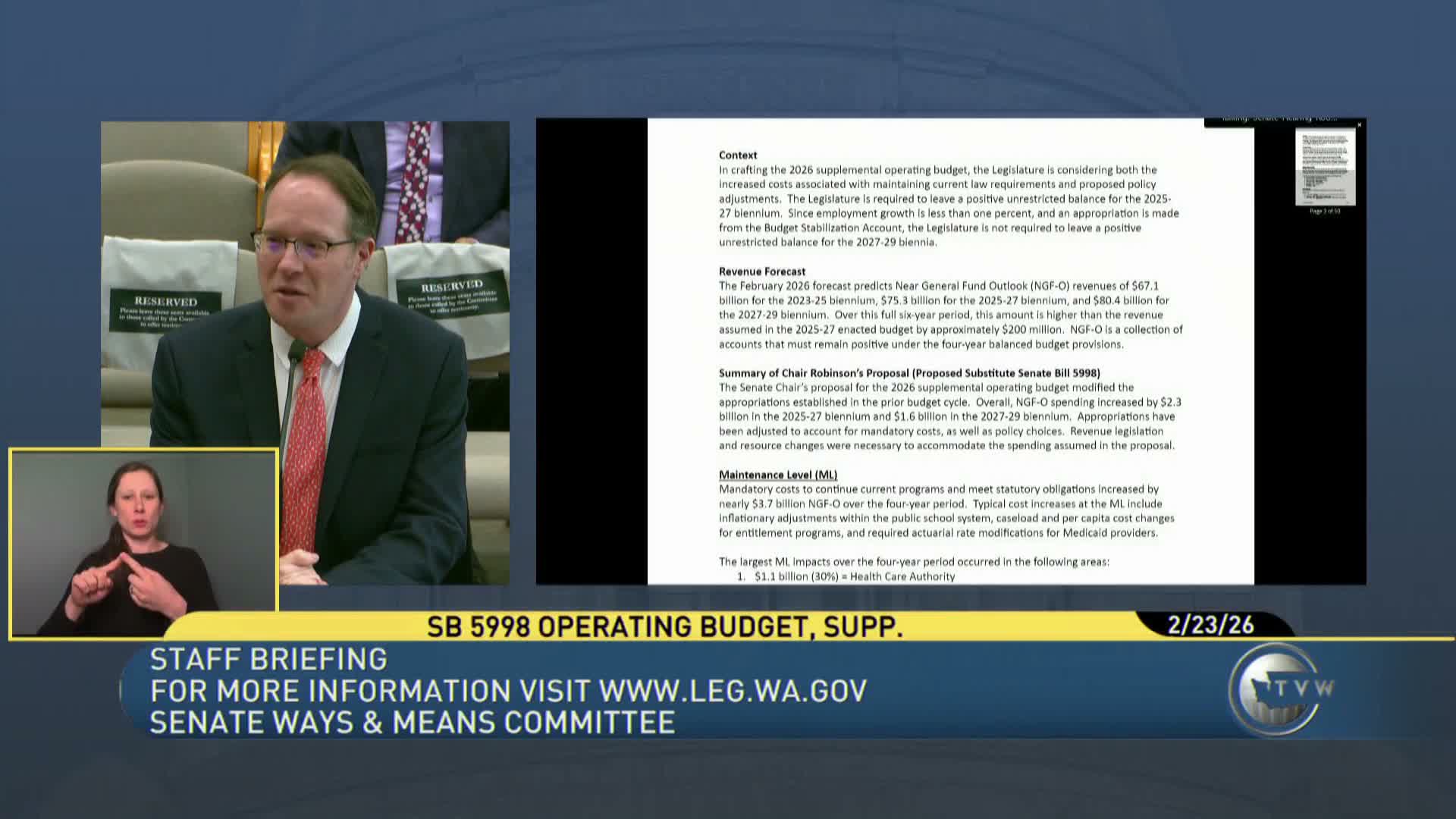
James Kettle, staff to the committee, opened the hearing with a briefing on the chair’s 2026 supplemental operating proposal, emphasizing that ‘revenue is actually basically flat’ after successive forecast revisions despite a February uptick. He told senators the net picture since the enacted budget shows limited new revenue while mandatory maintenance costs have risen sharply.
Kettle said mandatory maintenance items total about $3.7 billion, with the largest single item at roughly $1.1 billion for the Healthcare Authority and about $900 million in managed‑care rate adjustments for the Department of Social and Health Services. At the policy level, Kettle said adds and subtractions largely offset each other — approximately $2.5 billion in adds and $2.4 billion in subtractions — and that the proposal concentrates most policy‑level spending in a short list of large items.
Among the largest policy proposals he highlighted were a $1.0 billion four‑year set of expenditures for the state’s self‑insurance liability account to cover anticipated tort exposure late in the biennium and ongoing amounts to continue long‑term services for some people whose coverage changed under House actions. The briefing also identified assumed revenue bills that underlie the proposal and several transfers: a $750 million draw from the budget stabilization account, a $395 million diversion of certain capital gains distributions to the operating budget and a $375 million transfer from the Public Works Assistance account to the general fund.
Kettle flagged the four‑year near‑general‑fund outlook, which shows the chair’s proposal ending FY29 with roughly $1.0 billion and total reserves of about $3.0 billion (roughly 7.1 percent). He directed committee members to detailed agency recommendation summaries on the electronic bill book and fiscal.wa.gov for line‑level questions.
After the briefing the committee took one technical question and then began an extended public hearing with 180 people signed in to testify, starting with K‑12 education and moving through higher education, early learning, behavioral health, human services and natural resources. The committee closed the hearing with a reminder that amendment requests to Ways and Means staff are due by noon the following day and that the budget was scheduled for committee action Wednesday evening.