Get Full Government Meeting Transcripts, Videos, & Alerts Forever!
Get email alerts on the Renewable Fuels topic
No spam. Unsubscribe anytime.
Committee hears Commerce, WSDOT and Ecology on hydrogen, SAF and programmatic PEIS
Summary
Commerce and WSDOT described hydrogen investments and an upcoming WAZIP voucher program; Earth Finance outlined Cascadia's SAF work; Ecology briefed a programmatic EIS for alternative jet fuel (draft PEIS expected early 2027).
State agencies and private partners briefed the Senate Transportation Committee on Feb. 23 about investments and planning for hydrogen and alternative aviation fuels.
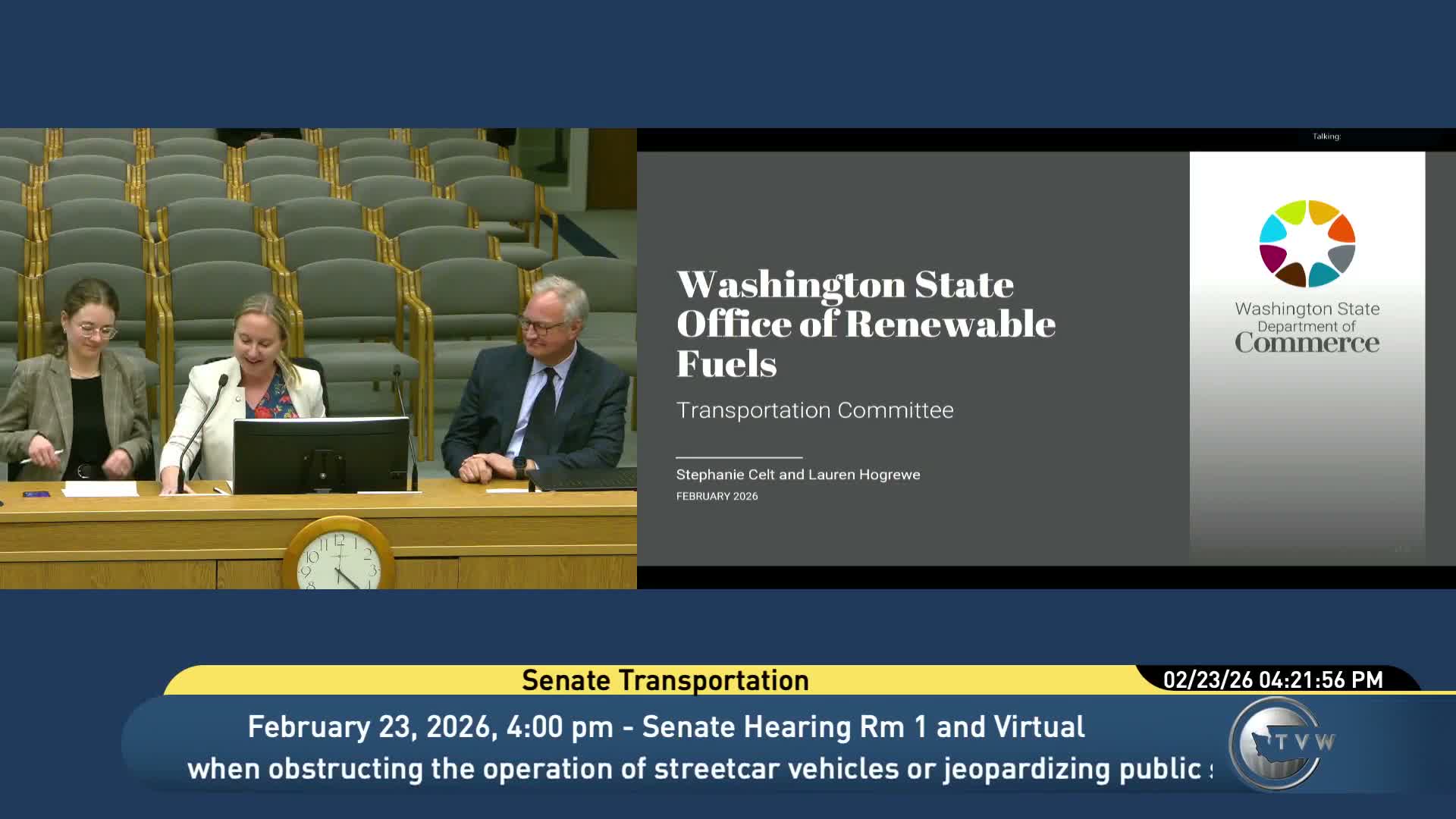
Stephanie Selt, leader of the Office of Renewable Fuels at the Department of Commerce, said the office — established by the legislature in 2022 and expanded in 2023 to include alternative jet fuel — modeled demand that shows renewable hydrogen and derived fuels could account for roughly 27% of Washington's energy demand in some scenarios by 2050. She highlighted tools Commerce is developing for community and tribal engagement, an environmental‑justice toolkit for hydrogen projects, and a $1,000,000 technical assistance program to help strategic hydrogen projects move forward.
Tim Zink of Earth Finance described progress by the Cascadia Sustainable Aviation Fuel (SAF) Accelerator, reporting more than $10 million in philanthropic match to legislative funds and sustained stakeholder engagement. Zink said Cascadia has convened producers, refiners and industry partners, and has founding investments from Amazon, Boeing, Alaska Airlines and Microsoft, among others, to address commercialization and certification challenges for SAF.
WSDOT representatives returned to discuss hydrogen in transportation. Tonia Buell said WSDOT is piloting hydrogen vehicles in its fleet and has directed more than $33 million in funding toward hydrogen transit buses and refueling infrastructure. Buell noted a $1.5 million agreement with Douglas PUD to support hydrogen fueling in East Wenatchee and described work on a West Coast truck corridor project that secured $102 million in discretionary funds for the region, with Washington's portion estimated at $21 million.
Diane Buterak of the Department of Ecology briefed the committee on a programmatic environmental impact statement (PEIS) directed by Senate Bill 5161 (2025). She said the PEIS is a scoping and planning document under the State Environmental Policy Act that will analyze production pathways, blending and distribution for alternative jet fuel, evaluate impacts on air, water, habitat, cultural and tribal resources, and identify mitigation. Scoping concluded in December 2025; Ecology plans a draft PEIS for public review in early 2027 and a final PEIS by June 2027.
Senator Gaynor asked how the required 50% greenhouse‑gas reduction threshold (tied to tax credits) will be measured. Ecology responded that evaluation will rely on lifecycle analysis of production pathways and feedstocks and that criteria are being finalized.
Presenters emphasized collaboration across state agencies, tribes, ports and private partners as key to moving projects from pilot to deployment, and urged continued funding and technical support during the next biennium.