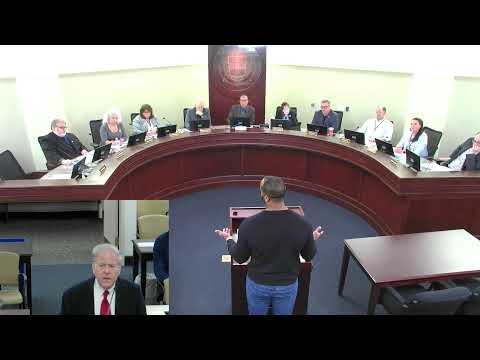
Rep. Bob Freeman outlines lease‑to‑purchase bill to expand path to homeownership
Loading...
Summary
State Rep. Bob Freeman presented House Bill 1696 to the Northampton County Economic Development Committee, proposing a statewide lease‑with‑guaranteed‑purchase program administered by PHFA that would place at least 20% of monthly payments into escrow, add consumer protections and cap payments at 110% of fair‑market rent.
Representative Bob Freeman on Thursday presented House Bill 1696, a proposal to create a statewide lease‑with‑guaranteed‑purchase program that would let renters build escrowed down‑payment funds through monthly payments and, under agreed terms, exercise an option to buy their homes.
"I really do believe in my heart of hearts this could provide a real opportunity for renters to acquire homeownership," Freeman told the committee, describing a model he traced to a local landlord who used rent‑to‑own arrangements to move working families into homeownership.
Under the bill as Freeman described it, a portion of each monthly payment would be designated for escrow and the escrow portion could not be less than 20% of the payment. The purchase price would be agreed at contract entry and supported by an appraisal paid by the landlord; if the parties dispute value, they could obtain separate appraisals and the average would set the contract price. The Pennsylvania Housing Finance Agency (PHFA) would administer the program and the General Assembly could appropriate funds to support predevelopment work, title searches, rehabilitation and matching funds for escrow accounts.
Freeman said the bill includes multiple consumer protections: mandatory disclosures that specify how much of a monthly payment goes to escrow and what security deposits apply; prohibitions on requiring a tenant to buy homeowner insurance while still renting; restrictions on penalty fees for early termination; and eviction safeguards that allow up to six months for a tenant to cure a payment default, plus a 15‑day grace period in certain breaches. He also described a remedy that could award reasonable attorney fees to a renter if a landlord fails to comply with the contract.
The measure would cap maximum monthly payments at 110% of the fair‑market rent for the county where the property is located and set minimum lease‑length protections so the option to purchase would not be subject to an unreasonably short squeeze (Freeman said the maximum number of lease years would not be less than 10 years). The bill permits a realty transfer tax exemption for transfers executed under the program as an incentive, he said.
Committee members pressed Freeman on several operational points. "But what beyond that would incentivize a landlord to participate in this program?" asked Mr. Bollett, expressing concern that locking in a purchase price could be a large sacrifice for owners when market values rise. Freeman said appropriations could cover rehab costs and other incentives might be considered to make participation more attractive, but participation would not be mandatory.
Members also asked how the proposal fits within statewide housing efforts and whether similar programs exist in other states. Freeman said he views the bill as "part of the equation" in addressing affordability and that PHFA helped draft consumer safeguards; he was not aware of a direct Senate companion bill and said he planned to speak with relevant House committee leaders about advancing the measure.
Freeman framed the approach as targeting households in distressed census tracts with incomes at or below 80% of median — with up to 30% of funds reserved for households below 50% of median income — and said PHFA would be charged with reasonable statewide distribution of funds.
No formal action on the bill was taken by the county committee. Freeman suggested the county might consider a supporting resolution and asked for local assistance in advancing the legislation in Harrisburg.