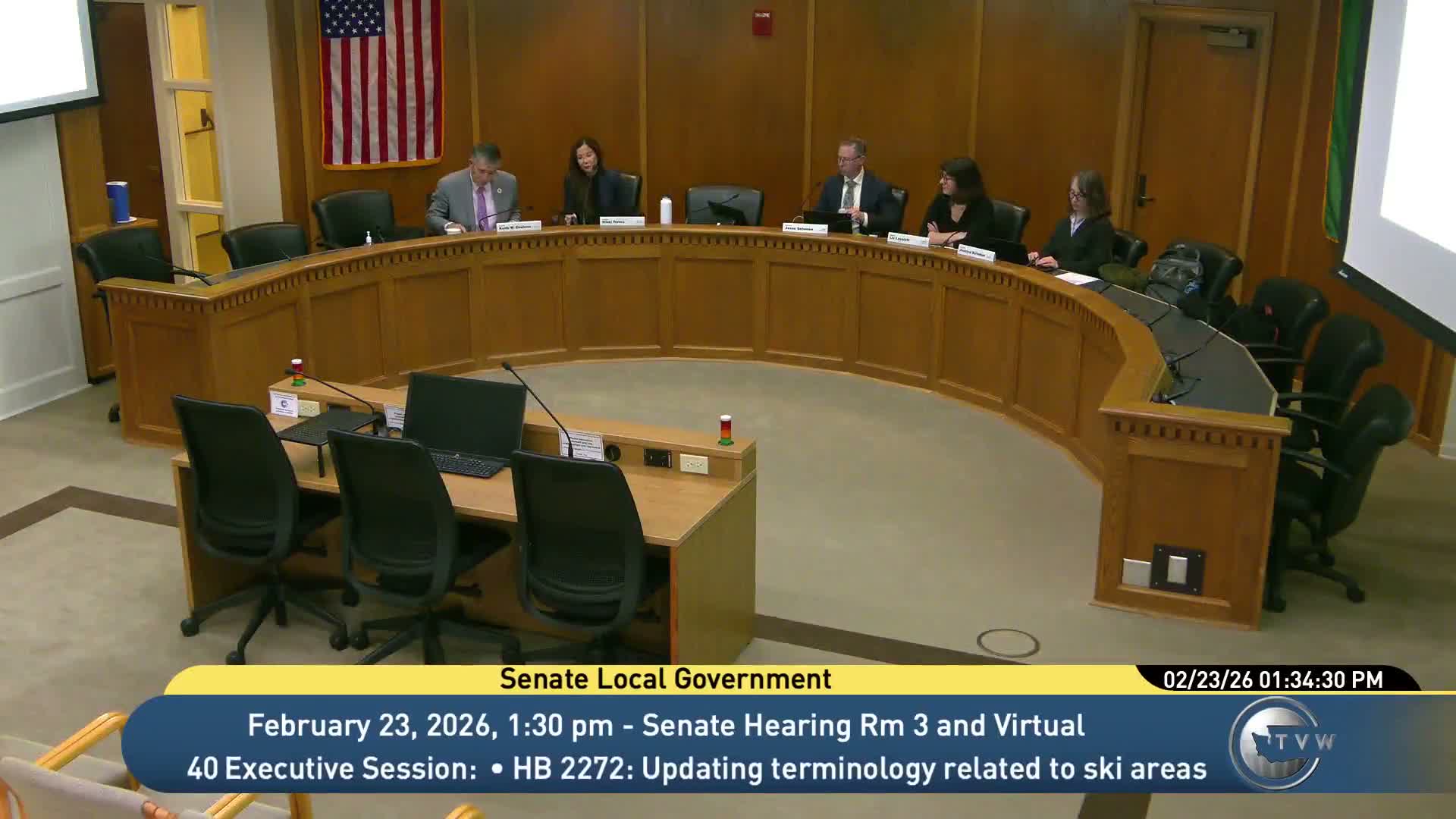
Senate committee advances permit-review overhaul with refund penalty, business‑day deadlines

Senate Local Government Committee · February 23, 2026

Get AI-powered insights, summaries, and transcripts

Subscribe
AI-Generated Content: All content on this page was generated by AI to highlight key points from the meeting. For complete details and context, we recommend watching the full video. so we can fix them.

Summary

The Senate Local Government Committee moved engrossed 2nd Substitute House Bill 2418 out of committee after adopting a striking amendment clarifying referral completeness for special purpose districts and switching some review limits to business‑day deadlines; the committee approved the bill by voice vote despite a 'without recommendation' from Senator Torres citing local costs.

The Senate Local Government Committee on Thursday advanced engrossed 2nd Substitute House Bill 2418, a measure that changes how government entities handle project permit applications, including new timing rules and a partial-fee refund for missed deadlines.

Staff summarized the bill as clarifying that a county or city’s determination about whether a permit application is procedurally complete is not a substantive review, requiring certain non-county/city government entities to complete their reviews within prescribed deadlines. If an entity misses the deadline, the bill requires it to refund 20% of the permit review fee. The bill also requires local governments to designate a permit-responsible official with authority to issue final administrative decisions on residential project permit applications and to name a single point of contact (a position, office, or functional unit) with publicly available phone or email for applicants. The designation does not, by itself, confer final decision-making authority unless a local ordinance provides that authority.

Committee members adopted a striking amendment described by staff as clarifying that referrals to special purpose districts or public utility districts are complete only when the referral includes all materials required under the district’s adopted procedures. The amendment also changed several calendar-day deadlines to business-day calculations — for example, reducing routine infrastructure review timelines to 45 business days and more complex infrastructure reviews to 60 business days under the amendment as presented.

Senator Torres said she would be "without rec today," citing the bill’s estimated local-government costs (reported in committee materials as about $2,000,000) and an emergency clause in the bill. "I believe that our local governments are going to need a little bit of time to implement the ordinance," she said. Chair (Speaker 1) replied that permit review is a core local-government function and urged support.

The committee approved the bill as amended by voice vote. The Chair announced the bill "passed, subject to signatures," and the measure was sent to the Rules Committee for further consideration.

Fiscal and procedural context: staff presented a fiscal note for the engrossed version showing general-fund state costs for the 2025–27 biennium of $113,531 (about $73,000 for Commerce and $40,500 for Ecology), a projected $100,000 for Commerce in the 2027–29 biennium, and estimated local government costs just over $2,000,000 (about $1.8 million for cities and $270,000 for counties). The bill was reported to have passed the House earlier, 93–0, according to staff’s summary.

Next steps: The bill will proceed to the Rules Committee; the committee record shows no roll-call tally from today’s voice vote and does not indicate additional amendments were adopted beyond the striking amendment described in committee.