Get Full Government Meeting Transcripts, Videos, & Alerts Forever!
Get email alerts on the Private Detention topic
No spam. Unsubscribe anytime.
Committee hears testimony supporting HB 2464 to require incident reporting by private detention facilities
Summary
Supporters told the Senate Human Services Committee that House Bill 2464 would require private detention operators to report serious incidents (abuse, death, suicide, inpatient-level injuries and service disruptions) to the Department of Health and local law enforcement by the next business day, improving transparency and enabling investigations.
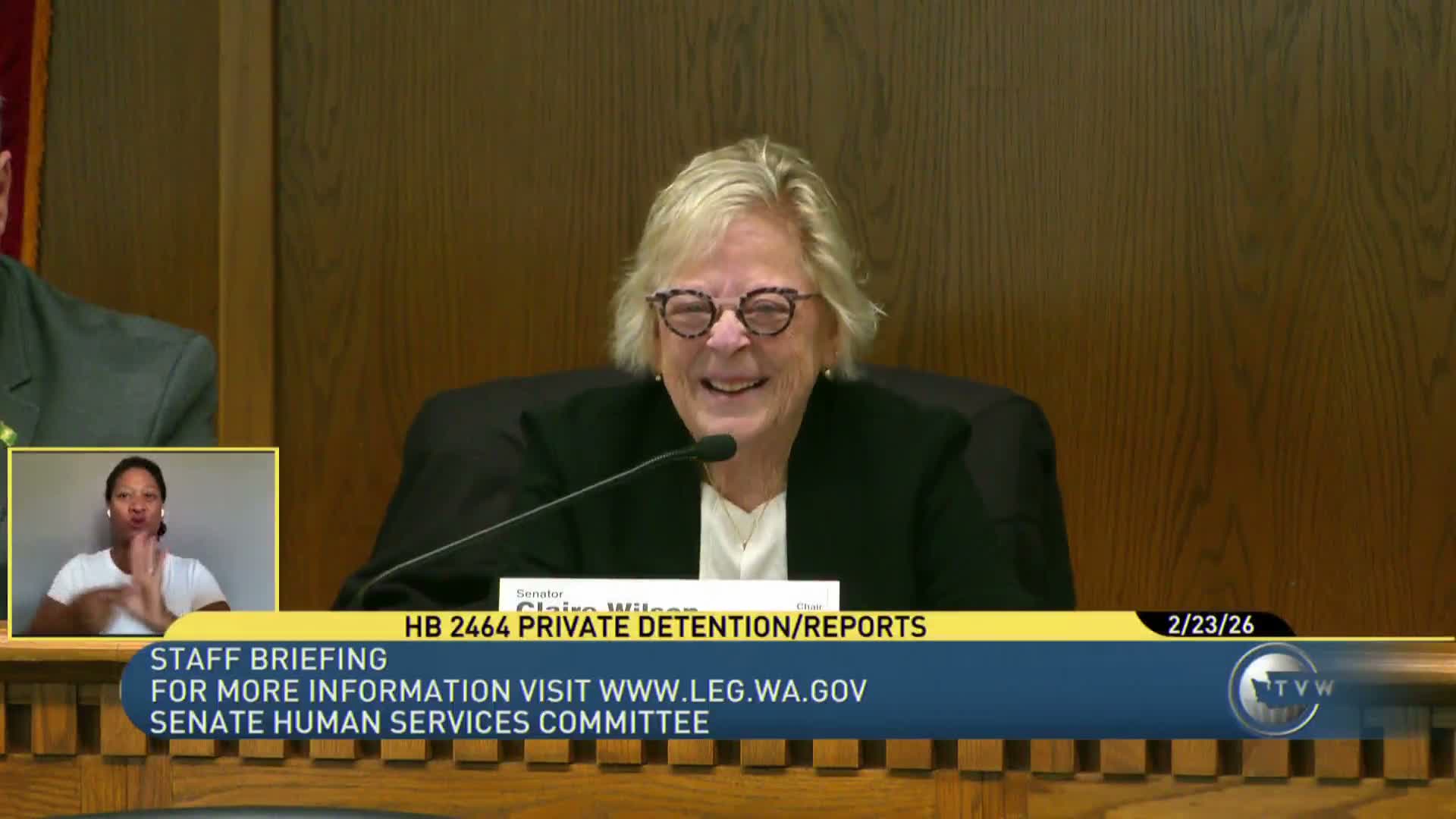
Supporters of House Bill 2464 told the Washington State Senate Human Services Committee on Feb. 23 that the bill would close critical gaps in reporting at privately operated detention facilities, including the Northwest ICE Processing Center in Tacoma.
"We need the stringent reporting requirements in this bill to protect survivors of assault and other abuses committed within private detention facilities," said Hannah Warner of Columbia Legal Services, citing a University of Washington Center for Human Rights report alleging systematic sexual assaults and underreporting at the Tacoma facility.
Representative Lillian Ortiz Self, sponsor of the legislation in the House, told the committee that private operators often provide inconsistent and late information to lawmakers and regulators. "We will hear about a suicide a month later. We'll hear about hunger strikes after they've been on the thirtieth day," Ortiz Self said, arguing the Department of Health and local law enforcement need timely, consistent data to respond appropriately.
Committee staff summarized the bill's requirements: private detention facilities must comply with Department of Health rules for sanitary, hygienic and safety conditions and must report any serious or undesirable outcomes — including allegations of abuse or neglect, death, suicide, inpatient hospital-level injuries and disruptions of services — to the Department of Health and the law enforcement agency with primary jurisdiction by the end of the next business day after an incident.
Advocates described operational barriers that prevent detained people from reporting crimes directly. "Detained people, at this facility cannot dial 911 directly. They must ask a guard ... Nor can they talk to the 911 dispatcher directly. A guard makes the call," Lydia Zapata of the League of Women Voters of Washington testified, recounting years of facility visits and unsuccessful attempts by detainees to get police reports filed.
Josefina Mora Chung of La Resistencia said her group has filed multiple reports on behalf of detainees who feared retaliation or whose guard-requests to file police reports went unfulfilled. Tim Warden Hertz of the Northwest Immigrant Rights Project described the measure as "common sense," saying it would allow victims to report crimes and enable local law enforcement to conduct investigations.
Committee staff noted the bill would not automatically apply to facilities operating under contracts in effect prior to Jan. 1, 2023 for the duration of those contracts, but it would apply to contract extensions or modifications. The staff report cited two private detention facilities in Washington state and listed a fiscal note with indeterminate but nonzero assumptions for law enforcement agencies that may need to prepare and file the annual reports required by the bill.
The committee did not take a vote during the hearing; witnesses urged members to pass the bill out of committee to ensure timely reporting and law enforcement access to incidents in private detention.
The committee adjourned and scheduled executive session work the following day to consider bills, including this measure.