
House committee hears divided testimony on bill to add felony tiers for major environmental violations
Get AI-powered insights, summaries, and transcripts
Subscribe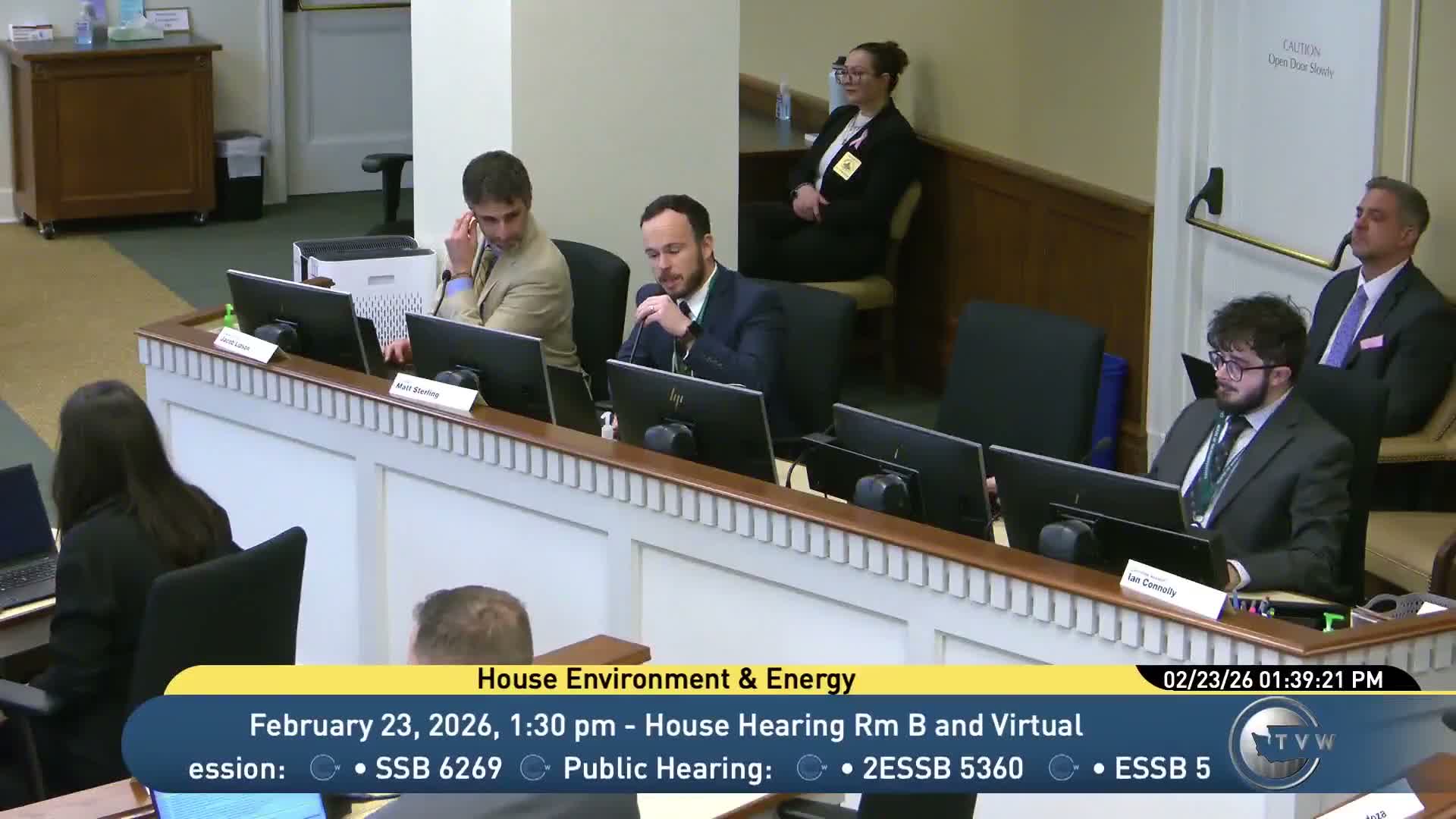
Summary
Lawmakers heard hours of testimony on SSB 53 60, which would create three tiers of criminal violations for major environmental statutes, raise penalties up to class B felony for knowing conduct that places people or resources in imminent danger, and add worker protections and whistleblower provisions. Supporters cited high-profile pollution cases; labor and industry urged clearer limits and stronger worker safeguards.
A Washington House committee on Thursday considered legislation that would create tiered criminal penalties for violations of the state’s Water Pollution Control Act, Clean Air Act and Hazardous Waste Management Act, and impose punishments ranging from a gross misdemeanor up to a class B felony.
Sen. Yasmin Trudeau (D-27), the bill’s sponsor, told the House Environment & Energy Committee the measure responds to repeated, large-scale pollution events and is intended to give prosecutors tools to match penalties to harms. "In my community, we had criminal polluters who wrote off really big issues as the cost of doing business," Trudeau said, describing the Tacoma boat fires and tire-crumb contamination of the Puyallup River as examples that motivated the bill.
The bill, as summarized by committee staff, creates three degrees of criminal violations. A first-degree violation would be a class B felony where a person knowingly violates an environmental statute and knows the conduct places another person in imminent danger of death or serious bodily harm; under some statutes that same mental state could apply to imminent danger to property or natural resources. The bill also includes affirmative defenses for employees who were ordered by their employer to engage in the conduct, statutory protections for workers who refuse to carry out illegal acts, and a requirement that the Attorney General’s Office provide an annual enforcement report to the Legislature.
Adam Eitman, legislative director for Attorney General Nick Brown, gave the AG’s perspective on enforcement and noted the office’s record of prosecutions. "If you review those cases, you'll see the types of things that we're talking about," he said, adding his office had provided a list of roughly 20 cases to the committee. Bill Sherman, division chief in the AG’s Environmental Protection Division, stressed that the Attorney General’s Office does not have original criminal jurisdiction and must receive concurrent jurisdiction from county prosecutors under state law before prosecuting a case.
Supporters — including tribal leaders, community groups and environmental advocates — urged the committee to pass the bill, saying existing civil penalties have not deterred repeat offenders. "When the river is harmed, our people feel it first," said Sylvia Miller, vice chairwoman of the Puyallup Tribe, urging stronger criminal accountability and noting a recent Pierce County Superior Court penalty and restitution award.
Labor unions, industry groups and county officials countered that the bill, as written, could expose frontline workers and public employees to criminal liability for accidents or permitted activities. "Workers cannot rely on the promise of protection" unless statutory language explicitly and durably shields them, said Josh Estes of the Association of Western Pulp and Paperworkers. Several union witnesses warned that the cost and consequences of defending an individual charged under the measure could be severe even if an employee ultimately prevailed.
Representatives of local government and trade associations also asked for clearer mental-state definitions and limits tying severe penalties to demonstrable harm. "There are two remaining concerns," said Ramona Brandes of the Washington Association of Criminal Defense Lawyers, urging standardized culpability and an economic threshold for property harms to ensure penalties focus on significant impacts.
Committee members asked repeatedly about enforcement mechanics. Staff and witnesses explained that while general peace officers can investigate crimes, the AG must be granted concurrent prosecutorial authority by a county prosecutor to bring cases in many circumstances.
The hearing produced an extended record of competing recommendations: supporters urged the bill as necessary to deter large polluters and to protect public health and treaty-protected resources; opponents urged narrowing, clearer defenses for workers, and additional stakeholder engagement before advancing criminal penalties. The committee closed the hearing without a final vote on SSB 53 60.
The bill will likely return to committee work as sponsors and stakeholders negotiate the mental-state framework and worker protections.