
Senate committee advances bill to create wage‑recovery fund for unpaid low‑wage workers
Get AI-powered insights, summaries, and transcripts
Subscribe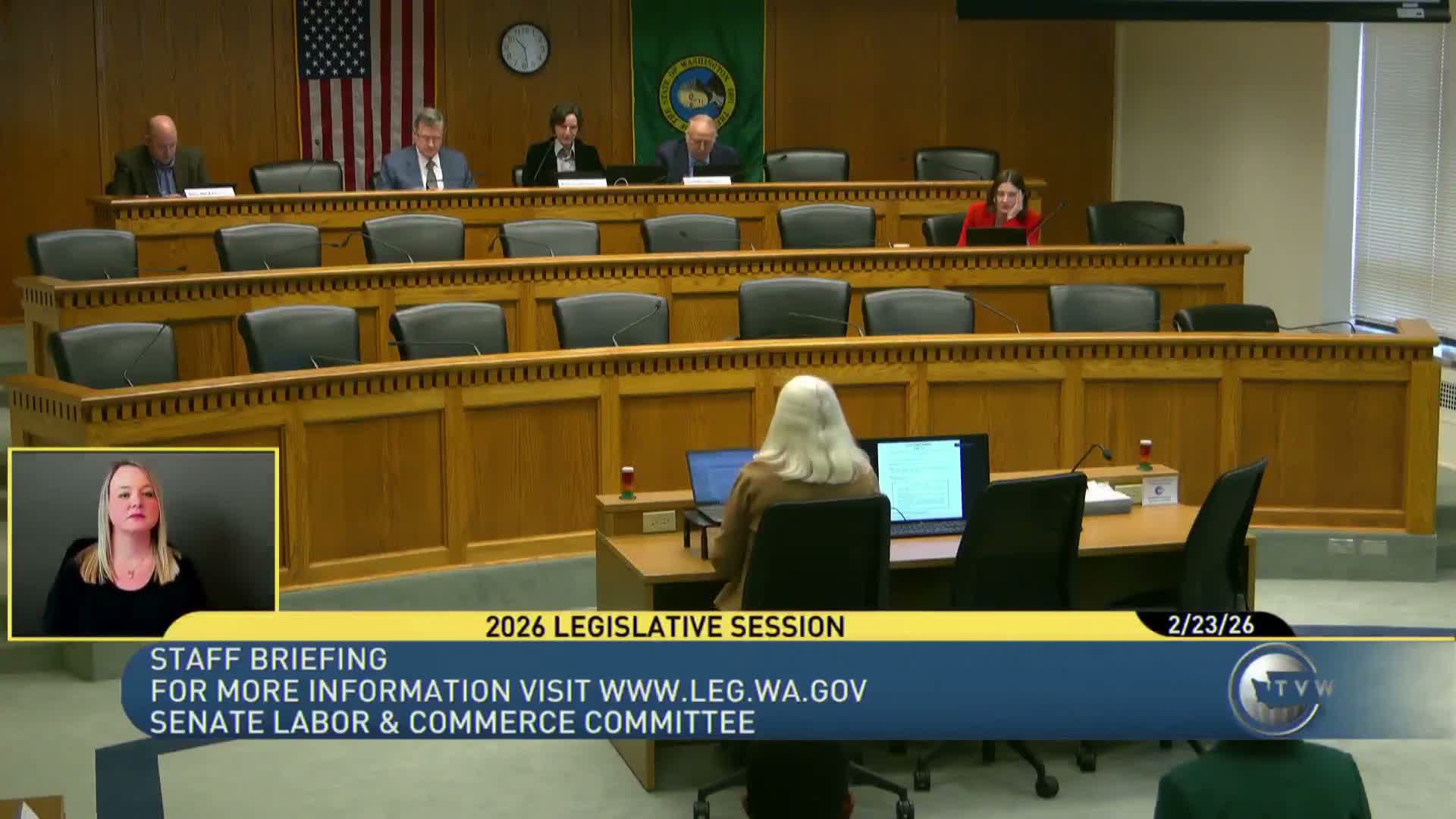
Summary
The Labor and Commerce Committee advanced HB 2479 after testimony from workers and employers; the bill would create a wage recovery program administered by L&I, fund it with civil penalties, allow interim payments up to $2,500, and raise civil penalties for repeat or willful wage violators.
The Washington State Senate Labor and Commerce Committee on Feb. 25 advanced House Bill 2479, a measure to create a wage recovery program to provide prompt payments to low‑wage workers who are owed unpaid wages.
Committee staff told members the bill establishes an account administered by the Department of Labor & Industries (L&I) funded by civil penalties collected under the Wage Payment Act. Under the proposal, L&I could disperse funds to eligible workers prior to collection from employers when the employee would otherwise face immediate economic harm. An eligible worker could receive up to 85% of anticipated wages, capped at $2,500 per worker. The program’s eligibility would begin in 2028 or when the account reaches $130,000, whichever is later.
"We rank the ninth worst nationwide in Washington state when it comes to wage theft," Representative Mary Fossey, the bill’s prime sponsor, told the committee, saying estimates place annual wage theft in the state at "over $600,000,000." Fossey described the bill as the product of a consensus work group that included labor, employers and legal services representatives and said the fund would prevent families from losing housing or food while L&I resolves complaints.
The bill would also change enforcement mechanics: L&I would be able to prioritize complaints under a publicly available written process, and the minimum civil penalty for willful violations would rise from $1,000 to $1,500 or an amount equal to 10% of unpaid wages. The bill removes the previous $20,000 maximum penalty and directs L&I to adopt a rulemaking matrix to set penalties based on enumerated factors; penalties would be inflation‑adjusted every three years starting in 2030.
Supporters at the hearing — including law‑clinic students, contractors’ groups, and NFIB, which co‑chaired the legislative work group — said the fund offers timely relief funded by penalties on employers who break wage laws rather than the general fund. Ross Colebrook, a Seattle University law student speaking for the Workers’ Rights Clinic, said the fund “creates a third option” to avoid prolonged waiting for enforcement.
Committee staff noted a fiscal note is available and estimated indeterminate receipts and expenses with a rough $2 million effect on the accident medical aid accounts for 2025–2029. When asked whether the fund requires general‑fund dollars, the sponsor replied L&I would use the civil‑penalty account and no general‑fund appropriation would be required to start the program.
The committee recorded public support in written testimony and advanced the bill to the next step in the legislative process with a recommendation from committee leaders. The bill’s next steps will depend on scheduling by the Rules Committee and subsequent floor action.