Get Full Government Meeting Transcripts, Videos, & Alerts Forever!
Get email alerts on the Emergency Operations topic
No spam. Unsubscribe anytime.
Bill would criminalize driving around emergency barricades; sponsors cite rescues, opponents call it overreach
Summary
HB 2203 would make knowingly entering a closed roadway a misdemeanor (elevated in some cases) with possible license suspension and cost recovery up to $25,000; sponsors and fire chiefs cited flood rescues and responder safety, while defense groups argued the measure is disproportionate and urged making it an infraction instead.
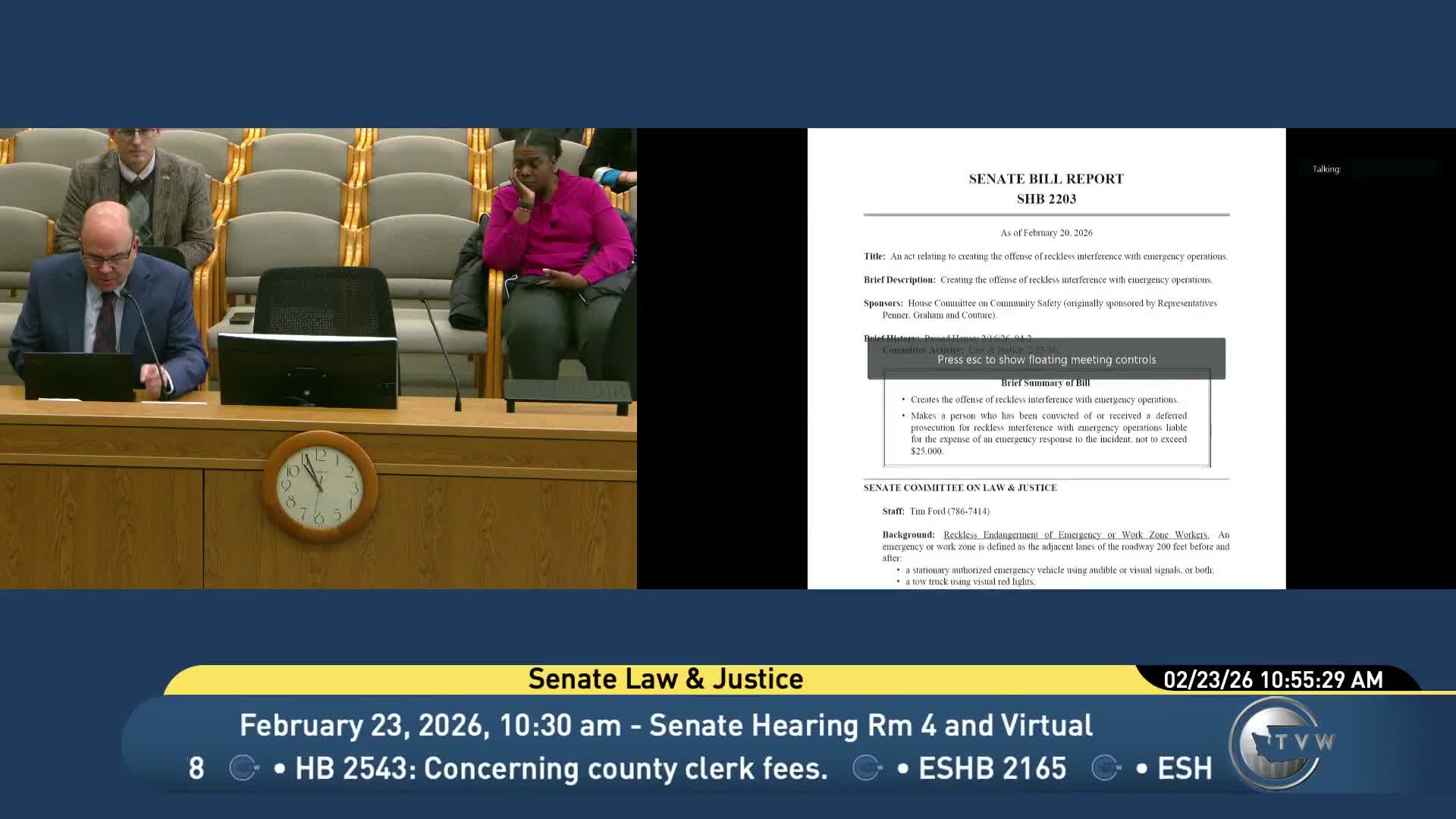
The Law and Justice Committee received briefing and public testimony on substitute House Bill 2203, which would create the offense of reckless interference with emergency operations for knowingly operating a vehicle on a public roadway that is closed due to hazardous conditions.
Tim Ford, staff counsel, outlined penalties: the offense is a misdemeanor (30-day license suspension) elevated to a gross misdemeanor (60-day suspension) if the violation requires emergency response and causes bodily injury to a first responder or if a minor or vulnerable adult is present; the Department of Licensing would suspend driving privileges accordingly and the bill allows recovery of emergency-response costs up to $25,000 per incident.
Representative Josh Penner, sponsor and a recently serving mayor, said the bill grew from firsthand experience during flooding, when people drove around barricades, became stranded and required multiple swift-water rescues. "We were doing an inordinate number of swift water responses for folks that were driving around emergency barricades," he said, arguing the law would create a "second thought" before people ignore closures.
Jeff Faucette, representing Washington Fire Chiefs, supported the bill, saying closures are safety measures and driving around them compromises incident control, increases responder exposure and creates secondary emergencies. He urged passage to reinforce that closures are not suggestions.
David Treeweiler (Washington Association of Criminal Defense Lawyers and Washington Defender Association) opposed the bill, calling it unnecessary, disproportionate and expensive to enforce. He described scenarios where ordinary motorists could face criminal records, fines, license suspensions and heavy restitution and urged the committee to consider making the offense an infraction rather than a criminal charge.
The committee closed the public hearing after hearing both supportive and opposing testimony and recorded a large number of sign-ins in support.