
Senate committee hears bill to presume driver negligence when vulnerable road users are harmed
Get AI-powered insights, summaries, and transcripts
Subscribe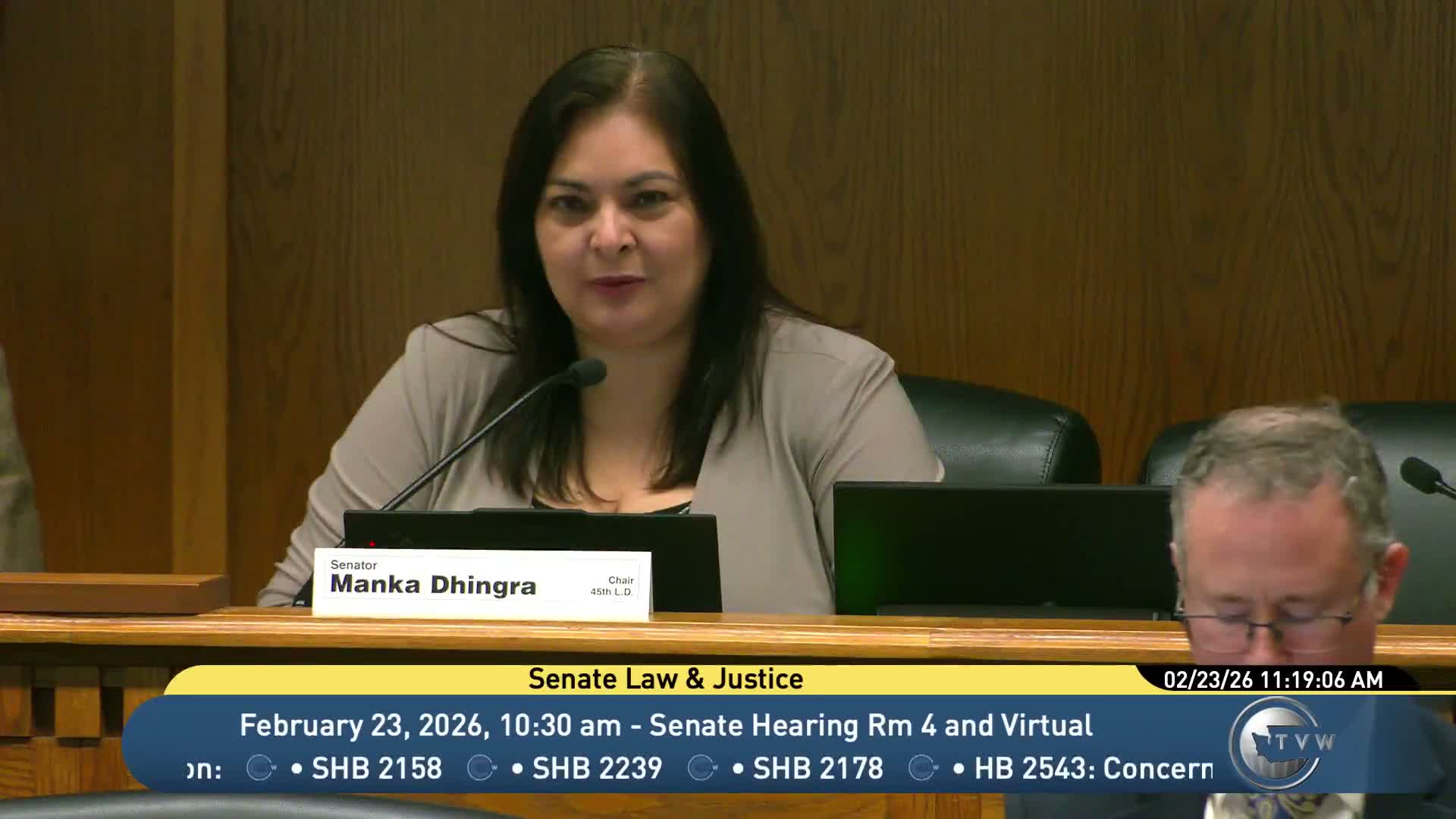
Summary
The Law and Justice Committee heard testimony for ESHB 2095, which would create a rebuttable presumption that drivers are negligent when they proximately cause injury or death to pedestrians, cyclists or other designated vulnerable users in state-designated facilities; sponsors and survivors urged passage while cities, defense groups and insurers raised concern about liability, fee-shifting and scope.
A Washington State Senate Law and Justice Committee hearing on Feb. 23 focused on ESHB 2095, a bill that would establish a rebuttable presumption of negligence for drivers who proximately cause the injury or death of a vulnerable user of the public way when that person is in a state-designated facility such as a sidewalk, crosswalk or bike lane.
Representative Julia Reid, the bill’s prime sponsor, said the measure is designed to protect people who use facilities the state has set aside for their safety. "If you're a mom walking on a sidewalk or a cyclist riding in a bike lane, you're using a facility set aside for your use," Reid said, urging the committee to adopt the changes and stressing the bill includes education for officers and prosecutors.
Supporters framed the proposal as a fairness and safety measure. Rita Holzman, whose husband Steve died after being struck while bicycling in December 2023, described the collision and its aftermath and urged passage so other families would be spared similar outcomes. "Nothing will bring Steve back, but if ESHB 2095 becomes law and is implemented correctly, I hope it will spare other vulnerable users and their families from going through what I and my family have experienced," she testified.
Advocates and practitioners said the bill would simplify victim recovery. Vicky Clark, deputy director of Washington Bikes, said the current system leaves injured or deceased vulnerable users at a disadvantage because they often cannot preserve evidence or complete investigations. Bob Anderton of Washington Bike Law said police reports frequently rely on drivers' statements when victims are taken away, creating disputes that impede insurance and civil recovery.
Medical testimony emphasized prevention and systems change. Dr. Ann Marie Dooley of Washington Physicians for Social Responsibility said the measure reframes injuries as preventable outcomes and argued education and accountability can improve safety.
Opponents raised legal and fiscal concerns. City and municipal representatives, including Kyle Wark of Kent and Derek Nunley of the Association of Washington Cities, warned the bill could expose local governments to more litigation and higher insurance costs. Defense and liability groups — including the Washington Defense Trial Lawyers and the Washington Liability Reform Coalition — criticized fee-shifting provisions and said the presumption mechanism is a significant change to common-law negligence doctrines.
Some stakeholders asked for clarifications. Paul Graves, general counsel for a trucking company, requested clearer interaction between the presumption and comparative-fault rules. Several speakers noted amendments taken in the House narrowed the bill in response to city and trucking concerns; Sponsor Reid said a striking amendment was under consideration to limit recovery to drivers.
The bill would allow plaintiffs to recover actual damages, statutory damages of $1,500, and reasonable attorney fees and costs when the presumption applies; the driver could rebut the presumption by a preponderance of the evidence. The presumption does not apply to emergency vehicle drivers performing their duties. The committee heard extensive public testimony and closed the hearing after hearing that hundreds of people had signed in in support.
The committee did not take a final vote on the bill at the public hearing. The most recent procedural development is that public testimony concluded and the committee moved to executive session to consider multiple bills and amendments.