Get Full Government Meeting Transcripts, Videos, & Alerts Forever!
Get email alerts on the Cap And Invest Regulation topic
No spam. Unsubscribe anytime.
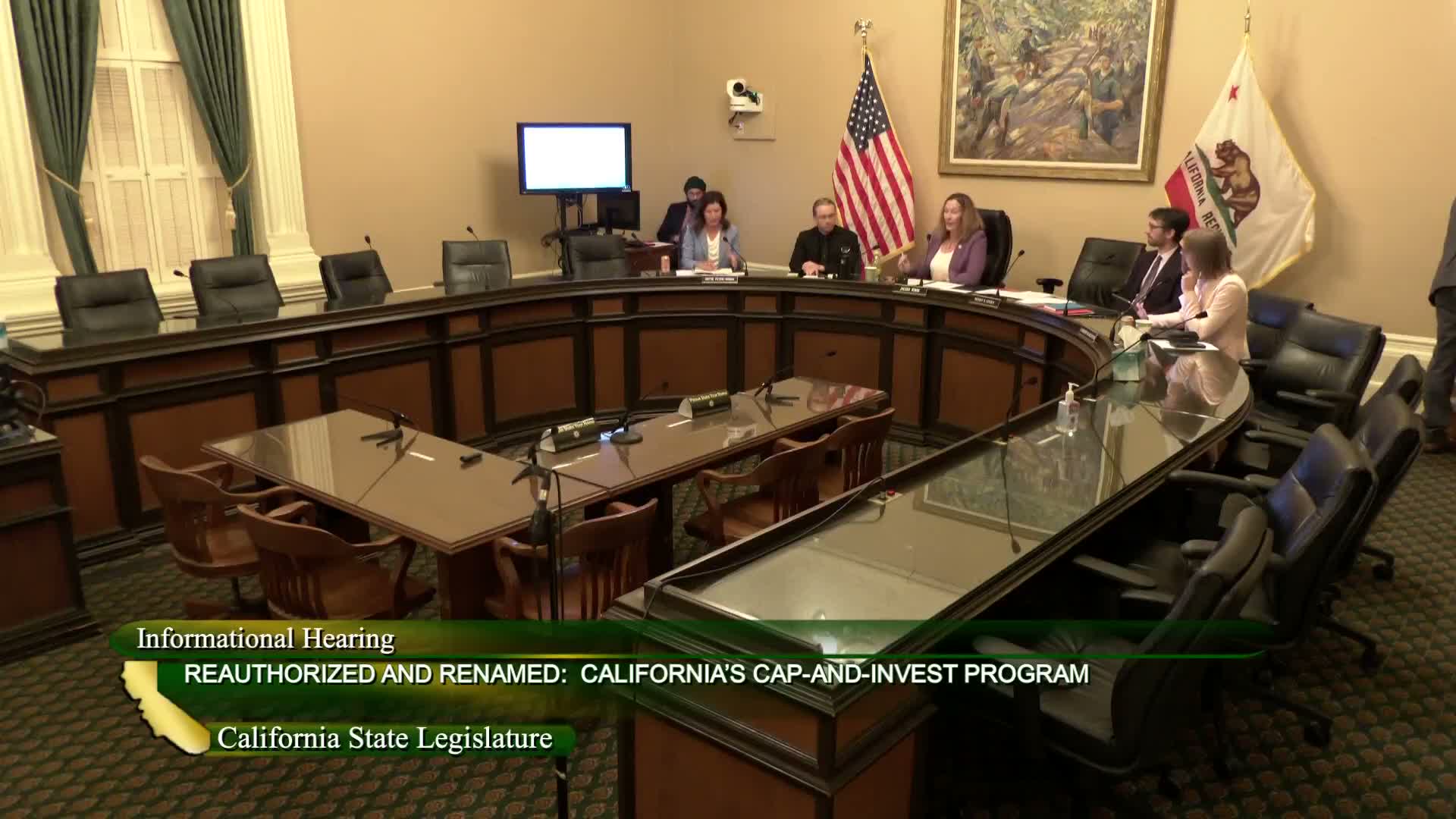
CARB defends Cap and Invest amendments as lawmakers press on utility credits, industrial allocation and timing
Summary
At a joint legislative hearing, California Air Resources Board officials outlined proposed amendments to the Cap and Invest program, defended a May rulemaking timeline and invited comments on utility allowance reallocations, industrial leakage safeguards and placeholder language for carbon removal; stakeholders urged faster action or warned of rate and leakage risks.
The California Air Resources Board on Wednesday presented proposed amendments to the state’s Cap and Invest program — the rebranded cap-and-trade system — and defended a schedule intended to finalize the regulation this spring while inviting additional public comment.
Chair Sanchez and Deputy Executive Officer Reginder Sahota told the joint legislative committee the amendments implement parts of the reauthorization bills (referred to in the hearing as AB 12 o 7 and SB 8 40) and aim to reduce emissions through 2045 while protecting affordability. “Formally known as cap and trade, the cap and invest program is a cost effective policy tool that makes polluters pay while reducing climate emissions over time,” a CARB official said during the presentation.
CARB staff summarized technical changes in the draft rule: retiring allowances when offsets are used for compliance, adding post-2030 allowances to the price containment reserve, updating reporting requirements to guard against market manipulation, and transferring free allowances from natural gas utilities toward electric utilities to support electrification and utility-bill affordability. CARB said the draft includes placeholder language recognizing carbon capture and removal (CCUS/CDR) as potential compliance pathways while separate SB 905 regulations are developed.
CARB also presented an economic assessment of the proposal. Staff said the estimated total cost of compliance is roughly $124,000,000,000 over 20 years and that projected statewide benefits outweigh those costs, including an estimated $180,000,000,000 in total benefits and $123,000,000,000 in avoided health-care costs from improved air quality. The agency said it expects an effective date of September 1, 2026, if the rule is adopted on the board timetable.
Lawmakers focused much of their questioning on timing, linkage and distributional effects. Several members urged CARB to meet a May adoption timetable so markets and potential linkage partners (including Washington and Quebec) can plan. CARB said it is committed to the May timeframe and remains in public comment through March 9, allowing time for adjustments before the board hearing.
Allocation of allowances to electric utilities and the planned shift of value from natural gas to electric customers drew sustained scrutiny. Assembly members and panelists warned that reducing allowances available to publicly owned utilities (POUs) and investor-owned utilities without smooth transition rules could erase the benefits of early decarbonization investments and push costs onto ratepayers. CARB staff responded that the staff proposal aims to provide free allowances sufficient to cover compliance costs and that the agency is soliciting additional utility data to smooth the transition.
Industry and municipal-utility representatives said interim changes in the allocation timeline have created uncertainty. Natalie Seitzman, government affairs manager for the Southern California Public Power Authority, told the committee the CARB proposal “stand[s] to lose 9,000,000 allowances from 2027 through 2030,” which she said would translate to hundreds of millions of dollars in lost revenues for POUs and could force rate increases or cutbacks in local decarbonization investments.
Panelists from the Legislative Analyst’s Office and academic and environmental groups urged greater transparency about how CARB derived allocation and leakage assumptions. The LAO highlighted that allowance counts and reallocation decisions determine how much money is available for the Greenhouse Gas Reduction Fund (GGRF) and the climate credit; several witnesses said the draft staff proposal reduces the pool of allowances available for auction and that projected GGRF revenue is lower under staff’s central scenario.
On leakage and refining, lawmakers and witnesses asked whether imported gasoline could undercut state goals if only tailpipe emissions are priced under Cap and Invest while life-cycle emissions are treated in the Low Carbon Fuel Standard (LCFS). CARB staff said cap-and-invest is based on in-state emissions accounting at the rack and that LCFS and the OpG model address life‑cycle intensity; staff said SB 253 reporting and work on OpG could provide more granular data.
Environmental groups and climate advocates pressed for tighter near-term allowance budgets and a faster transition of the climate credit from gas to electric bills. The Environmental Defense Fund and others urged CARB to adopt stronger near-term ambition to raise auction prices and increase GGRF proceeds, and to finish rulemaking in the spring to restore market certainty.
The hearing closed with a public-comment period featuring a broad range of voices: municipal utilities and industry groups warning of affordability and leakage risks; environmental organizations, health and community groups urging faster emissions reductions and protections for disadvantaged communities; and advocates urging careful but timely implementation.
CARB’s staff invited written comments and data during the public-comment window and said it will consider adjustments before formal board consideration. The agency and the legislature signaled they expect continued engagement as the rulemaking proceeds.