Get Full Government Meeting Transcripts, Videos, & Alerts Forever!
Get email alerts on the Wildfire Mitigation topic
No spam. Unsubscribe anytime.
State Fire Marshal lays out HB 3940 programs: survivor grants, home‑hardening and a $42M biannual forecast
Summary
The Oregon State Fire Marshal briefed the committee on House Bill 3940 implementation, describing the Community Wildfire Risk Reduction Program, an $81 million initial investment, new revenue streams (oral nicotine tax and rainy‑day fund interest), and program elements including individual retrofit grants, a wildfire survivor grant, and county block grants.
The Oregon State Fire Marshal told the Public Safety Subcommittee on Feb. 12 that House Bill 3940 creates a suite of wildfire mitigation programs and new revenue streams; the office is building program rules, grant structures and outreach to match funding to local needs.
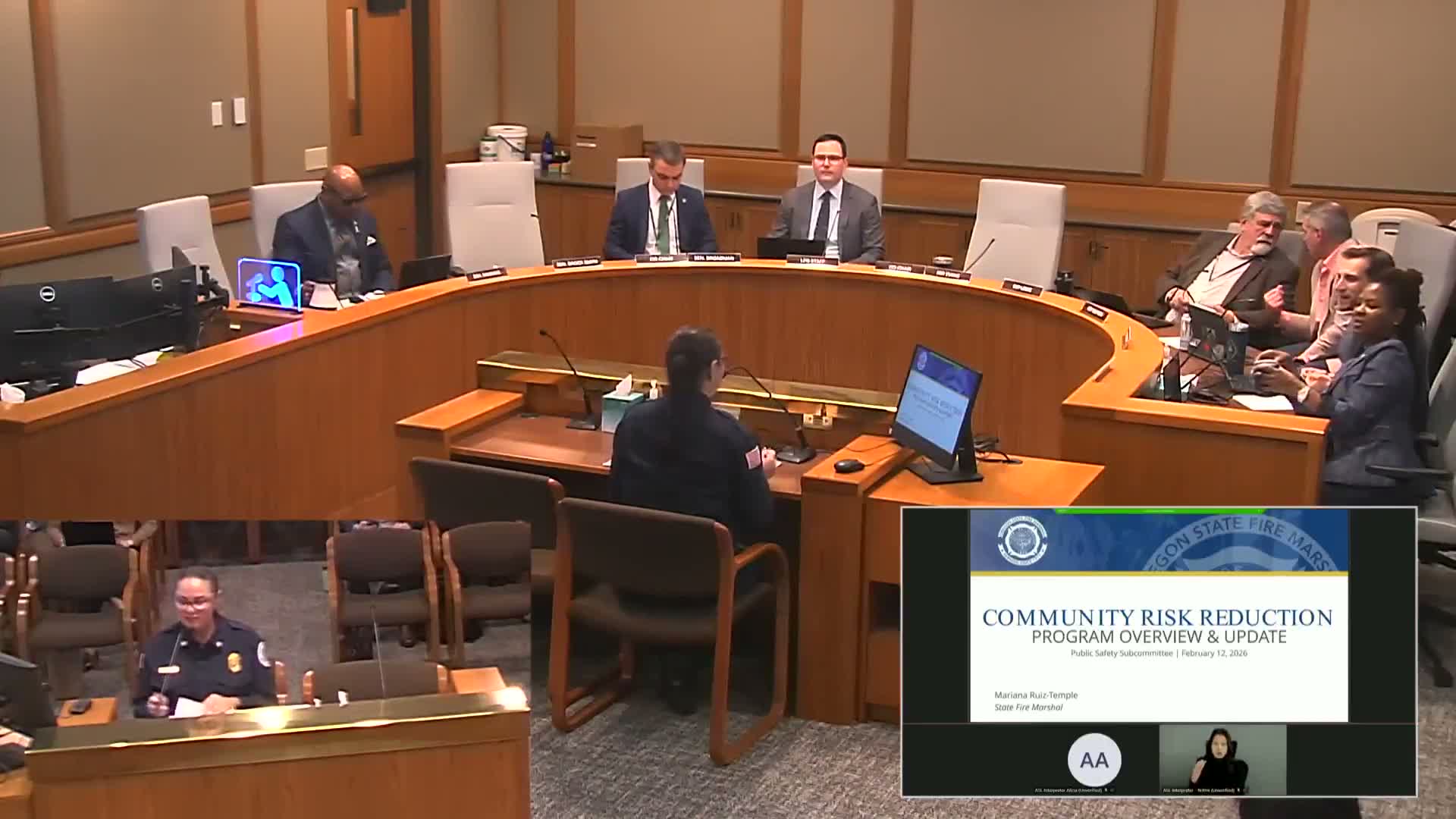
State Fire Marshal Mariana Reese Temple (presentation name in transcript varies between "Rees" and "Reese") recapped the policy evolution following devastating wildfire years and legislative action that created the Community Wildfire Risk Reduction Program. She said the state received a one‑time investment of about $81 million that funded grant programs, engines, staffing and community mitigation work and that HB 3940 moves mitigation funding forward with new revenue sources.
Temple described three required program elements under HB 3940: an individual retrofit program (home hardening grants for eligible retrofits such as vents, gutters or spacing around cedar fences), a wildfire survivor grant to assist households whose homes were destroyed or significantly damaged ("one of the first in the nation"), and a county block grant to allow counties to design and implement local programs. She said the defensible‑space code is expected to enter rulemaking in March or April and will remain voluntary until local adoption by counties, cities or authorities having jurisdiction.
On financing, Temple said two new revenue streams will begin flowing: an oral nicotine tax that started Jan. 1 (estimates show transfers beginning May 2026 and about $9.6 million expected through June 2027) and interest from the rainy‑day fund that has begun monthly transfers. She said the agency also received a $13 million general‑fund appropriation (about $6.5 million delivered so far) and forecasts roughly $42 million biannually for the 2027–29 period. OSFM said it has a request for an additional $212 million in limitation to support future grant rounds over the biennium.
Temple emphasized the challenge of demand vs. available resources: roughly 1.1 million homes in the wildland‑urban interface need mitigation while the agency is working from a $42 million biannual forecast. To design effective programs, OSFM held seven focus groups and listening sessions with more than 300 participants, and partners have prioritized investments in technology, regionalization, workforce development, and a defensible‑space/home‑hardening ecosystem.
Temple also highlighted prior grants that put 76 engines in priority areas and seasonal staffing grants that have added about 1,500 firefighters during wildfire seasons. She urged the committee to consider tradeoffs in program design and said OSFM may return to brief the committee as grant rules and allocations are finalized.
The briefing was informational. Committee members thanked OSFM and there was no formal vote or action recorded.