Get Full Government Meeting Transcripts, Videos, & Alerts Forever!
Get email alerts on the Background Checks topic
No spam. Unsubscribe anytime.
Oregon State Police say FBI approved RAPBACK enrollment; agencies must fix statutes to participate
Summary
Oregon State Police told the legislature that the state-level application to join the FBI RAPBACK service has been approved, but many Oregon statutes need compulsory language before agencies can be enrolled; OSP proposes a pilot and will help affected agencies pursue statute changes during the grace period.
Oregon State Police officials told the Public Safety Subcommittee on Feb. 12 that the state’s application to participate in the FBI’s RAPBACK continuous‑monitoring service has been approved, but that statutory changes are required before many regulatory agencies can be enrolled.
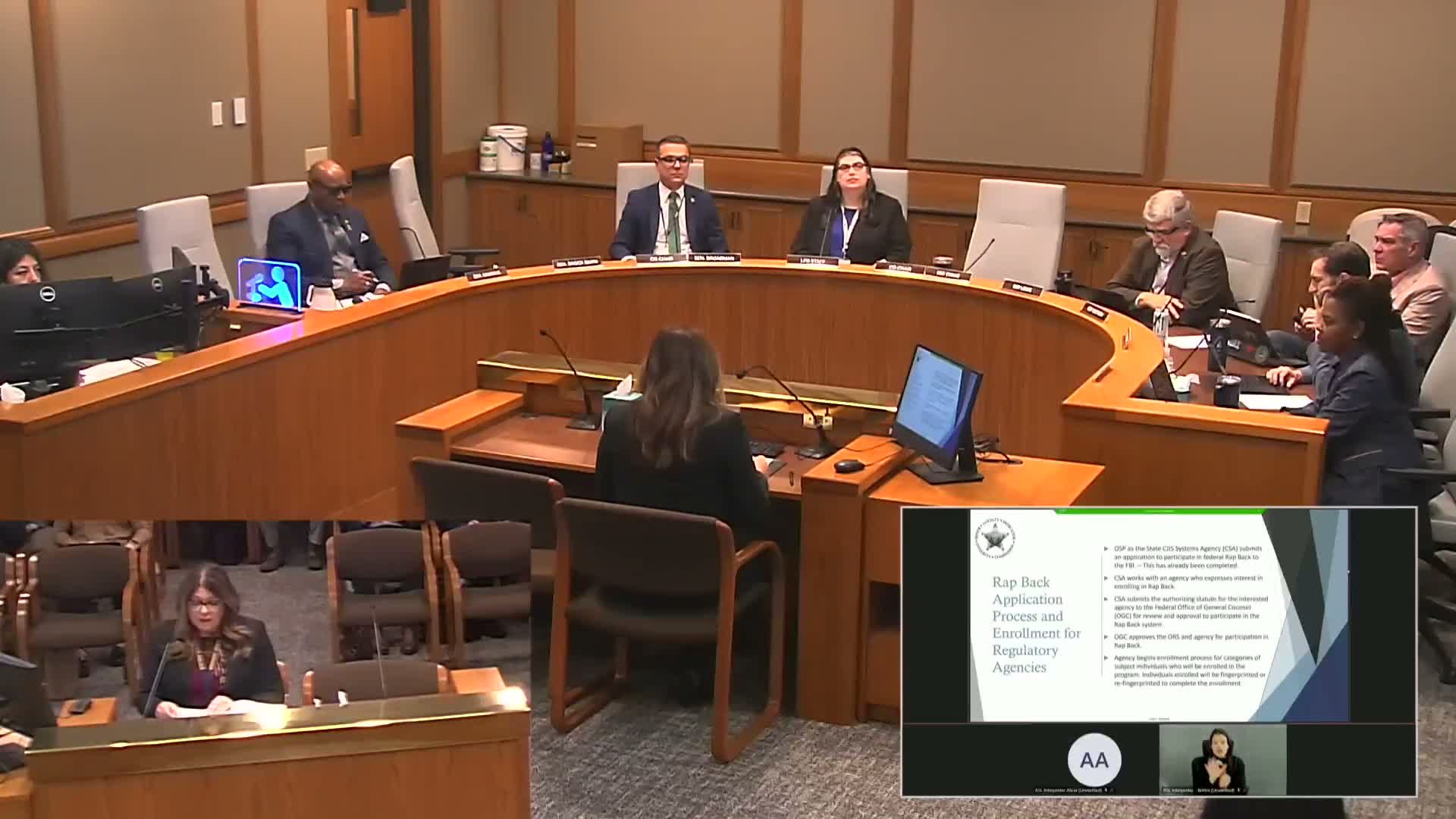
Deputy Director Wendy Landers of the Criminal Justice Information Services division said OSP began the FBI CJIS application in April 2024 and "On 02/19/2025, OSP received the signed approval from the FBI CJIS division and completed the approval process by signing and returning the application to them." She explained that federal approval of the state's application does not automatically enroll individual regulatory agencies; each agency must be approved by the FBI CJIS law unit based on the agency's statutory authority to submit fingerprints.
Landers described how fingerprint‑based checks work today and why RAPBACK matters: under the existing process an agency receives a one‑time snapshot of an applicant's criminal history. With RAPBACK, "there will be an automated notification sent to the authorized agency if the individual is later fingerprinted due to an arrest or a conviction," enabling prompt action to protect vulnerable populations.
OSP said it had identified statutory gaps in Oregon law. The agency told the committee that some statutes use permissive language (allowing an agency to request fingerprints) rather than mandatory language that Public Law 92‑544 requires for nationwide fingerprint submissions. OSP said the 2024 legislature corrected some of those gaps through House Bill 4122 but that additional amendments remain necessary; the FBI has granted a grace period to allow states time for corrections with a deadline of Jan. 1, 2031.
On operations and capacity, Landers provided 2025 processing figures for the ABIS fingerprint unit (the automated biometric identification system): the team processed 202,525 regulatory fingerprint cards and 118,357 criminal fingerprint cards, with each technician averaging about 1,300 cards per month. OSP warned that initial enrollment of large agencies could produce a temporary surge in reprints: the Department of Human Services previously estimated it might submit roughly 350,000 reprints over a two‑year enrollment period, potentially requiring two to four times current staffing to avoid backlog.
OSP currently charges $43 for each non‑criminal‑justice fingerprint card it processes and pays $10 of that to the FBI. The agency said it has not determined whether an additional retention fee for RAPBACK will be necessary; the amount would depend on enrollment choices, turnover rates and whether agencies reprint previously cleared individuals. To test operations, OSP asked the subcommittee to allow a pilot using general‑fund dollars provided by HB 4122: OSP said it could absorb a pilot of 50,000 RAPBACK fingerprinting events without charging a new retention fee and would only require pilot agencies to pay the existing processing fee.
Committee members asked whether agencies should change policies while awaiting statutory corrections. Landers said agencies may continue to operate under the FBI‑granted grace period but should work on statutory amendments next session and OSP will help guide affected agencies through compliance and enrollment steps.
The hearing was informational; no formal action or votes were taken.