
Judge Stephanie Boyd presides over 187th District docket; revocations, sentences and expedited PR‑bond review ordered
Get AI-powered insights, summaries, and transcripts
Subscribe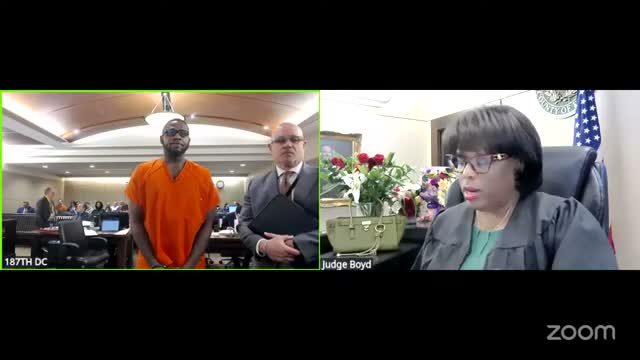
Summary
Judge Stephanie Boyd handled a full docket that included a revocation and two‑year sentence for a probationer, an expedited PR‑bond application in a case complicated by an ICE detainer, multiple revocations accepted under plea agreements and several probation placements and evaluations ordered.
Judge Stephanie Boyd of the 187th District Court presided over a packed docket that included multiple community‑supervision revocations, plea‑agreement sentences and an expedited review of a personal‑recognizance bond application complicated by an ICE detainer.
The court found allegations in the State's motion to revoke community supervision against Jashaun (Deshaun) Steen true after Steen and defense counsel discussed probation department recommendations. "Probation is recommending ISF...in order to address Mr. Steen's cognitive issues," defense counsel David McClain said, adding that Steen is employed and has sought treatment. Judge Boyd told Steen the court would grant the motion, sentenced him to two years in prison and imposed a $1,500 fine. The judge also reviewed the limited right to appeal and recommended therapeutic community options for the defendant.
In a separate matter, defense counsel Jeff Keith asked the court to grant a PR bond for Juan Manuel Martinez and explained that an ICE detainer has complicated bail in the case. "ICE has placed a detainer on him," Keith said, noting efforts to have the detainer lifted. Judge Boyd ordered an application for a PR bond to be filed and expedited and said she would rule after that application is processed; if the bond application is denied, counsel may seek a bond reduction.
Several other matters concluded under plea agreements. The court accepted a plea and revoked community supervision for Jonathan Ruiz, sentencing him to two years in prison and ordering restitution of $1,797.56 to Jasmine Romo and a continued no‑contact order. For Christopher Zuniga (also referenced as Sunaga in the record), parties presented a sentencing agreement and the court followed it, revoking supervision and sentencing the defendant to two years in prison with credit for treatment; the judge prohibited residing in homes with minors while conditions apply.
Judge Boyd also addressed requests for treatment referrals and mental‑health supervision. In Juan Lozano's matter the judge denied a motion to amend conditions to place him in a local ISF without supporting documentation, ordered an in‑custody evaluation for the mental‑health caseload and directed probation to refer the defendant to the Center for Healthcare Services as appropriate.
Other scheduling and procedural outcomes included a jury trial set for Ray Cordova (April 28), a plea deadline and PSI/TAP evaluation dates for 17‑year‑old Jose Salazar (plea deadline April 27; PSI/TAP April 7), and a plea and probation offer accepted for Herman Mitchell with supervised‑probation conditions spelled out (four years of probation, random UAs, outpatient treatment and 200 hours of community‑service restitution, with meeting credits).
The court repeatedly reminded defendants of punctuality for court settings, explained statutory admonishments and emphasized that certain plea bargains waive appeal rights on matters covered by the waiver. The docket proceeded through the morning with the judge directing probation, mental‑health evaluations and expedited administrative steps where requested by counsel.
The most immediate next steps are the expedited PR‑bond application for Martinez, the mental‑health caseload evaluation ordered for Lozano and the scheduled trial and plea‑deadline dates identified by the court.