Get Full Government Meeting Transcripts, Videos, & Alerts Forever!
Get email alerts on the Judicial Security topic
No spam. Unsubscribe anytime.
Committee hears bill to strengthen penalties for threats to judges and public officials after 2023 assassination
Summary
HB 631 would increase penalties for people who threaten or attempt violence against judges and other public officials; sponsors cited rising threats and the 2023 murder of a Maryland judge as a key precedent. Prosecutors and bar associations urged passage citing deterrence and safety, while members probed sentencing utility and data on prosecutions.
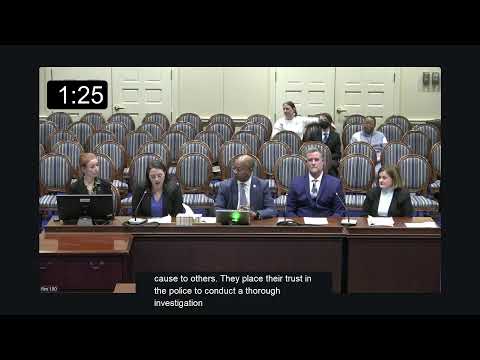
A measure to raise penalties for violent threats directed at judges and other public officials drew testimony from prosecutors, judges and security experts on Feb. 10 as the House Judiciary Committee considered HB 631.
"House bill 631 would increase penalties for individuals who knowingly and willingly threaten to the life of, kidnap or cause physical injury to state or local public officials," Delegate Matthew J. Schindler said, citing the 2023 assassination of a Maryland circuit court judge as motivation for stronger statutory deterrents. He told the committee threats to judges and prosecutors have intensified nationally and locally.
Miro Williamson, speaking for the Maryland State Bar Association and the Maryland State's Attorneys Association, described repeated death threats and targeted harassment against court officers and prosecutors and asked the committee to issue a favorable report to emphasize the seriousness of such conduct. An Anne Arundel County assistant state's attorney recounted local threats and the psychological toll on victims and court staff.
Members asked whether the bill covers appointed as well as elected officials (witnesses said the text covers judges and judicial appointees), and about extending protection to immediate family members (testimony noted other states include family and that could be considered). Questions also addressed whether enhanced penalties would change actual sentencing practices; proponents said reclassifying some conduct as a felony would increase the available sentencing range and provide a stronger deterrent even if judges retain discretion.
The committee heard no recorded opposition in the transcript and left the panel with strong prosecutorial and judicial support, though several members cautioned about relying solely on sentencing increases and emphasized protective measures and threat‑identification work.