City staff outline home energy score disclosure policy, council presses on costs and equity
Loading...
Summary
Staff presented research and engagement on a proposed DOE-based home energy score disclosure policy; councilors raised questions about cost burdens for sellers and renters, administrative home in sustainability, compliance, equity mitigations, and next steps for ordinance drafting on March 9.
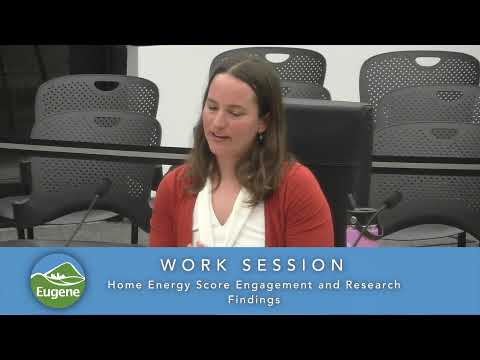
City staff presented part one of a two-part work session on a proposed home energy score disclosure policy to the Eugene City Council on Feb. 23, 2026, describing research, public engagement, and trade-offs ahead of a policy discussion scheduled for March 9.
Danielle Klincobell, a climate policy analyst in the sustainability program, said the home energy score is a U.S. Department of Energy standardized assessment that produces a 1–10 score and a report with estimated energy costs and improvement recommendations; typical assessor costs cited were $150–$250 and a score is valid for seven years. Klincobell said roughly 65% of Eugene’s housing stock predates modern efficiency standards, which contributes to higher energy costs and disproportionately affects low-income households.
Staff framed three primary goals of disclosure: increase transparency about energy features and costs for buyers, educate homeowners and buyers on opportunities to improve efficiency, and connect homeowners to financing and incentives. Klincobell described engagement with roughly 630 people (including mock debates, intercept surveys, focus groups and an online survey reporting about 65% support) and summarized research by Earth Advantage.
From research and peer-city experience staff presented six themes: transparency benefits (buyers lack energy-performance information), disclosure’s role in encouraging upgrades (homes with scores are 8–23% more likely to pursue incentives), modest impacts on housing prices (research shows small premiums for high-scoring homes and no systematic avoidance of low-scoring homes), limited direct emissions reductions from disclosure alone (savings occur when owners complete upgrades), implementation questions (enforcement, exemptions, equity subsidies, triggering event), and workforce/economic potential (an estimated 16–20 assessor jobs in Eugene).
Councilors pressed staff on several practical and equity questions. Councilor Clark noted the difference between a one-time $150–$250 assessor cost and the effect that cost could have in an already high-priced housing market, including potential pass-through to renters, and asked how the community engagement shaped staff recommendations; Klincobell said engagement and research were done concurrently and used to inform one another.
Councilor Groves and others requested more local demographic and housing-age analyses (for example, prevalence of older homes among residents on fixed incomes) before committing to an ordinance. Councilor Evans asked where the program would live administratively; staff said the sustainability program would administer it and estimated a 0.5 FTE to handle outreach, compliance and reporting. Councilors also asked whether subsidy pools are typical; staff said peer cities set aside small funds to subsidize scores for low-income sellers (staff presented estimates ranging from $5,000 to $10,000 annually depending on jurisdictional practice).
Staff identified Bend, Portland, Hillsboro and (out-of-state example listed in the packet) Milwaukee as jurisdictions with existing programs and noted Oregon has about 60,000 score reports statewide. Bend’s reported compliance rate was cited at 83%.
Staff concluded that disclosure expands information and can lay groundwork for targeted incentives, but that the council should expect to consider implementation design — exemptions, subsidy programs, enforcement, assessor workforce development and budget needs — at the next work session when staff will present a draft ordinance framework and implementation budget.
No council vote or ordinance motion occurred at the Feb. 23 session; staff and council scheduled a follow-up work session for March 9 for policy choices and possible direction to draft an ordinance.