Tualatin planning panel backs expanding backyard chicken rules to include domestic fowl with clarifications
Loading...
Summary
The Tualatin Planning Commission voted to recommend PTA 26-0001 — expanding backyard chicken rules to cover domestic fowl — while asking staff to clarify combined limits (four birds), explicitly prohibit emu and ostrich, refine setback language and replace 'harvesting' with 'butchering and slaughtering.'
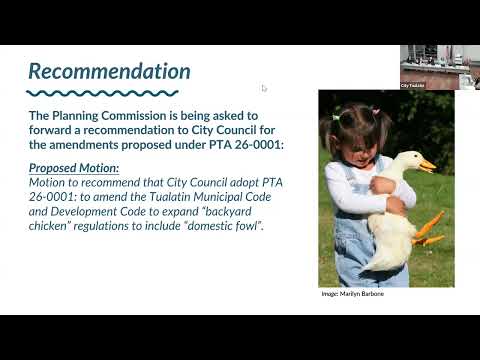
The Tualatin Planning Commission voted on Feb. 18 to recommend that the City Council adopt PTA 26-0001, a city-initiated amendment that would expand backyard chicken regulations in the RL (low-density residential) zone to cover a broader category of domestic fowl.
City planner Erin opened the staff report, telling commissioners the amendment is intended to provide minimum standards for keeping domestic fowl humanely in urban backyards while safeguarding public health and safety. Staff proposed defining "domestic fowl" to include chickens, ducks, pheasants, pigeons, quail, partridges and doves, and to carry that umbrella term through both the Tualatin Municipal Code and the Tualatin Development Code.
Homeowner Kevin Mulvaney, whose case prompted the change, told the commission he kept two-month-old ducks and sought clarity after enforcement uncertainty. "They are pets," Mulvaney said, asking the city for rules so residents know what is allowed and do not live in limbo.
Commissioners spent much of the discussion narrowing the amendment’s practical effects. Staff reported the city’s records (2019–2025) show eight complaints related to backyard fowl, three of which referenced rats, but none that resulted in municipal-court action. Erin also pointed commissioners to existing nuisance and noise code sections that prohibit animal noises audible for a continuous 15 minutes and bar accumulation of debris or manure that creates a public-health nuisance.
The commission requested several clarifications before forwarding the proposal to council: limit the total number of permitted domestic fowl to four per lot as a combined total across permitted species; explicitly prohibit large exotics (commissioners specified emu and ostrich) to avoid loopholes; clarify that the 25-foot separation applies to adjacent residences (and not unintentionally to an owner’s own structure); and replace the current vague phrase "harvesting" with the clearer wording "butchering and slaughtering" to indicate the city’s intent to restrict on-site slaughter.
Members also asked staff to pursue follow-up work prior to council consideration: consult with code enforcement about whether enforcement tools or training can improve detection and response to vermin issues; research minimum coop and run space standards or point to a reputable external guidance document (for example, USDA or university extension recommendations) rather than codifying species-by-species minutiae; and identify an accredited reference for humane-care practices to incorporate by reference.
On the motion presented by the chair and seconded by a commissioner, the commission approved the recommendation by voice vote and forwarded PTA 26-0001, with the specified clarifications and direction to staff, to a City Council hearing scheduled for March 9.
The commission also agreed to consult with county animal-control or public-health authorities where animal-cruelty or broader public-health investigations are needed and to coordinate with code enforcement on composting and feed-storage guidance to reduce vermin attraction.
The commission adjourned after the vote.