Prosser career center outlines expansion, funding and plan to implement Indiana's new work'based learning requirements
Loading...
Summary
Prosser leaders told the New Albany'Floyd County School Board that the career center will expand programs, pursue aviation maintenance with a $110,000 grant, and work with district staff to implement Indiana's revised diploma seals by hiring a work'based learning coordinator and improving tracking systems.
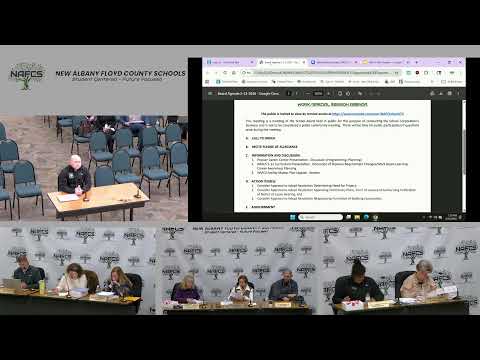
Kyle, Prosser's CTE director, told the New Albany'Floyd County School Board that Prosser remains a central regional workforce pipeline serving 16 sending districts across six counties and a range of employers, and that the center is preparing program and staffing changes to align with the state'issued Indiana diploma revisions.
The district'level presentation emphasized how Prosser combines tuition, federal grants and Perkins funding to operate. Kyle provided examples: the district'per'pupil ADM contribution ("$7,583.15" at New Albany-Floyd was cited), a per'credit CTE funding range (examples given of roughly "$299 to $1,069 per credit"), and the tuition Prosser charges districts ("$3,995 per student"). He said recent Perkins dollars, federal reserve grants (including a cited $110,000 reserve grant to support a planned aviation maintenance pathway) and other funding sources cumulatively yield roughly $6.6 million that help cover operating costs.
Why it matters: state diploma changes released in late 2024 added new seals and specific work'based learning and employability-hour requirements. Amy Cook and Stephanie Chapman (district 5'12 curriculum leads) told the board the changes require detailed tracking and a coordinator role to manage training plans, hour verification and data entry into the state reporting system (the presenters said "everything is going to be put into enters"). They outlined a phased rollout: phase 1 (current months) to identify existing in'school and Prosser experiences and hire a coordinator; phase 2 (1'2 years) to extend opportunities into ninth and tenth grades with project'based employer problems; and phase 3 (3'5 years) to scale capstones and employer placements tied to CTE pathways.
District and board questions focused on how pathways are added or removed, student access, equity and transportation. Kyle said creating a pathway typically takes several years and removal decisions consider multiple factors including student interest, safety, funding and consortium input. On equity, Kyle said counselors and a consortium selection process are used to reduce bias and that the district will prioritize increasing nontraditional enrollments (gender and minority representation) through marketing and targeted grant work.
On implementation details, the presenters described pilot options: the 2'20 Youth Learning virtual platform (students complete rotations and can log hours remotely, with a company estimate that 75 hours a semester is realistic), in'house workplace simulations and school'based enterprises (for example culinary catering or the existing Highlander Outfitters). They warned that tracking will be labor intensive and that coding choices in the state system determine which experiences are funded; the presenters said coding pilots this fall will inform whether WBL funding can offset a coordinator position.
Kyle framed Prosser's role as both an educational and economic intervention: "I profoundly believe the career center is that place. It's the silver bullet for this region," he said, arguing the center helps students gain employability skills and can lift households out of poverty. The presentation closed with a plan to convene advisory boards, a district CTE council and to pilot coding and tracking this year so courses and caps can be offered in the fall once reporting processes are tested.
Next steps: the district will pilot WBL coding and 2'20 youth-learning enrollments this fall, finalize a work'based learning coordinator job description and hold an advisory board meeting in April to begin project planning for 2025'26 implementation.