
Superintendent urges caution on direct purchase of district solar array, favors service agreement
Get AI-powered insights, summaries, and transcripts
Sign Up Free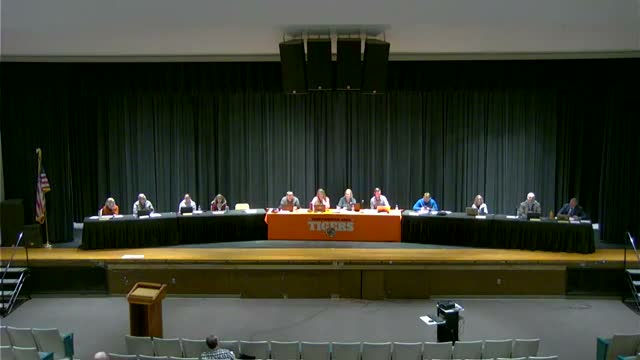
Summary
After consultant review, Superintendent Doherty told the board he cannot recommend purchasing the district solar system because lawyers could not find an example of a successful federal direct payment; he suggested a power service agreement that transfers tax‑credit risk to the vendor and said feasibility work will continue.
Superintendent Doherty updated the board on a proposed large solar project and said he could not, in good conscience, recommend a direct purchase at this time because his legal and financial consultants could not identify an example of a successful federal direct payment to a school district.
Doherty said the district would legally qualify for a federal direct payment that could be "in the neighborhood of $4,500,000," but McNeese Wallace (legal/financial consultants) could not find an example of an entity that has actually received the direct payment. "Based on that information alone, I cannot look at this board and recommend that we purchase this," he said.
He reported that an alternative — a power service agreement (PSA) offered by the vendor — would guarantee tax‑credit benefits flow through the vendor (SRE/Greenworks), removing the direct‑payment risk for the district while still producing multi‑million‑dollar savings over time. Doherty said the PSA would forgo eligibility for a state grant (about $1,200,000) because that grant applies only to owners of systems, but it avoids the district making a multi‑million‑dollar cash outlay during construction.
Technical and financial points: Board discussion flagged PennElec interconnection estimates that rose during the feasibility study to roughly $700,000 for one location and an estimated $850,000 total interconnection cost. Consultants reported differing long‑term projections: SRE/Greenworks presented cumulative net cash flow figures around "18.3" for the PSA scenario and "17.1" for direct purchase; McNeese Wallace's analysis showed larger savings under a direct purchase model. Doherty said the district would also need maintenance agreements; the superintendent said he expects warranties on panels and noted the project included US‑built panels to maximize credits.
Board action: No purchase decision was made. Several members said the PSA figures were attractive enough to continue with the feasibility study; the board directed staff to finish the PennElec interconnection work and return with updated analyses.
Quote: "I'm not willing to take that gamble," Doherty said of proceeding with a direct purchase without guarantees.
Ending: The superintendent told the board he would continue the feasibility study with PennElec and return with updated numbers rather than proceeding with a direct purchase at this meeting.