Get Full Government Meeting Transcripts, Videos, & Alerts Forever!
Get email alerts on the School Boundaries topic
No spam. Unsubscribe anytime.
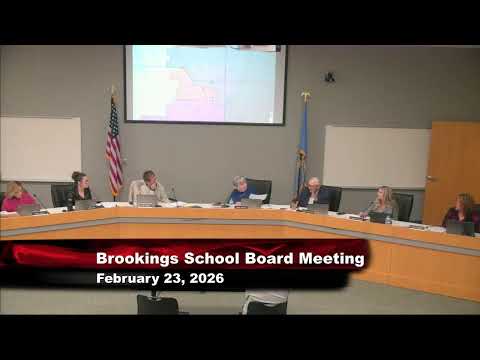
Brookings board leans toward modest boundary changes and agrees to study K–2 partner-school model
Summary
At a Feb. workshop the Brookings School District 05-1 Board reviewed enrollment and capacity data, two boundary reconfiguration options, and a longer-term 'partner schools' K–2/3–5 model; the board recommended Option 2 for next fall and asked staff for more analysis on the partner-school plan and financial impacts.
The Brookings School District 05-1 Board of Education spent its Feb. workshop reviewing elementary boundary options and exploring a partner-school model that would group K–2 and 3–5 programming for instructional and operational efficiencies.
Board Chair opened the meeting and reminded the public that “it is part of our current policy that we review boundaries at least every 5 years, and we have not made any boundary changes since 2017,” before turning the discussion to Doctor Schultz and district staff for an overview of objectives, timelines and data. Doctor Schultz said the stakeholder committee began work in January 2026 after a summer delay to import state student services data, and that the committee reviewed enrollment, capacity and special-services implications before developing options for the board to consider.
Staff presented three broad models: the status quo (three neighborhood K–3 schools feeding an intermediate Camelot for grades 4–5), a full four-building PK–5 neighborhood approach (not recommended for further study), and a partner-school configuration pairing K–2 and 3–5 sites. Chris Gruenhagen walked the board through two draft boundary options the committee recommended for possible fall implementation. Gruenhagen said Option 2 would return students from Aurora and several small neighborhoods to Hillcrest and would affect roughly 12–13% of current K–3 enrollment; Option 3 would shift about 15% of enrollment.
Staff and board discussion focused on several themes: instructional and special-education service delivery, transportation and safety, capital costs, and the predictability of enrollment. Doctor Schultz emphasized the Title-funding implications of reassigning students, noting the districtwide free-and-reduced percentage (20%) and how changes could cause a school to fall below thresholds that allow federally funded staff “so that’s something we have to make sure we’re watching.” Shannon, who had analyzed caseloads, said centralizing related services could equalize caseloads and improve service alignment.
The board asked for and reviewed financial estimates from the committee report. Chair and staff cited a range of projected efficiencies for moderate K–3 reconfiguration—“$200,000 to $500,000”—and larger recurring savings in the partner-school scenario, which staff summarized from committee materials as roughly “$582,000 to $895,000” when factoring transportation and staffing efficiencies. Staff explained that many of those overhead reductions would recur in subsequent years as staffing and administrative positions are adjusted.
Board members pressed on implementation details—grandfathering, the potential for double moves for a small number of students in phased conversions, timing for kindergarten registration, and the need for clear public communication—and asked staff to bring specific facility and financial analyses back to the board. Chris Gruenhagen explained how boundary petitions (families already allowed to remain by petition) would be handled under a return-to-boundary approach versus honoring petitions and showed maps and household-level counts used in the analysis.
By the end of the workshop the board did not take a formal vote but reached a consensus recommendation: move forward with Option 2 for consideration for next fall and continue a deliberate study of the K–2 partner-school model as a phase-two possibility. The Chair summarized that recommendation and set expectations for staff to return with prioritized guiding principles, detailed financials, transportation implications and proposed timelines so the board can act at or before the March meeting.
What’s next: staff will refine maps and financial analyses, clarify grandfathering/exception criteria under Policy JECC, and develop a public engagement plan and timeline for any phased implementation; the board signaled it wants those materials ahead of the March decision meeting.