Get Full Government Meeting Transcripts, Videos, & Alerts Forever!
Get email alerts on the Gun Policy topic
No spam. Unsubscribe anytime.
Committee advances bill requiring localities to establish voluntary gun give-back programs, with edits
Summary
Delegate Cole's HB702 asks local law enforcement to establish voluntary gun give-back programs by 2028, add forensic screening and annual reporting; committee debated whether the mandate belongs in code, funding needs for small towns, confidentiality and law-enforcement chain-of-custody safeguards, and adopted amendments before reporting to finance.
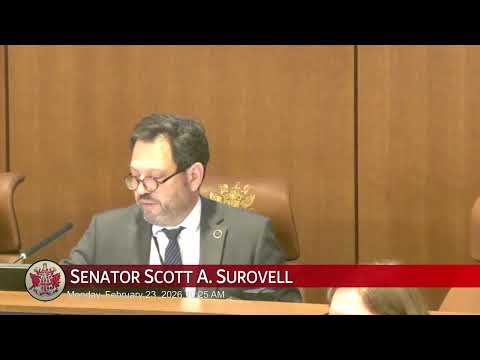
The Senate Courts of Justice Committee moved House Bill 702 forward after a detailed discussion of scope, implementation and drafting.
Delegate Cole, the bill's patron, said the measure requires local police and sheriff departments by 2028 to create voluntary gun give-back or buy-back programs and sets minimum standards including forensic screening of surrendered firearms, evidence-retention rules for crime-linked firearms, confidentiality protections for participants and annual reporting to the Department of State Police. "We changed it over in the House. It is just mandating that local police departments and sheriff departments by 2028 create a voluntary gun give back or buy back program," the patron told the committee (SEG 1847-1853).
Committee members raised several drafting and policy issues: whether the mandate should be codified (Title 15.2) rather than appear in a section-one directive, how small towns with minimal policing capacity could comply, and whether non-historical firearms should be auctioned via FFLs to prevent reintroduction into criminal markets. Representatives of VACDL opposed some aspects and urged caution on terminology and disposition; others, including communities that operate buybacks, supported the measure as a safety tool.
The committee adopted an amendment to preserve participant confidentiality "except as necessary for a criminal prosecution," addressing chain-of-custody concerns, and debated whether towns should be included or given permissive status; the record shows the committee voted to put the policy direction into code and then considered town-specific language. After discussion and technical tweaks, committee reported the bill as amended and referred it to finance for further review.
Members repeatedly questioned funding and staffing requirements for smaller localities; proponents and counsel said localities would draft implementation policies and could enter MOUs where helpful, but the committee signaled that finance would examine fiscal impacts.
The committee's recorded action advances HB702 to the finance committee for fiscal analysis and further stakeholder work.