
Commerce Committee considers bill requiring age verification on dedicated adult sites, with privacy safeguards
Get AI-powered insights, summaries, and transcripts
Subscribe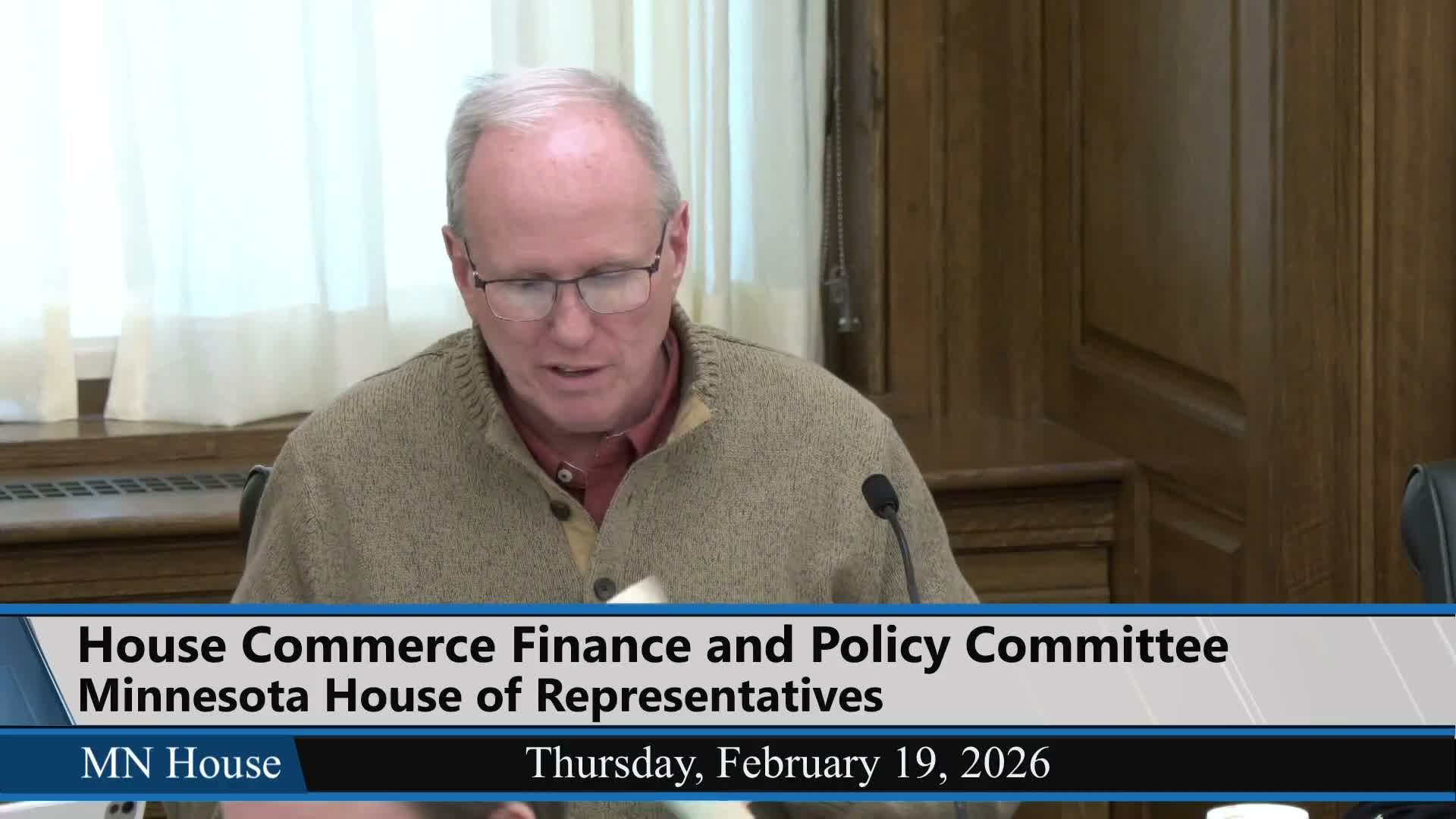
Summary
House File 1434 would require dedicated adult websites to verify users' ages, mandate deletion of verification data within 24 hours, prohibit sale of identifying data and require independent audits for attorney-general review. Testimony included privacy, technical and legal experts and survivors; members raised enforcement, scope and potential unintended consequences.
Representative Bakeberg (author) told the Commerce Committee HF 1434 would bring the physical-world practice of age checks into the digital realm by requiring dedicated adult websites to verify that users are adults before granting access. The bill, as described by the author and testifiers, would: apply to sites where roughly one-third or more of content meets the bill's definition of material harmful to minors; require deletion of identifying data within 24 hours; bar sale or transfer of identity data except to comply with law; and mandate an independent annual audit of age-verification providers, with proof of compliance available to the attorney general upon request.
Rebecca Delahunt of Minnesota Family Council and other child-protection advocates testified in favor, citing Common Sense Media survey results about teen exposure and arguing that state action is warranted because industry self-regulation has been insufficient. Ian Corby, executive director of the Age Verification Providers Association (testifying by Zoom), described privacy-preserving age-assurance techniques that can prove age without retaining identity and said interoperable solutions can allow reusable age confirmations without centralized databases. Legal testimony (Renee Carlson, True North Legal) referenced recent U.S. Supreme Court decisions cited in the hearing as supporting the state's authority to require age verification for certain content, and witnesses acknowledged the bill is not a complete solution for all online exposure.
Committee members pressed authors on definitions (how "material harmful to minors" and the 1/3 threshold would be applied), fiscal impact and enforcement mechanics, potential effects on nonprofit or educational sites, and how the attorney general's investigatory role would be exercised without being weaponized. The author acknowledged the Department of Commerce would be involved in implementation and that the committee would continue work with stakeholders to refine language. The A3 author's amendment was adopted to get the bill in the desired shape, and the committee laid HF 1434 over for further work.