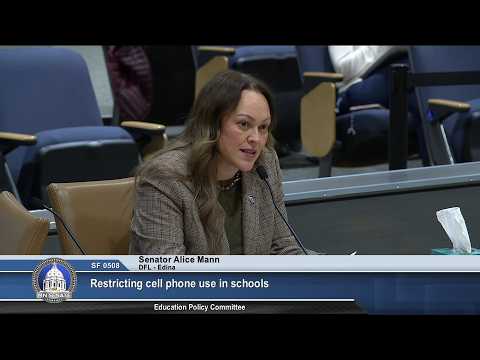
Committee lays over bill to restrict student phone use after hours of testimony for and against statewide mandate
Get AI-powered insights, summaries, and transcripts
SubscribeSummary
Senate File 508, a proposal to prohibit cell phones for K–8 students during the school day and limit classroom use for high school students, was laid over after more than an hour of testimony from psychologists, school leaders, teachers, parents and students debating student mental-health benefits, evidence from districts with bans, and local-control and safety concerns.
Senate File 508, a bill proposing statewide limits on student use of personal devices, drew some of the most contentious public testimony on the Feb. 23 Education Policy Committee agenda and was laid over for possible inclusion in the education omnibus bill.
Senator Mann, the bill’s sponsor, said the measure responds to widespread reports that phones harm focus, classroom culture and student mental health. The bill, as presented, would prohibit cell phones and smartwatches for students in grades K–8 during the school day (districts may store devices in lockers, classrooms or offices) and restrict classroom use for grades 9–12, while leaving implementation details to local districts.
Supporters cited local experience and mental-health expertise. Parent Katrina Ball described campaigning for a K–12 ‘bell-to-bell’ device policy in her small district and said smartphones and social media “are a public health crisis.” High-school teacher Grant Eustace urged stronger action, calling it “this generation’s big tobacco moment” and saying districts that removed phones saw more in-person socializing and fewer disruptions. Psychologist Dr. Anna Tierney and child psychiatrist Dr. George Realmuto testified that unrestricted smartphone access is associated with attention problems, anxiety and exposure to harmful content; both endorsed the bill’s developmental distinctions (stronger limits for younger students) and supported funding for implementation and disability accommodations.
Opponents and those urging caution emphasized local control, safety, and the need for community buy-in. School-board member Liz Damiola and the Minnesota School Boards Association representative Katie Hockert warned that a statewide mandate could undercut locally developed policies and hamper districts’ ability to adapt to safety needs and unique community contexts. Multiple speakers, including student Kyla Chen, said complete bans raise practical safety concerns (examples included family emergencies and notifications about safety threats). District leaders such as Stillwater Superintendent Dr. Mike Funk described successful local bell-to-bell bans but urged that the law not replace local engagement that produced buy-in.
Committee members probed the bill’s language and exceptions (for safety and medical needs) and discussed whether the proposal should be stronger (bell-to-bell for all grades) or more flexible to preserve local control. Senators from across the aisle praised the sponsor’s work but differed on how prescriptive state law should be; the chair said the committee would lay the bill over as amended for possible omnibus inclusion.
What’s next: SF 508 was laid over with amendments for possible inclusion in the education omnibus bill; sponsors signaled further drafting to clarify safety exceptions and implementation language.
Key quote: "This is our generation's big tobacco moment," said Grant Eustace, summarizing testimony that framed phones as a public-health threat to student attention and social development.