
Minnesota panel backs creation of task force to review dual-enrollment funding
Get AI-powered insights, summaries, and transcripts
Subscribe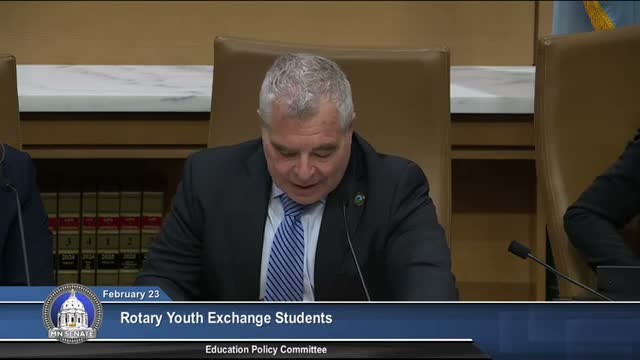
Summary
The Senate Education Policy Committee advanced Senate File 2769, which would create a time-limited task force to study how Minnesota funds dual-enrollment programs (PSEO and concurrent enrollment), after authors and student, educator and principal witnesses testified about access gaps, funding complexity, and geographic inequities.
The Minnesota Senate Education Policy Committee on Feb. 23 voted to move Senate File 2769 to the Committee on Higher Education after hearing from the bill author and a string of students, educators and principals who urged a structured review of dual-enrollment funding.
Senator Umer Verbaton, the bill’s author, told the committee SF 2769 establishes a dual-enrollment funding task force to take “a serious data-driven look” at how Minnesota funds PSEO and concurrent enrollment, examine regional cost differences, administrative burdens and equity gaps, and deliver recommendations within a year. Verbaton said Minnesota enacted the nation’s first dual-enrollment law in 1986 and cited Minnesota Department of Education data showing nearly 50,000 students participate in concurrent enrollment and PSEO annually.
Supporters told the committee the program expands opportunity but requires a modernized funding approach. Beatrice Hanlon, president of People for PSEO and a former PSEO student, said the task force is “vital to the continued success and growth of the PSEO program” and that access problems persist, including information gaps on school websites, transportation barriers and campus meal access. Student Rohan Sharma said PSEO had provided a “second runway” in his academic path but stressed that outreach and student representation on the task force are essential so policy reflects lived experience.
Joe Nathan, who said he helped write the original 1985 law, encouraged the committee to review evidence in the packet showing improved college attainment among historically underserved students who take dual-credit courses. Bob Driver, representing MASSP principals, urged inclusion of principals from urban, suburban and rural districts and recommended transparent per-credit reimbursement, prorating for withdrawals, and reimbursements for counseling and oversight that home districts provide even when students take college classes.
Committee members asked detailed questions about attendance tracking, student representation and whether private postsecondary institutions and business voices would be on the task force. Senator Abler recommended additional perspectives from superintendents and business partners; Verbaton said appointees include a private postsecondary representative named by the Office of Higher Education and that he had revised student representation to include one Minneapolis–St. Paul metro student and one greater-Minnesota student.
The committee adopted the author’s A-4 amendment and then voted to recommend SF 2769 as amended and refer it to the Committee on Higher Education by voice vote. Chair and members said they expect further amendments as the bill moves through additional education committees.
What’s next: SF 2769 will be considered by the Senate Committee on Higher Education; the task force, if created, would be charged to produce recommendations within a year.
"This bill will ensure that any future reform has the appropriate foundations of evidence and stakeholder engagement," Senator Umer Verbaton said during his presentation.