Get Full Government Meeting Transcripts, Videos, & Alerts Forever!
Get email alerts on the Fraud Response topic
No spam. Unsubscribe anytime.
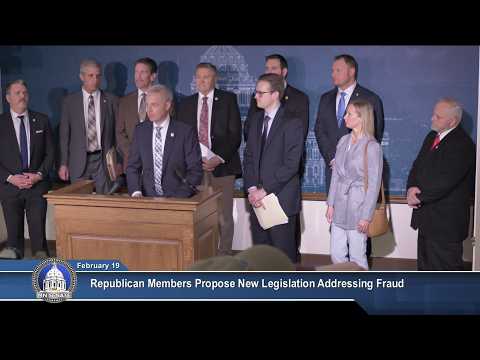
Minnesota Senate Republicans unveil anti-fraud package calling for independent inspector general, verification measures and unannounced site visits
Summary
Senate Republicans outlined a multi-part proposal to tackle alleged large-scale fraud in state welfare programs: creating an independent Office of Inspector General with law-enforcement authority, a state "do not pay" database, mandatory managed-care verification with a 2% withhold, unannounced provider site visits, and restored OIG reporting to the legislature.
Sen. Mark Johnson, the Senate Republican leader, said Tuesday that Minnesota needs "top down reform" to address what GOP senators described as extensive fraud in state welfare programs and outlined a package of bills intended to strengthen oversight, verification and enforcement.
The proposal centers on creating an independent Office of Inspector General (OIG) with investigative and enforcement powers. "Make no mistake, our Office of Inspector General Bill will not be gutted," Sen. Michael Kroon, a lead author, said during the press conference. Sponsors described a law-enforcement division inside the OIG designed to work with the Bureau of Criminal Apprehension (BCA) while maintaining statutory independence.
Why it matters: Sponsors said recent cases—including widely publicized provider fraud and the Feeding Our Future scandal—showed gaps in verification, site visits and reporting that allowed improper payments to continue. They argue that centralized investigative capacity and clearer reporting to the legislature are needed to detect and deter large-scale schemes and to protect services for vulnerable Minnesotans.
Major proposals announced
- Office of Inspector General: Senate sponsors reiterated language from last year’s Senate-passed OIG proposal, saying it must be independent and have the investigative tools to refer criminal matters. Kroon said prior working groups produced a bicameral, bipartisan product and that removing the law-enforcement component in a House amendment would weaken enforcement.
- Restore confirmation process for commissioners: Sponsors said they will introduce legislation to reverse a change that they say allows commissioners to become "automatically confirmed" by omission and to require affirmative Senate confirmation votes.
- Spending-monitor bill for DHS and DCYF: Sen. Jordan Rasmussen proposed automatic oversight triggers for forecasted programs: if a program exceeds its budget by 5%, the Office of the Legislative Auditor (OLA) would review it; if it exceeds 10%, the legislature would have to review and approve additional spending before extra appropriations are made.
- Senate File 2625 — "Do Not Pay" list: Sen. Steve Droskowski described a proposal to build a Minnesota "do not pay" database modeled on federal practice, requiring state agencies to contribute data on ineligible recipients, convictions or debtors and to check the database before making payments or awarding contracts.
- Senate File 3190 — "I'm Not a Robot": Also described by Droskowski, this measure would require managed care organizations (MCOs) to send verification forms to enrollees and would impose a 2% withhold from capitation payments until verification is returned. Sponsors discussed using withhold funds (discussed in the press conference at roughly $300,000,000 in aggregate in the withhold example) to help fund county technology upgrades.
- Mandatory unannounced site visits: Sen. Michael Holstrup said his bill would require unannounced, in-person site visits before enrollment, re-enrollment and revalidation for DHS/DCYF providers, with providers’ service fees funding inspections. He cited instances where site visits were falsified or performed remotely and said unannounced visits are a common-sense safeguard.
- Restored OIG reporting: Sen. Glenn Gruenhagen proposed requiring DHS and DCYF to send detailed annual reports to the legislature regarding fraud prevention, oversight and program integrity, restoring reporting that sponsors say stopped after 2017.
Costs and implementation: Sponsors acknowledged technology upgrades for eligibility and record systems would take years and carry significant price tags. Sen. Mark Kran said a full statewide replacement could run into the low hundreds of millions up to $500 million in estimates, while urging short-term emergency projects and vendor aggregation to deliver quicker improvements. Sponsors identified a modest seed amount for an OIG start-up in prior fiscal notes (they cited $9,000,000 as a recent figure from last year’s fiscal note).
Prosecution and enforcement: On whether the proposals would help secure prosecutions, leaders said prosecutorial work has relied heavily on the U.S. Attorney’s Office amid staffing transitions and resignations; sponsors noted federal partners, including counsel teams from the Centers for Medicare & Medicaid Services, have indicated Minnesota is a priority for assistance. Senators said expanding prosecutorial capacity (for example, by adding positions in the state attorney general’s Medicaid-fraud control unit) is an idea they could consider depending on legislative decisions.
Questions from reporters also covered the House amendments to the OIG bill, potential executive-branch influence on the House process, the estimated fiscal impacts of IT upgrades and whether the package is politically motivated. Sponsors said they aim to work across the aisle where possible but warned they would not accept changes that they view as stripping enforcement tools.
What’s next: Sponsors said they will continue negotiations with House members and described the measures as priorities in the legislative session. None of the bills announced at the press conference were reported as having final votes; the sponsors framed the items as proposals and as work in progress that they hope to refine in negotiations.
Ending: The caucus said it will press for bipartisan support but defended the need for the enforcement tools and verification measures they outlined, framing the package as a response to what they described as systemic failures that have allowed improper payments to continue.